Indigenous Loanwords in Latin American Spanish
Spanish has absorbed vocabulary from the indigenous languages of the Americas — Nahuatl, Quechua, Taino, Guaraní, Mayan languages, Mapudungun, and many others. From chocolate and tomate to huracán and quinoa, the indigenous contribution to contemporary Spanish is large and ongoing.

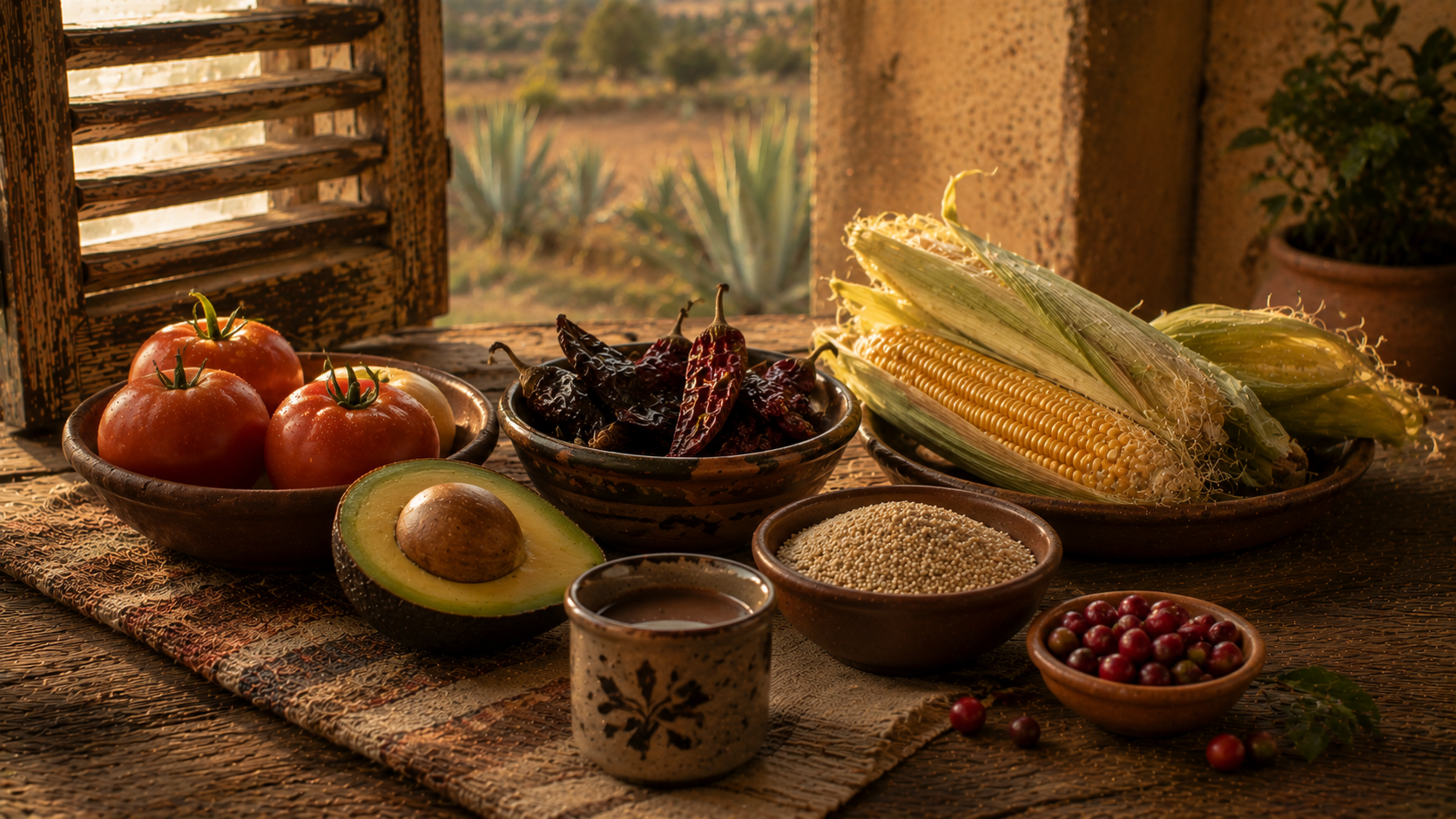
A reference on the vocabulary that has entered Spanish from the indigenous languages of the Americas — Nahuatl from central Mexico, Quechua and Aymara from the Andes, Taino from the Caribbean, Guaraní from Paraguay and northeast Argentina, Mayan languages from Guatemala and southern Mexico, Mapudungun from Chile and Argentine Patagonia, and many smaller contributors; the words that have entered global Spanish (chocolate, tomate, huracán, canoa) and the words that remain regional; the foods, plants, animals, places, and cultural concepts that the indigenous languages have given to Spanish-speaking culture; and the living indigenous-language traditions that continue to shape the variety today.
The Foundation Beneath the Spanish
A learner of Spanish, particularly one studying Latin American Spanish, is constantly engaging with vocabulary that came from the indigenous languages of the Americas — often without realising it. The avocado on the breakfast plate (aguacate) entered Spanish from Nahuatl. The tomato in the salad (tomate) entered Spanish from Nahuatl. The chocolate after dinner (chocolate) entered Spanish from Nahuatl. The hurricane in the weather forecast (huracán) entered Spanish from Taino. The condor flying across the Andes (cóndor) entered Spanish from Quechua. The poncho worn against the cold (poncho) entered Spanish from Quechua or Mapudungun — the etymology is contested. The jaguar in the Amazon (yaguareté in some varieties, jaguar in standard Spanish) entered through Guaraní. The chayote in the soup, the cancha for sports, the chacra for the small farm, the canoa for the canoe, the maíz for the corn — all came from indigenous American languages.
This is not a peripheral feature of Spanish. The contribution of indigenous American languages to contemporary Spanish is large. Several hundred high-frequency words in everyday Spanish — and more in regional varieties — came from Nahuatl, Quechua, Taino, Guaraní, Mayan languages, and other indigenous sources. Many have entered global Spanish, used in Madrid and Buenos Aires alike, used by speakers who could not identify the source language. Others remain regional, used primarily in the countries where the indigenous languages were spoken. Together they represent one of the most consequential linguistic inheritances in contemporary Spanish.
The history is one of sustained encounter. The Spanish arriving in the Americas in 1492 encountered languages and cultures that named realities Spanish had no words for — plants, animals, foods, geographic features, cultural practices unknown to Europe. The Spanish adopted indigenous words to name these new realities, just as English would later adopt many of the same words (through Spanish) to name them again: tomato, chocolate, hurricane, canoe. The borrowing continued through the colonial period and into the contemporary moment, with each generation of Spanish speakers in particular regions absorbing further indigenous-origin vocabulary from sustained contact with indigenous-speaking communities.
The indigenous-language traditions that contributed this vocabulary remain living languages. Approximately seven million people speak indigenous languages in contemporary Mexico, with Nahuatl, Maya, and many others maintaining real speaker populations. Approximately eight to ten million people speak Quechua across Peru, Bolivia, Ecuador, and neighboring countries. Approximately four million people speak Guaraní in Paraguay and the surrounding region. Many smaller indigenous languages continue with cultural-linguistic vitality. The borrowing continues — contemporary Spanish in indigenous-speaking regions continues to absorb vocabulary from neighboring indigenous languages.
This guide treats the indigenous-language contribution to Spanish, organized by source language. The major contributors — Nahuatl, Quechua, Taino, Guaraní, Mayan languages — receive extended treatment. Smaller contributors including Aymara, Mapudungun, Chibchan languages, Tupi (which contributed significantly to Portuguese but also to Spanish in some regions), and others receive briefer treatment. The guide provides a reference for learners interested in the etymology, the contemporary use, and the geographic distribution of indigenous-origin Spanish vocabulary.
A note on scope. The focus is on vocabulary that has entered Spanish from indigenous languages of the Americas — primarily Mesoamerican and South American languages. The Arawakan, Cariban, Tupian, Otomanguean, and other language families are represented through the major languages within each that contributed most to Spanish. The guide does not pretend to comprehensive coverage of every indigenous language's contribution; the scope of such coverage would require book-length work for each of the major contributors. What is collected here is the orientation a learner needs to recognize and engage with indigenous-origin vocabulary in contemporary Spanish.
1. Nahuatl: The Largest Single Contributor
Nahuatl, the language of the Mexica (Aztec) empire and of many other Mesoamerican peoples, has contributed more vocabulary to contemporary Spanish than any other single indigenous language. The reasons are historical: Nahuatl was the dominant language of central Mexico when the Spanish arrived; it served as a lingua franca across much of Mesoamerica during the early colonial period; and Mexico, where Nahuatl was spoken, became the largest Spanish-speaking territory in the Americas, with the demographic-cultural weight that has shaped Spanish globally.
Nahuatl remains a living language. Approximately 1.7 million people speak Nahuatl in contemporary Mexico, primarily in the states of Puebla, Veracruz, Hidalgo, Guerrero, San Luis Potosí, and Tlaxcala. The language has notable dialect variation across these regions, with Eastern Huasteca Nahuatl, Western Huasteca Nahuatl, Central Nahuatl, and many other varieties maintained in their respective communities. Nahuatl literary and cultural production continues, with contemporary work in poetry, fiction, and academic study.
1.1 — Food and Agriculture
The Nahuatl contribution to food vocabulary is enormous, reflecting the agricultural inheritance from pre-Columbian Mesoamerica:
- Aguacate — avocado (from ahuacatl)
- Tomate — tomato (from tomatl)
- Chocolate — (from chocolatl or xocolatl, meaning "bitter water")
- Cacao — cocoa (from cacahuatl)
- Chile — chili pepper (from chilli)
- Cacahuate — peanut (from cacahuatl; called maní in most of Latin America from Taino but cacahuate in Mexico)
- Elote — fresh corn (from elotl)
- Mole — the iconic Mexican sauce (from molli, meaning sauce)
- Ezquite / esquite — corn snack (from izquitl)
- Tamal — corn-based wrapped food (from tamalli)
- Atole — corn-based drink (from atolli)
- Pozole — corn-based stew (from pozolli)
- Mezcal — distilled agave spirit (from mexcalli)
- Pulque — fermented agave drink (the word itself may be of unclear origin, but the cultural context is Nahuatl)
- Jícama — the root vegetable (from xicamatl)
- Camote — sweet potato (from camotli)
- Chayote — the squash (from chayotli)
- Epazote — herb used in cooking (from epazotl)
- Huitlacoche / cuitlacoche — corn fungus, a Mexican delicacy (from cuitlacochi)
- Capulín — wild cherry (from capolin)
- Nopal — prickly pear cactus pad (from nohpalli)
- Tuna — prickly pear fruit (from tonalli or related)
- Achiote — annatto, the cooking colorant (from achiotl)
- Aguarrás — turpentine (Nahuatl-related etymology)
- Maguey — agave plant (the name maguey itself may be Taino, but the cultural complex is Nahuatl)
1.2 — Animals
- Coyote — (from coyotl)
- Ocelote — ocelot (from ocelotl)
- Tlacuache — opossum (from tlacuatzin)
- Mapache — raccoon (from mapachin)
- Guajolote — turkey (from huexolotl; called pavo in standard Spanish but guajolote in Mexico)
- Chapulín — grasshopper (from chapolin)
- Tecolote — owl (from tecolotl)
- Cenzontle — mockingbird (from centzontli, meaning "four hundred voices")
- Quetzal — the bird, also the Guatemalan currency (from quetzalli; though the Nahuatl word referred specifically to the bird's feathers, in Spanish it refers to the bird itself)
- Zopilote — vulture (from tzopilotl)
- Ajolote — axolotl, the famous Mexican salamander (from axolotl)
1.3 — Plants and Geography
- Hule — rubber (from olli)
- Mecate — rope (from mecatl)
- Petate — woven mat (from petlatl)
- Jacal — hut (from xacalli)
- Tianguis — open-air market (from tianquiztli)
- Tequio — communal work (from tequitl)
- Tequila — the spirit and the town (from tequitl + tlan, "place of tribute")
- Acapulco — coastal city, from Nahuatl roots
- Place names throughout central and southern Mexico: Cuernavaca, Tepoztlán, Xochimilco, Tlaxcala, Cuautla, Iztapalapa, and hundreds of others
1.4 — Cultural and Everyday Vocabulary
- Cuate / cuata — twin, close friend (from cōātl, "snake" or "twin")
- Apapachar — to caress, to comfort lovingly (from patzoa or related roots)
- Chamaco / chamaca — kid (Nahuatl-influenced; etymology disputed)
- Popote — drinking straw (from popotli)
- Chante — house (from chantli; used in some Mexican casual speech)
- Mitote — celebration, fuss (from mitotl, dance)
- Pinole — corn-based powder food (from pinolli)
- Pinacate — beetle (from pinacatl)
1.5 — Words That Have Entered Global Spanish
Many Nahuatl-origin words have entered standard Spanish worldwide, used in Madrid and Buenos Aires alike, often without speakers being aware of the source: chocolate, tomate, aguacate, chile, cacao, coyote, ocelote, mapache, hule, mezcal, tequila, mole, jícama, chayote, camote, quetzal, and many others.
For systematic country-specific treatment of Mexican Spanish vocabulary including Nahuatl loanwords, see the Mexican Spanish profile.
2. Quechua and Aymara: The Andean Contributors
Quechua, with its dialect family extending across Peru, Bolivia, Ecuador, southern Colombia, and northwestern Argentina, and Aymara, concentrated in the Lake Titicaca region of Bolivia and Peru, have contributed extensively to Spanish — particularly in the Andean countries, but with pan-Hispanic reach for some vocabulary.
Quechua remains a living language with approximately eight to ten million speakers across Peru, Bolivia, Ecuador, and neighboring countries. Aymara has approximately two million speakers, primarily in Bolivia and Peru.
2.1 — Animals
- Cóndor — the great Andean bird (from Quechua kuntur)
- Llama — the iconic Andean camelid (from Quechua llama)
- Alpaca — the related camelid (from Quechua allpaqa)
- Vicuña — the wild Andean camelid (from Quechua wikuña)
- Guanaco — the wild camelid (from Quechua wanaku)
- Puma — the mountain lion (from Quechua puma)
- Vizcacha — the rodent (from Quechua wisk'acha)
2.2 — Food and Agriculture
- Papa — potato (from Quechua papa; this is the standard Spanish word for potato across most of Latin America, distinct from Iberian patata)
- Quinoa / quinua — the grain (from Quechua kinwa)
- Maíz — corn (note: maíz is from Taino, not Quechua, but the Andean grain culture has been shaped by Quechua-speaking peoples)
- Mate — the leaf and the drink (from Quechua mati, gourd)
- Choclo — fresh corn cob (from Quechua choccllo)
- Locro — stew (from Quechua ruqru)
- Chuño — freeze-dried potato (from Quechua ch'uñu)
- Mote — boiled grain (from Quechua mut'i)
- Ají — chili pepper (note: ají is from Taino, used widely in South America; Mexican chile is from Nahuatl — the two terms reflect different colonial linguistic encounters)
- Charqui / charque — dried meat (from Quechua ch'arki; the source of English jerky)
- Pampa — plain, grassland (from Quechua pampa)
- Cocaína / coca — coca plant (from Quechua kuka)
- Olluco / ulluco — Andean tuber (from Quechua ulluku)
- Oca — Andean tuber (from Quechua uqa)
- Yuca — cassava (note: yuca is from Taino, but Andean cuisine has many yuca-based preparations)
2.3 — Cultural and Everyday Vocabulary
- Pampa — flat plain (from Quechua pampa)
- Chacra — small farm, agricultural plot (from Quechua chajra)
- Cancha — open ground, sports field (from Quechua kancha)
- Chasqui — messenger (from Quechua chaski)
- Tambo — way station (from Quechua tampu)
- Inca — the ruling people and emperor (from Quechua inka)
- Quipu — knotted-cord record-keeping system (from Quechua khipu)
- Caucho — rubber (from Quechua kawchu)
- Carpa — tent (from Quechua karpa)
- Choza — hut (Quechua-related etymology)
- Cuy — guinea pig (from Quechua quwi)
- Pucho — cigarette stub (from Quechua puchu, leftover; this Quechua word entered Argentine Lunfardo and is used productively in Argentine Spanish)
- Apunarse — to suffer altitude sickness (from Quechua puna, high-altitude plain)
- Soroche — altitude sickness (Quechua-related etymology)
- Anaco — traditional Andean wrap-around skirt (from Quechua anaku)
- Ojota — sandal (from Quechua ushuta)
2.4 — Place Names
Quechua-origin place names map much of the Andean region: Cuzco (from Quechua Qosqo, "navel"), Lima (etymology contested but possibly Quechua), Quito, Cochabamba (from Quechua qhocha pampa, "lake plain"), Cajamarca, Arequipa, Andahuaylas, Ayacucho, Apurímac, Ancash, Junín, Huancayo, Huancavelica, and hundreds of others.
2.5 — Aymara Contributions
Aymara has contributed somewhat less than Quechua to Spanish but with notable regional presence:
- Alpaca (etymology contested between Quechua and Aymara)
- Vicuña (similar)
- Chuño (related to Quechua usage)
- Achachilas — Andean mountain spirits (Aymara cultural-religious vocabulary)
- Wawa — baby (shared with Quechua; entered some Spanish varieties as guagua)
- Aguayo — traditional Andean carrying cloth (from Aymara)
- Ch'alla — ritual offering (Aymara cultural vocabulary)
- Achachay — exclamation of cold (Aymara/Quechua-influenced, used in Ecuadorian Spanish)
- Apacheta — stone cairn (Aymara/Quechua origin)
For systematic country-specific treatment of Andean Spanish vocabulary including Quechua and Aymara loanwords, see the Peruvian Spanish profile, the Bolivian Spanish profile, and the Ecuadorian Spanish profile.
3. Taino: The Foundational Caribbean Contributor
Taino, the language of the indigenous Caribbean peoples encountered by Columbus in 1492, was the first indigenous American language to contribute vocabulary to Spanish. Although the Taino people were largely destroyed by disease, violence, and forced labor in the first century after European contact — with Taino-descended populations continuing in the Dominican Republic, Cuba, and Puerto Rico — Taino vocabulary entered Spanish during the early colonial period and has shaped the language globally.
Many Taino words entered Spanish through the early colonial Caribbean experience and from there spread to the rest of the Americas and to global Spanish. These were often the first indigenous American words for plants, animals, and cultural practices that Europe had no names for.
3.1 — Foundational Vocabulary in Global Spanish
- Huracán — hurricane (from Taino huracán; the word entered all European languages from this Taino source)
- Canoa — canoe (from Taino canoa; one of the first indigenous American words borrowed by Spanish)
- Hamaca — hammock (from Taino hamaca)
- Tabaco — tobacco (from Taino tabaco; though there is some debate about whether the word originally referred to the plant or to the cigar-like rolled leaves smoked by indigenous Caribbean people)
- Maíz — corn (from Taino mahís)
- Yuca — cassava (from Taino yuca)
- Maní — peanut (from Taino maní; the standard South American term, distinct from Mexican cacahuate)
- Ají — chili pepper (from Taino ají; the standard South American and Caribbean term, distinct from Mexican chile)
- Batata — sweet potato (from Taino batata; the source of English potato)
- Iguana — (from Taino iwana)
- Caimán — alligator/caiman (from Taino kaiman)
- Caribe — the Caribbean people and region (from Taino kalinago or related; the word caníbal — cannibal — comes from the same source through Spanish misperception)
3.2 — Foods and Plants
- Mamey — the tropical fruit (from Taino mamey)
- Guayaba — guava (from Taino guayaba)
- Anón — the fruit (from Taino)
- Mango (the fruit name in Spanish — though with a contested etymology, with several South Asian sources also possible)
- Casabe — cassava bread (from Taino cazabi)
- Maguey — agave plant (from Taino, though the cultural complex is more associated with Mexico)
3.3 — Cultural and Geographic Vocabulary
- Bohío — hut (from Taino bohío)
- Cacique — chief (from Taino cacique; the term spread throughout Spanish-speaking Latin America for "local leader" or "political boss")
- Sabana — savanna (from Taino sabana)
- Cayo — small island (from Taino cayo; source of English cay)
- Areíto — traditional dance ceremony (from Taino)
- Batey — central plaza (from Taino batey)
- Conuco — small agricultural plot (from Taino)
- Cazabe — cassava bread (as above)
3.4 — Place Names
Many Caribbean place names are Taino-origin: Cuba, Haití, Quisqueya (the indigenous name for Hispaniola, still used poetically for the Dominican Republic), Borinquen (the indigenous name for Puerto Rico, still used culturally), Jamaica (which entered English from Taino through Spanish), and many smaller place names throughout the Caribbean.
For systematic country-specific treatment of Caribbean Spanish vocabulary including Taino loanwords, see the Cuban Spanish profile, the Dominican Spanish profile, and the Puerto Rican Spanish profile.
4. Guaraní: The Paraguayan and Southern Cone Contributor
Guaraní, one of the larger indigenous languages of South America with approximately four million speakers primarily in Paraguay and neighboring regions, has contributed extensively to Spanish. The unique situation in Paraguay — where Guaraní is co-official with Spanish under the 1992 Constitution and where the great majority of the population speaks both — produces sustained bilingual exchange. Guaraní vocabulary appears throughout Paraguayan Spanish and in the Spanish of northeast Argentina, parts of Bolivia, and parts of southern Brazil.
4.1 — Animals
- Jaguar — (from Guaraní yaguar, "wild beast")
- Yaguareté — jaguar (the Guaraní form used in some South American varieties)
- Tapir — (from Guaraní tapiir)
- Ñandú — the rhea, the South American flightless bird (from Guaraní ñandu)
- Capibara — the world's largest rodent (from Guaraní kapiyba)
- Carpincho — capibara in some varieties (from Guaraní)
- Tucán — toucan (from Guaraní/Tupi tucan)
- Coatí — coati, the raccoon-related mammal (from Guaraní)
- Mbocayá — palm tree (Guaraní)
- Piraña — piranha (from Guaraní pirá-añá, "tooth fish")
- Aguará — fox (Guaraní)
- Yacaré — caiman (Guaraní)
4.2 — Food and Agriculture
- Mandioca — cassava (from Guaraní mandi'og; this is the standard South American term, related to Portuguese mandioca — though Spanish also uses yuca from Taino)
- Chipa — Paraguayan cassava cheese bread (Guaraní)
- Mbeju — Paraguayan starchy flatbread (Guaraní)
- Tereré — Paraguayan cold mate beverage (Guaraní)
- Yerba (mate) — the plant (from Guaraní context, though yerba is Spanish)
- Sopa paraguaya — the Paraguayan cornbread (Spanish, but Guaraní cultural context)
- Maracuyá — passionfruit (from Tupi-Guaraní moruku'iá)
4.3 — Cultural and Everyday Vocabulary in Paraguayan Spanish
In Paraguayan Spanish particularly, Guaraní vocabulary appears in everyday speech through the jopará mixed register:
- Anga — emphasis or affection marker (Guaraní)
- Niko — assertive marker (Guaraní)
- Voi — emphatic marker (Guaraní)
- Pa — interrogative marker (Guaraní)
- Nde — emphatic address (Guaraní)
- Karai — sir, respectful term (Guaraní)
- Cuñataí — young woman (Guaraní)
- Mitã — child (Guaraní)
- Porã — beautiful, good (Guaraní)
- Vaí — bad, ugly (Guaraní)
- Cuxa — traditional Paraguayan drink
4.4 — Place Names
Most Paraguayan place names are Guaraní-origin: Paraguay itself (etymology contested but likely Guaraní), Asunción (Spanish, but in a Guaraní cultural context), Itaipú, Itapúa, Ñeembucú, Caaguazú, Areguá, and many others. Guaraní place names extend into northeast Argentina (Iguazú, Misiones, Corrientes), southern Brazil, and parts of Bolivia.
For systematic country-specific treatment, see the Paraguayan Spanish profile.
5. Mayan Languages: The Guatemalan and Southern Mexican Contributors
Mayan languages — a family of approximately thirty living languages spoken across Guatemala, southern Mexico, Belize, and parts of Honduras and El Salvador — have contributed to Spanish, particularly in the regions where they remain in active use. K'iche', Q'eqchi', Mam, Kaqchikel, Yucatec Maya, and many other Mayan languages have real speaker populations and continuing linguistic vitality.
5.1 — Food and Cultural Vocabulary
- Cenote — limestone sinkhole (from Yucatec Maya ts'onot)
- Henequén — agave variety for fibre production (from Yucatec Maya)
- Pibil — underground cooking technique (from Yucatec Maya pib)
- Cochinita pibil — the iconic Yucatecan slow-cooked pork dish
- Salbutes — Yucatecan fried tortilla snack (Maya origin)
- Panuchos — Yucatecan stuffed tortilla snack (Maya origin)
- Maíz — corn (note: shared cultural foundation, but the word itself is Taino)
- Tikin xic — Yucatecan fish dish (Maya)
- Chayote — squash (primarily Nahuatl, but also has Maya cultural context)
- Chaya — Yucatecan leafy green (Maya)
- Xtabentún — Yucatecan anise-honey liqueur (Maya)
5.2 — Cultural and Geographic Vocabulary
- Maya — the people and culture (self-designation)
- K'iche', Q'eqchi', Mam, Kaqchikel — major Mayan language and ethnic group names
- Quetzal — though primarily Nahuatl in origin, the cultural-political weight in Guatemala is significant (the national bird and currency)
- Milpa — traditional cornfield (Nahuatl-origin but used throughout Mayan-cultural Mesoamerica)
- Chinchorro — fishing net or hammock (regional Maya-cultural)
- Cumbarí — type of pepper (regional)
- Patojo / patoja — kid, distinctively Guatemalan (Mayan-influenced)
5.3 — Place Names
Mayan-origin place names map Guatemala and southern Mexico: Tikal, Quiché, Chimaltenango, Quetzaltenango (also Xela from Mam), Sololá, Sacatepéquez, Huehuetenango, Totonicapán, Cobán, Atitlán, Petén, Chichicastenango, Antigua (Spanish, but in a Maya cultural context), and many others. The Yucatán Peninsula place names are largely Yucatec Maya: Yucatán itself, Mérida (Spanish, but built on Maya T'hó), Chichén Itzá, Uxmal, Cancún (from Maya kankun), Cozumel, Tulum, and many others.
For systematic country-specific treatment, see the Guatemalan Spanish profile and the Mexican Spanish profile for the Yucatecan dimension.
6. Mapudungun: The Chilean and Argentine Patagonian Contributor
Mapudungun, the language of the Mapuche people in Chile and southern Argentina, has contributed to Chilean Spanish and, to a lesser degree, to Argentine Patagonian Spanish. The Mapuche population is approximately 1.7 million in Chile and approximately 200,000 in Argentina, with cultural-political organising that includes contemporary indigenous-rights movements.
6.1 — Vocabulary
- Poncho — the cloak (etymology contested between Mapudungun and Quechua; both are possible sources)
- Pucho — cigarette stub (in some Chilean usage; the word also appears with Quechua origin)
- Guata — belly (from Mapudungun huata; widely used in Chilean Spanish)
- Pichintún — a small amount (from Mapudungun pichi, small)
- Cahuín — gossip, scandal (from Mapudungun)
- Cancha — open ground, sports field (more commonly Quechua origin, but Mapudungun-influenced in Chile)
- Chumbeque — type of cake or confection (Mapudungun-influenced)
- Pilcha — clothing, rags (Mapudungun in some etymologies)
- Pololo / polola — boyfriend/girlfriend (Mapudungun origin)
- Pellín — solid wood, by extension something solid (Mapudungun)
- Trapelacucha — type of Mapuche jewellery
- Trutruca — Mapuche musical instrument
- Mate — though primarily Quechua, the Mapuche have their own mate culture
- Quitra — pipe for smoking (Mapudungun)
6.2 — Cultural and Geographic Vocabulary
- Mapuche — the people (self-designation, meaning "people of the land")
- Pehuenche, Huilliche, Lafkenche, Picunche — Mapuche regional groups
- Machi — Mapuche spiritual leader/healer
- Lonko — Mapuche traditional leader
- Werken — Mapuche traditional messenger
- Trafkintu — Mapuche reciprocal exchange (cultural practice)
- Ruka — Mapuche traditional dwelling (Mapudungun)
- Wallmapu — Mapuche traditional territory (Mapudungun)
6.3 — Place Names
Mapudungun-origin place names map southern Chile and Argentine Patagonia: Chillán, Talca, Curicó, Linares, Cauquenes, Bío-Bío, Temuco, Valdivia (Spanish, but in a Mapuche cultural context), Pucón, Villarrica, Osorno, Llanquihue, Calbuco, Chiloé, and many others in Chile. In Argentine Patagonia: Bariloche (from Mapudungun Vuriloche), Neuquén (from Mapudungun), Aluminé, Junín de los Andes, San Martín de los Andes, and many others.
For systematic country-specific treatment, see the Chilean Spanish profile and the Argentine Spanish profile.
7. Other Contributors
Beyond the major contributors, smaller indigenous languages have contributed to Spanish in their respective regional contexts.
7.1 — Chibchan Languages (Colombia, Costa Rica, Panama)
The Chibchan language family extends across Colombia, Panama, Costa Rica, and into Nicaragua. The Muisca language (Chibchan, extinct since the eighteenth century) was spoken on the Bogotá plateau and contributed vocabulary to Colombian Spanish, particularly place names: Bogotá (from Muisca Bacatá), Cundinamarca, Boyacá, Tunja, Soacha, Sogamoso, Chía, Suba, Engativá, and many others. Other living Chibchan languages — Bribri, Cabécar, Guna, Ngäbere — contribute regionally in Costa Rica and Panama.
7.2 — Tupi (Brazilian Influence into Spanish)
Tupi — the family that includes Guaraní and the historically significant Tupinambá and other Brazilian indigenous languages — contributed extensively to Brazilian Portuguese and, through Portuguese, to some Spanish, particularly in border regions. Words like piraña, tapir, capibara, jaguar, tucán show overlapping Guaraní-Tupi etymology, with the exact source language sometimes contested.
7.3 — Indigenous Languages of the Pacific Coast (Ecuador, Colombia, Panama)
Various indigenous languages of the Pacific coastal regions — including the Chibchan languages mentioned above, and languages like Awá, Tsáchila, Chachi, and Cofán in Ecuador — have contributed regionally.
7.4 — Indigenous Languages of the Amazon
The indigenous-language diversity of the Amazon basin — including languages of the Tucanoan, Witotoan, Yaguan, and many other families — contributes regionally in the Peruvian, Colombian, Bolivian, Ecuadorian, and Brazilian Amazon contexts.
7.5 — Indigenous Languages of Mexico (Beyond Nahuatl and Maya)
Many other Mexican indigenous languages have contributed regionally to Spanish: Mixtec, Zapotec, Otomi, Purépecha (Tarascan), Totonac, Mazatec, and many others. Particularly:
- Tomate — though Nahuatl, with related forms in other Mexican indigenous languages
- Chayote — Nahuatl, with regional variations
- Mole — Nahuatl, with regional Mexican cuisine variations
- Many regional food and plant names from specific Mexican indigenous languages
7.6 — Indigenous Languages of Central America
Beyond Mayan languages, Central American indigenous languages including Lenca (Honduras, El Salvador), Pipil/Nahuat (El Salvador), and the various Chibchan languages of Costa Rica and Panama contribute regionally.
7.7 — Indigenous Languages of Northern South America
Various indigenous languages including Wayuu in Colombia and Venezuela, and many others, contribute regionally to Spanish.
8. The Patterns of Indigenous Borrowing
Looking across the various contributions, several patterns emerge.
8.1 — Why These Words Were Borrowed
Indigenous American vocabulary entered Spanish primarily for the reasons cross-linguistic borrowing usually occurs.
Names for unfamiliar realities. The Spanish encountered plants, animals, geographic features, and cultural practices that European languages had no words for. Borrowing the indigenous word was the natural solution: tomate, chocolate, aguacate, papa, maíz, huracán, llama, cóndor, jaguar, piraña, tabaco — these named realities that European Spanish had no prior vocabulary for.
Cultural concepts. Indigenous cultural concepts that became part of colonial and post-colonial life entered Spanish: cacique (local leader), areíto (traditional ceremony), milpa (traditional cornfield), chasqui (Inca messenger). These words preserved cultural realities that the Spanish administration adopted or adapted.
Place names. The indigenous-origin place names throughout the Americas reflect both the pre-colonial naming systems and the practical need to identify locations the Spanish encountered as already named.
Personal and family names. Many indigenous-origin personal names continue, particularly in contemporary indigenous-identifying communities.
8.2 — How the Borrowings Spread
The borrowed words spread through three main mechanisms.
Within indigenous-speaking regions. Words from a particular indigenous language are most prevalent in the Spanish spoken in the regions where the language is or was spoken. Quechua-origin words are most prevalent in Andean Spanish; Nahuatl-origin words most prevalent in Mexican Spanish; Guaraní-origin words most prevalent in Paraguayan and northeast Argentine Spanish.
Through pan-American Spanish. Some words from a particular indigenous language spread to Spanish-speaking regions far from the original language. Nahuatl-origin words like chocolate, tomate, chile spread to all of Spanish-speaking America. Taino-origin words like huracán, canoa, hamaca spread to all of Spanish-speaking America. The early colonial Caribbean experience produced particularly wide pan-American spread.
To global Spanish. Words that became established in pan-American Spanish often entered global Spanish — used in Spain, in the Philippines historically, in contemporary diaspora communities worldwide. Chocolate, tomate, huracán, canoa, hamaca, tabaco, maíz, papa, mango (the fruit), iguana, caimán — these are now standard Spanish vocabulary worldwide.
8.3 — The Contemporary Borrowing
Borrowing continues. In bilingual contexts where Spanish and indigenous languages remain in sustained contact — Mexican communities where Nahuatl, Maya, and other languages continue; Andean communities where Quechua and Aymara continue; Paraguayan communities where Guaraní is universal; Guatemalan communities where Mayan languages continue — new vocabulary enters Spanish from the indigenous languages, particularly in domains like food, agriculture, cultural practice, and the contemporary indigenous-cultural movements.
The borrowing is not historical but ongoing.
9. The Contemporary Cultural-Political Context
The indigenous-language contribution to Spanish exists within a broader cultural-political context that has shaped how indigenous languages and their speakers have been treated across Latin American history.
9.1 — The Colonial Context
The indigenous-language contribution to Spanish during the colonial period reflected both practical necessity (the Spanish needed names for unfamiliar realities) and demographic-cultural reality (indigenous populations were the demographic majority of many colonial regions). At the same time, the colonial period involved sustained suppression of indigenous languages and cultures, with the Catholic Church's mixed record of preserving some languages through missionary linguistic work and suppressing others.
9.2 — The Post-Independence Context
Through the nineteenth and twentieth centuries, most Latin American countries pursued various forms of cultural-political hispanización — emphasising Spanish-speaking national identity and often actively discouraging indigenous languages. The decline of many indigenous languages during this period reflects both these policies and the broader pressures of modernization, urbanization, and economic incorporation.
9.3 — The Contemporary Recovery
In recent decades, movements have aimed to revitalize indigenous languages and cultures across Latin America:
- Constitutional recognition of indigenous-language rights in Mexico, Colombia, Bolivia, Ecuador, Paraguay, and others
- Bilingual intercultural education programmes in many countries
- Indigenous-language literary and cultural production
- Indigenous-political organising, including contemporary indigenous-rights movements
- The cultural-political weight of figures like Rigoberta Menchú (K'iche' Maya, Nobel Peace Prize 1992), Evo Morales (Aymara, President of Bolivia 2006–2019), and many others
The contemporary indigenous-cultural moment continues to develop, with implications for how indigenous languages and their contributions to Spanish are understood and engaged with.
9.4 — Approaching the Material
For learners engaging with indigenous-origin Spanish vocabulary, awareness of this context is part of engaged understanding. The words are not historical curiosities from "vanished" cultures but contributions from living languages spoken by millions of people in contemporary Latin America. Engagement involves recognition of the cultural-historical depth and the contemporary indigenous-cultural reality.
10. For the Learner
A few practical paths into the indigenous-language inheritance in Spanish.
Recognize the words you already know. As discussed at the beginning of this guide, much of the vocabulary you have learned in Spanish — particularly food vocabulary, place names, and geographic terms — comes from indigenous American languages. Recognition of this dimension transforms how you engage with these words.
Develop awareness of source-language patterns. The major contributing languages — Nahuatl, Quechua, Taino, Guaraní, Mayan languages, Mapudungun — each have distinctive sound patterns that can help in recognising words from each. Nahuatl has characteristic -tl endings and complex consonant clusters. Quechua often has qu, ll, and p' patterns. Taino words often have repeated consonants. Developing awareness of these patterns helps with recognition.
Engage with the country profiles for systematic country-specific treatment. Each of the Country Profile series entries treats the indigenous-language inheritance for that specific country in detail. The Mexican, Peruvian, Bolivian, Ecuadorian, Paraguayan, Guatemalan, and Chilean profiles in particular have extended treatments of the relevant indigenous-language dimensions.
Engage with indigenous-language cultural production. A contemporary cultural production exists in and around indigenous languages and their Spanish-language presence: the Mayan-language literary tradition, the contemporary Mapudungun cultural recovery, the Andean cultural production, the Guaraní-language work in Paraguay. Engagement with this dimension provides real depth.
Consider basic study of an indigenous language for serious engagement. For learners with sustained engagement in specific regions, beginning study of the relevant indigenous language can deepen the engagement considerably. Even basic Nahuatl, Quechua, Guaraní, K'iche', or other indigenous-language study transforms how the Spanish vocabulary is understood.
Treat the inheritance with the respect it deserves. The indigenous-language contribution to Spanish reflects pre-Columbian civilizations, colonial-period encounters, and contemporary indigenous-cultural reality. The vocabulary is not exotic or peripheral; it is fundamental to contemporary Spanish.
Recognize the contemporary indigenous-language presence. The speaker populations of Nahuatl, Quechua, Aymara, Guaraní, Mayan languages, Mapudungun, and many other indigenous languages mean that the contribution to Spanish continues actively, not as historical legacy alone.
A Closing Note
The indigenous-language contribution to Spanish — through Nahuatl from central Mexico, Quechua and Aymara from the Andes, Taino from the foundational Caribbean encounter, Guaraní from Paraguay and the southern cone, Mayan languages from Guatemala and southern Mexico, Mapudungun from Chile and Argentine Patagonia, and many other contributors — is one of the most consequential linguistic-cultural facts about contemporary Spanish. The vocabulary that names many of the foods we eat, many of the animals we recognise, many of the geographic features we know, many of the cultural practices we encounter, and many of the places we visit comes from indigenous American languages, often without speakers being aware of the source.
The contribution reflects the pre-Columbian linguistic-cultural reality that the Spanish encountered upon arrival in the Americas, the colonial-period borrowing as Spanish absorbed indigenous vocabulary for unfamiliar realities, and the ongoing borrowing as contemporary Spanish in bilingual contexts continues to absorb vocabulary from neighboring indigenous languages. The indigenous-language traditions remain living — millions of people speak Nahuatl, Quechua, Aymara, Guaraní, Mayan languages, Mapudungun, and many other indigenous languages in contemporary Latin America, with cultural-political organising and contemporary cultural production.
For a learner, recognition of this inheritance transforms the experience of learning Spanish. The vocabulary is not arbitrary or exotic; it carries cultural-historical depth and continues to be shaped by contemporary linguistic-cultural reality. Engagement with this dimension provides access to one of the most consequential and most underappreciated dimensions of contemporary Spanish-speaking culture.
The work, as always, is what the work always is: time, patience, attention, exposure, and the willingness to engage with a linguistic-cultural inheritance that has shaped contemporary Spanish across five centuries and continues to shape it today.