Guatemalan Spanish: A Learner's Guide
Guatemalan Spanish operates alongside more than twenty Mayan languages still in active use, making Guatemala the country with the largest indigenous-language inheritance in Latin America. With universal voseo and the cultural depth of the Mayan civilisational heritage.

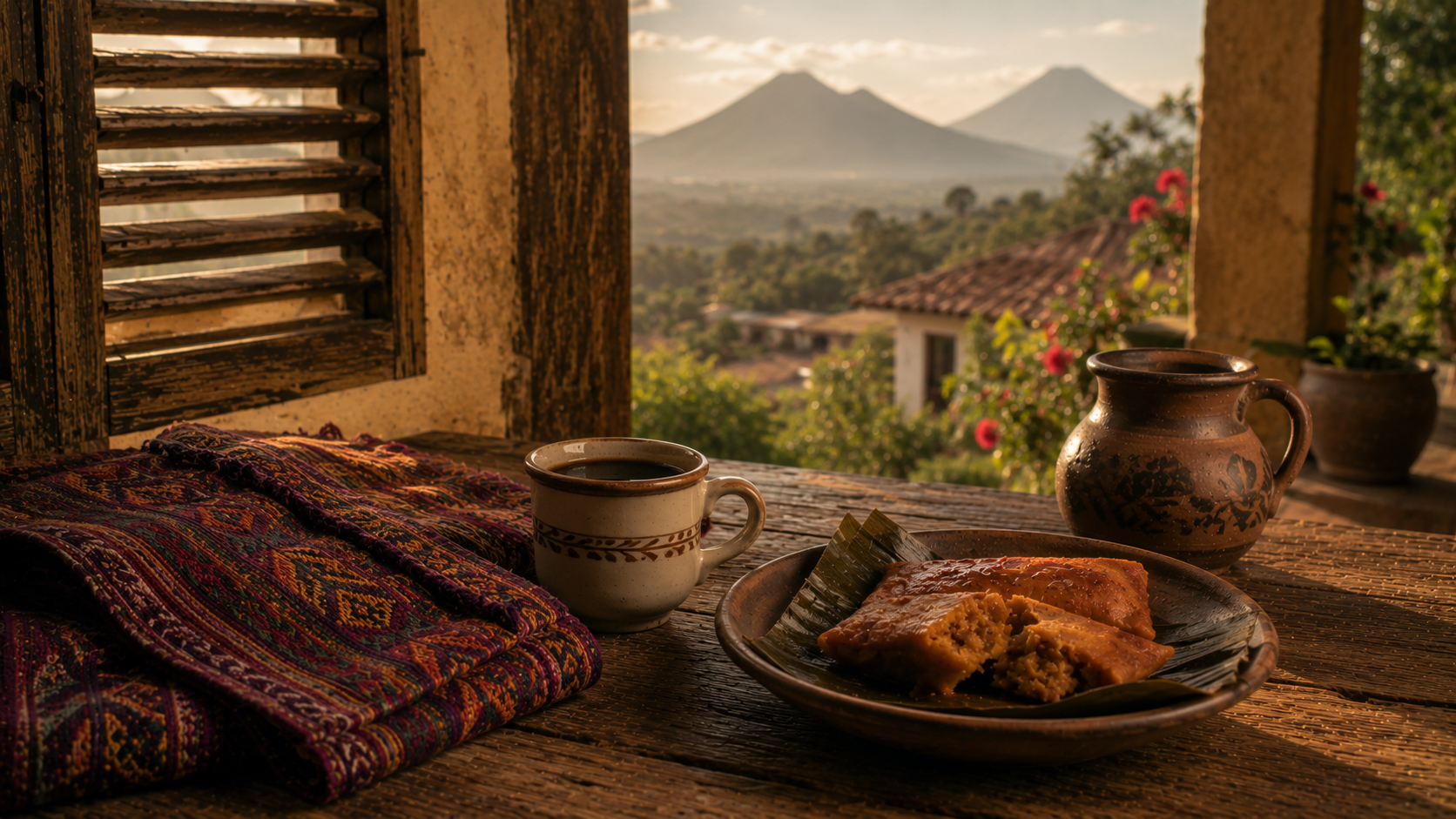
A reference on the Spanish of Guatemala — the country with the largest Mayan-language inheritance in Latin America, with more than twenty Mayan languages still in active use; the universal voseo shared with neighboring Central American countries; the complex three-pronoun system in which vos, tú, and usted occupy distinct pragmatic registers; the Mayan civilizational depth that has shaped contemporary cultural identity; the difficult political-historical context including the civil war and the genocide of the early 1980s; the ladino and indigenous Mayan dual identity; the cultural register that produced Miguel Ángel Asturias as the 1967 Nobel laureate in Literature; and the large diaspora that has spread Guatemalan Spanish across the United States and other host countries.
A Country of Spanish and Twenty-Plus Mayan Languages
A learner approaching Guatemalan Spanish encounters a country whose linguistic reality is more layered than most Spanish-speaking countries' realities. Guatemala officially recognises 24 languages — Spanish plus 23 indigenous languages (22 Mayan languages, plus Garífuna and Xinka). The Mayan-language families spoken in Guatemala include K'iche' (with approximately 1 million speakers, the largest Mayan language in Guatemala and one of the largest indigenous languages in the Americas), Q'eqchi' (approximately 800,000 speakers), Mam (approximately 600,000 speakers), Kaqchikel (approximately 500,000 speakers), and many smaller languages including Q'anjob'al, Tz'utujil, Ixil, Achi, and others. The total Mayan-speaking population in Guatemala is several million people, representing approximately forty per cent of the national population.
This is the largest indigenous-language inheritance in any Spanish-speaking country other than Paraguay (which has the unique Spanish-Guaraní bilingual situation) and the Andean countries Peru and Bolivia (where Quechua and Aymara have large speaker populations). But Guatemala's situation differs from these others: where Paraguay has near-universal bilingualism in two languages, and Peru and Bolivia have widespread bilingualism in Spanish and Quechua/Aymara, Guatemala has multiple Mayan languages spoken in distinct geographic regions, with the bilingualism being concentrated in specific indigenous communities rather than universal. A Mayan-language-speaking community in highland Guatemala — a K'iche' community in the western highlands, a Mam community further west, an Ixil community in the Cuchumatanes mountains, a Q'eqchi' community in the eastern lowlands — operates linguistically very differently from a ladino (mestizo) community in Guatemala City or in the south coastal region.
The result is that Guatemala has linguistic diversity that exceeds what most learners of Spanish have encountered. The country's Spanish has been shaped by sustained contact with Mayan languages across centuries, producing vocabulary, phonological features, and pragmatic patterns that distinguish Guatemalan Spanish from neighboring Central American varieties. The Mayan-language presence is not historical legacy alone — it is contemporary reality, with hundreds of thousands of speakers learning Mayan languages as first languages and Spanish as second languages, with bilingual education programmes operating in many regions, and with active cultural-political work to maintain and develop the Mayan-language traditions.
Beyond the indigenous dimension, Guatemalan Spanish shares core features with Central American Spanish — the universal voseo (used universally in casual contexts), the moderate phonology that preserves consonants more than Caribbean varieties, the Central American intonation patterns, and the broader regional vocabulary. The country also has the historical and contemporary complexity that distinguishes it from its Central American neighbors: the Mayan civilizational depth (Guatemala is the heartland of the ancient Mayan civilization, with archaeological sites like Tikal among the most important in the Americas), the difficult twentieth-century history (the civil war 1960-1996, including the genocidal violence against indigenous populations in the early 1980s), and the contemporary political-economic situation including large-scale migration to the United States.
This guide treats Guatemalan Spanish in its bilingual-multilingual context, with attention to the Mayan-language dimension throughout. The profile addresses the universal voseo and the three-pronoun system that operates with voseo, tú, and usted in distinct contexts. It treats the Mayan civilizational heritage as fundamental to Guatemalan identity rather than as historical curiosity. It addresses the genocide and its aftermath honestly, recognising that contemporary Guatemalan Spanish cannot be understood without awareness of this dark recent history.
A note on scope. Guatemalan Spanish in this guide refers primarily to the Spanish spoken in Guatemala by both ladino (mestizo) and bilingual indigenous Mayan populations, with attention to the major regional varieties — the Guatemala City and central highland variety (the dominant national variety), the western highland varieties (which include the regions with the largest Mayan-speaking populations), the Petén lowland variety (the northern jungle department), the south coastal variety, and the Caribbean coast variety (the smaller Garífuna-speaking and English-Creole-speaking communities). The Mayan-language dimension is integrated throughout rather than confined to a single section, since the bilingualism is fundamental to the variety.
1. The Pronoun System: Three Pronouns, Distinct Contexts
Guatemalan Spanish operates with three second-person singular pronouns — vos, tú, and usted — used in distinct pragmatic contexts. This makes Guatemala one of the few Spanish-speaking countries (along with Costa Rica) where all three pronouns are in active use, though the Guatemalan system operates differently from the Costa Rican system.
The systematic treatments of voseo and intimate ustedeo are in The Voseo Guide and The Ustedeo Guide. What follows is the Guatemalan-specific picture.
1.1 — Voseo as the Default Informal Pronoun
Vos is the standard informal second-person singular pronoun in Guatemalan Spanish, used in nearly all casual contexts. The pattern aligns Guatemala with neighboring Nicaraguan and Salvadoran Spanish in the broader Central American voseo cluster.
The pronoun. Vos replaces tú as the standard informal pronoun in most casual contexts.
The verb forms. Guatemalan voseo follows the standard Central American pattern: vos hablás, vos comés, vos vivís, vos sos. Final-syllable stress in present indicative.
The imperative. Voseo imperatives follow standard pattern: hablá, comé, viví, andá, sé, hacé, poné, salí, vení, decí.
The subjunctive. Guatemalan voseo typically uses the voseo subjunctive (que vos hablés) in more conservative or rural speech, and the tuteo subjunctive (que vos hables) in urban educated speech. The pattern varies and is in flux.
1.2 — Tú in the Intermediate Register
Guatemalan Spanish has real use of tú in intermediate contexts — neither the casual familiarity of vos nor the formal distance of usted. Tú in Guatemala can appear in:
- Speech directed at someone with whom the speaker has medium familiarity (not close enough for vos, not distant enough for usted)
- Some professional contexts with moderate familiarity
- Some media-influenced contexts
- Some speakers' usage with foreigners or strangers in non-formal contexts
The tú register is not as central as either vos or usted, but it has a real place in the Guatemalan pronoun system that distinguishes the variety from Argentine voseo (where tú is essentially absent) and from countries with simple tuteo systems.
1.3 — Usted in Multiple Functions
Usted in Guatemala operates in several distinct functions:
Standard formal usage — with elders, in professional contexts, with strangers, with hierarchical superiors. This is the textbook formal pronoun.
Intimate ustedeo in some indigenous communities and traditional family contexts — Guatemala shares with several other Andean and Central American varieties some patterns of intimate ustedeo, particularly in conservative rural communities and in some indigenous-language-influenced contexts. The pattern is not as universal as in Costa Rica but is present.
Distance or seriousness in moments of reproach — within familial or close vos relationships, a speaker may shift to usted to signal seriousness or formality.
1.4 — The Pragmatic Navigation
Guatemalan speakers navigate the three-pronoun system through pragmatic cues that learners gradually internalize through extensive exposure. The shifts between pronouns can carry meaning:
- A speaker using vos with a friend who shifts to usted may be marking the conversation as more serious
- A speaker using tú in an intermediate professional context may be marking moderate familiarity
- A speaker using usted with their child in moments of reproach within a normally vos relationship is using usted pragmatically for seriousness
These dynamics are subtle and require extensive listening to internalise.
1.5 — Practical Consequences for the Learner
A learner of Guatemalan Spanish should master voseo as the dominant informal pronoun (vos hablás, vos comés), develop awareness of tú in intermediate contexts, and master usted in formal contexts. The recognition that the three-pronoun system is more complex than simple binary tuteo/formal systems — and that pragmatic choice between pronouns carries social meaning — is part of engaging with the variety as it operates rather than as the textbook describes it.
2. The Sound of Guatemala
Guatemalan phonology is moderate — neither the dramatic Caribbean reductions nor the conservative Andean preservation. The systematic treatment of regional phonological patterns is in A Pronunciation Guide to Latin American Spanish. What follows is the Guatemalan-specific picture.
2.1 — Generally Preserved Consonants
The s. Guatemalan Spanish generally preserves the final s in careful and educated speech, with some weakening in casual speech but typically less aggressive than Caribbean reductions. The pattern aligns Guatemala with Mexican and broader Central American Spanish.
Stable final consonants. Final and intervocalic consonants are generally preserved in careful speech, with some softening in casual speech.
Past participle d. The intervocalic d in past participles can soften in casual speech (cansado → cansao), similar to broader Latin American patterns, but is preserved more often than in Caribbean varieties.
2.2 — The Distinctive Guatemalan J
A notable feature of Guatemalan Spanish is the realization of the j sound (before e/i) and of g before e/i. The Guatemalan realization tends to be a more forceful, slightly velar fricative — somewhere between the soft Caribbean h sound and the harder Spanish-Spanish ch sound. Jefe in Guatemalan speech can sound slightly more emphatic than in Mexican speech, with a quality that some observers describe as resembling the German ach sound.
The pattern varies regionally and socially within Guatemala, with educated urban speech sometimes softer and rural or traditional speech sometimes harder.
2.3 — The Assibilated R in Some Contexts
Like Costa Rican Spanish, some Guatemalan speakers produce the trill r with an assibilated quality — a sound with fricative-like properties rather than the standard alveolar trill. The pattern is more pronounced in some regions and some speakers than in others.
2.4 — Standard Yeísmo
Guatemalan Spanish uses standard yeísmo — ll and y both pronounced with the standard y sound. Llamar sounds like yamar.
2.5 — Distinctive Intonation
Guatemalan Spanish has a characteristic melodic intonation that distinguishes it from neighboring Central American varieties. The pattern is partly shaped by sustained Mayan-language contact in regions with large bilingual populations. The intonation is one of the markers that immediately identifies Guatemalan speech to other Central Americans.
2.6 — Mayan-Influenced Features in Bilingual Speech
In speakers with strong Mayan-language dominance, Spanish can carry Mayan phonological influences:
- Some vowel realizations influenced by Mayan vowel systems
- Some consonant patterns
- Distinctive intonation patterns reflecting Mayan prosodic structures
- The glottal stop (which is phonemic in Mayan languages) sometimes appearing in Spanish
These features vary by speaker, with monolingual Spanish-dominant Guatemalans showing minimal influence and Mayan-dominant bilingual speakers showing more.
2.7 — Speech Rate
Guatemalan Spanish moves at a moderate pace, similar to Mexican and broader Central American Spanish.
3. The Mayan-Language Dimension
The relationship between Spanish and the Mayan languages in Guatemala deserves substantive treatment, given the scale and contemporary vitality of the indigenous-language presence.
3.1 — The Mayan Language Families
Mayan languages spoken in Guatemala belong to the broader Mayan language family, which is one of the major language families of the Americas. The family includes approximately 30 living languages spoken across southern Mexico, Guatemala, Belize, Honduras, and El Salvador. Of these, approximately 22 are spoken in Guatemala.
Major Mayan languages in Guatemala:
K'iche' (sometimes spelled Quiché) — the largest Mayan language in Guatemala, with approximately 1 million speakers concentrated in the western highlands departments of Quiché, Sololá, Totonicapán, Quetzaltenango, and others.
Q'eqchi' (sometimes Kekchí or Kekchi) — approximately 800,000 speakers concentrated in the eastern highlands and northern lowland departments of Alta Verapaz, Baja Verapaz, Petén, and Izabal.
Mam — approximately 600,000 speakers in the western highlands, particularly Huehuetenango, San Marcos, and parts of Quetzaltenango.
Kaqchikel — approximately 500,000 speakers in the central highlands, particularly Chimaltenango, Sacatepéquez, Sololá, and parts of Guatemala department.
Smaller Mayan languages include Q'anjob'al, Tz'utujil, Ixil, Poqomchi', Poqomam, Akateko, Awakateko, Sakapulteko, Sipakapense, Uspanteko, Tektiteko, Mopan, Chuj, Ch'orti', Achi, and others.
Non-Mayan indigenous languages:
- Xinka — a small indigenous language family unrelated to Mayan, with a very small number of speakers in southeastern Guatemala
- Garífuna — an Afro-Indigenous language spoken by the Garífuna people in the Caribbean coastal department of Izabal
3.2 — Mayan Loanwords in Guatemalan Spanish
Hundreds of Mayan-origin words appear in Guatemalan Spanish, with many being part of everyday vocabulary throughout the country:
Food and agriculture:
- Milpa — the traditional cornfield (Nahuatl origin, but used in Mayan-influenced Spanish throughout Mesoamerica)
- Tamal / tamales — the corn-based dough wrapped in leaves (Nahuatl origin)
- Chuchito — small tamal
- Chipilín — a leafy green used in Guatemalan cuisine
- Cuxa — a traditional fermented drink
- Atol (or atole) — a corn-based drink (Nahuatl origin, with Mayan adoption)
- Pinol — corn-based powder
- Pacaya — a palm flower used in cuisine
- Chompipe — turkey (in some Guatemalan usage)
Cultural and traditional vocabulary:
- Chapín / chapina — Guatemalan (the colloquial demonym, of contested origin but widely used)
- Patojo / patoja — kid, young person (distinctly Guatemalan)
- Cipote — child (also used in Salvadoran and Honduran Spanish)
- Cuxa — traditional alcoholic drink
- Caite — traditional sandal
- Comal — flat cooking surface (Nahuatl origin)
- Petate — woven mat
- Cuche — pig (Mayan origin)
Place names — Most Guatemalan place names are Mayan-origin: Tikal, Quiché, Chimaltenango, Quetzaltenango (also called Xela, from the Mam name), Sololá, Sacatepéquez, Huehuetenango, Totonicapán, Antigua, Atitlán, Petén, and many others. Some place names mix Mayan and Nahuatl elements (Nahuatl came with Mexican Mexica/Aztec influence and Spanish colonization).
3.3 — Mayan Influence on Spanish Beyond Vocabulary
Beyond loanwords, Mayan languages have shaped Guatemalan Spanish in deeper ways in bilingual speakers and in communities with sustained bilingual history:
Phonological influence — discussed in Section 2.6.
Syntactic influence — bilingual speakers sometimes show Mayan-influenced patterns:
- Particular word-order patterns
- Distinctive use of evidential markers
- Some constructions reflecting Mayan grammatical structures
Pragmatic influence — Mayan-language pragmatic patterns can shape Spanish use in bilingual communities, including patterns of formality, respect, and indirection.
3.4 — The Contemporary Situation
In contemporary Guatemala, Mayan languages have legal recognition and real cultural-political support, though structural challenges remain:
Legal status — The 2003 Law of National Languages recognized the official status of indigenous languages alongside Spanish, providing legal framework for bilingual education and indigenous language use in government services.
Education — Bilingual intercultural education programmes operate in many Mayan-speaking regions, though implementation varies and many indigenous students still face educational systems primarily in Spanish.
Media — Mayan-language radio stations, some television programming, and growing online presence have expanded Mayan-language media. The expansion has been real but uneven.
Cultural revival — Continuing cultural-political work has aimed to revitalize Mayan languages and cultures, including:
- Language standardization and academic study (the Academia de las Lenguas Mayas de Guatemala plays an important role)
- Cultural celebrations and the broader indigenous-rights movement
- The role of Mayan-language speakers in literature, academia, and public life
Challenges — Despite these developments, Mayan-language transmission to younger generations has been complicated by:
- Educational systems still primarily in Spanish
- Economic pressures favoring Spanish-language skills
- Migration that disrupts community language transmission
- The lingering effects of the civil war and genocide on indigenous communities
3.5 — Rigoberta Menchú and the International Recognition
The 1992 Nobel Peace Prize awarded to Rigoberta Menchú Tum brought international attention to Mayan indigenous experience and to the K'iche' Maya specifically. Menchú's testimonial Me llamo Rigoberta Menchú y así me nació la conciencia (1983) became one of the most internationally read works about indigenous Latin American experience and decisively shaped international understanding of Guatemala's situation. Menchú continues to be a major public figure in Guatemala and internationally.
3.6 — Practical Consequences for the Learner
A learner of Guatemalan Spanish has options regarding the Mayan dimension:
- Awareness only — Understanding that Guatemala is multilingual, recognising Mayan-origin vocabulary, and accepting that some pragmatic features have indigenous roots
- Recognition — Developing ability to recognize Mayan-influenced features when they appear
- Active study of a Mayan language — For learners with serious Guatemala engagement (academic, family, professional), beginning study of K'iche', Q'eqchi', Mam, or Kaqchikel can deeply enrich engagement with Guatemalan culture
Most learners will operate at the awareness or recognition level. Active Mayan-language study is a real additional commitment.
4. The Civil War and the Genocide
Any serious treatment of contemporary Guatemala must address the civil war (1960-1996) and the genocidal violence of the early 1980s. These events shape contemporary Guatemalan society and cultural-linguistic life in fundamental ways, and a learner approaching Guatemalan Spanish cannot fully engage with the country without awareness of this history.
4.1 — The Historical Context
The Guatemalan Civil War lasted thirty-six years (1960-1996) and involved military governments, leftist guerrilla movements, and the indigenous Mayan population caught between them. The conflict was rooted in long-standing structural inequalities, the legacy of the 1954 CIA-backed coup against the elected reformist government of Jacobo Árbenz, and the broader Cold War dynamics in Central America.
4.2 — The Genocide
The most intense period of violence occurred during the early 1980s, particularly under the military government of Efraín Ríos Montt (1982-1983). During this period, the Guatemalan military conducted scorched-earth campaigns against indigenous Mayan communities, particularly in the western highlands departments of Quiché, Huehuetenango, Alta Verapaz, and others. The campaigns destroyed approximately 600 indigenous villages, killed an estimated 200,000 people (the great majority of whom were indigenous Mayans), and caused approximately 1.5 million internal displacements. Approximately 45,000 people remain "disappeared."
In 2013, Ríos Montt was convicted of genocide and crimes against humanity by a Guatemalan court — the first time a former head of state had been tried for genocide in his own country. The verdict was subsequently annulled on procedural grounds, but the legal recognition of the genocide remained historic.
4.3 — The Aftermath and Contemporary Consequences
The civil war ended formally with the 1996 peace accords, but the aftermath has continued to shape Guatemalan society:
- Unresolved historical justice issues at scale
- Continued impunity for many perpetrators
- The destruction of indigenous community structures
- Massive internal displacement and migration
- The development of a large Guatemalan diaspora, particularly to the United States
- The continuing structural inequalities that contributed to the conflict
- The ongoing violence that has characterized post-war Guatemala, including high rates of gang violence and femicide
4.4 — The Linguistic-Cultural Consequences
The genocide and its aftermath have shaped contemporary Guatemalan linguistic-cultural life in fundamental ways:
- Disrupted Mayan-language transmission in affected communities
- Large migration that has spread Guatemalan Spanish (and Mayan languages) across the United States and other host countries
- The development of contemporary indigenous-rights movements that have shaped Mayan-language revitalization efforts
- The cultural-political consciousness that informs contemporary Guatemalan literature, music, and cultural production
- The sustained work of memory and historical truth that continues to develop
4.5 — Approaching This History as a Learner
A learner engaging seriously with Guatemalan Spanish and Guatemalan culture cannot avoid this history. The contemporary country is shaped by it in ways that surface in literature, in political discourse, in family histories, in indigenous-rights movements, and in everyday conversation. Engaged understanding involves awareness of this context, with the sensitivity that the history requires.
5. Distinctive Guatemalan Vocabulary
Guatemalan Spanish has developed extensive vocabulary that is recognisably Guatemalan. Some is shared with broader Central American Spanish; some is specifically Guatemalan; a considerable share is Mayan or Nahuatl-derived.
5.1 — Core Guatemalan Vocabulary
A selection of high-frequency Guatemalan words a learner will encounter:
- Chapín / chapina — Guatemalan (the universal informal demonym, the cultural equivalent of Tico for Costa Ricans)
- Patojo / patoja — kid, young person. Distinctly Guatemalan.
- Cipote — child (also Salvadoran and Honduran)
- Mucho / mucha — used affectionately for friends or family in some contexts
- Va — interjection used at end of sentences, similar to "right?" or "okay?" — common Central American discourse marker
- Vos — universal informal pronoun
- Pisto — money (slang). Distinctly Guatemalan.
- Casaca — lie, falsehood. No me digás casaca (Don't lie to me).
- Bochinche — gossip
- Burra — bus (informal). Distinctly Guatemalan.
- Chévere — cool, great (less common than in Caribbean varieties but used)
- Tuanis — cool, great (shared with Costa Rican usage, less central in Guatemala)
- Pisado / pisada — situation or person (informal)
- Chivearse — to give up
- Estar chivo — to be cool, great
- Estar de a verga — to be cool/great (vulgar in origin)
- Estar hule — to be broke
- Ver — to look (often used in expressions like vení a ver — come and see)
- Brocha — sucker, easily fooled person (slang)
- Sho — sometimes used as interjection
- Bayunco / bayunca — silly, foolish (affectionate)
- Aguas — be careful, watch out (shared with Mexican usage)
- Camellar — to work hard
- Chambonear — to mess up, to do something poorly
- Charrúa — referring to Uruguayan/Argentine origin (used in some contexts)
- Coche — pig (Guatemalan usage differs from Iberian coche for car)
- Carro — car
- Bolo / bola — drunk, drunken person
5.2 — Mayan-Origin Vocabulary
Many Mayan-origin words appear in Guatemalan Spanish:
- Patojo / patoja — kid, young person (Mayan origin)
- Cuche — pig (Mayan origin)
- Chipilín — leafy green
- Tayuyo — type of tamal
- Cuxa — traditional drink
- Comal — cooking surface (Nahuatl-Mayan)
- Petate — woven mat
- Quetzal — the national bird and currency (Mayan word)
5.3 — Food Vocabulary
Guatemalan cuisine has produced an extensive vocabulary:
- Pepián — the traditional stew
- Kaq ik — turkey soup, particularly traditional in Cobán
- Jocón — green herbed chicken stew
- Tamales colorados — red tamales
- Tamales negros — black tamales
- Chuchitos — small tamales
- Paches — potato-based tamales
- Atol de elote — corn drink
- Frijoles parados — beans served standing (in traditional way)
- Frijoles volteados — refried beans
- Tortillas — handmade corn tortillas, central to Guatemalan cuisine
- Quesadilla — Guatemalan version (a sweet cheese bread, different from Mexican usage)
- Rellenitos — sweet plantain fritters with bean filling
- Mole — sweet dessert (different from Mexican mole)
- Buñuelos — sweet fried pastries
- Chocolate caliente — hot chocolate, traditionally prepared
5.4 — Cultural-Political Vocabulary
The contemporary political-historical context has produced distinctive vocabulary:
- Indígena — indigenous person (the preferred contemporary term)
- Ladino / ladina — non-indigenous Guatemalan (mestizo or of European descent)
- Maya — referring to Mayan indigenous identity (used productively in cultural-political discourse)
- Q'anjob'al, K'iche', Q'eqchi', Mam, Kaqchikel — Mayan language and ethnic group names
- Conflicto armado interno — the formal term for the civil war
- La guerra — the war (colloquial reference to the civil war)
- La firma de la paz — the signing of peace (1996)
- Desaparecido / desaparecida — disappeared person (from the war period)
- Refugiados — refugees
- Retornados — returnees (those who returned from refuge in Mexico after the war)
- Mara — gang (the term for the broader gang culture)
- Mara Salvatrucha (MS-13) — the gang originating in Los Angeles among Salvadoran and Guatemalan migrants
6. The Diminutive in Guatemalan Spanish
As covered in The Diminutive in Latin American Spanish, Latin American varieties use diminutives at varying frequencies. Guatemalan Spanish uses diminutives at moderate to high frequency, comparable to broader Central American patterns.
The Guatemalan diminutive functions for affection and softening within the standard pragmatic patterns. Mamita, papito, abuelita, hijita — affectionate diminutives in family contexts. Some Mayan-influenced affective patterns appear in heavily bilingual contexts.
Distinctively Guatemalan diminutive expressions include patojito / patojita (little kid) and various other forms reflecting the broader Central American patterns.
7. Pragmatics: The Guatemalan Style
Beyond grammar and vocabulary, Guatemalan Spanish has pragmatic features that distinguish it from neighboring Central American varieties.
7.1 — Layered Politeness
Guatemalan Spanish, like Costa Rican and Andean varieties, maintains layered politeness in many contexts. The use of usted, of titles (Don, Doña, Licenciado/a, Doctor/a, Ingeniero/a, Profesor/a), and of polite expressions is consistent. The cultural emphasis on respect, particularly toward elders and authority figures, shapes pragmatic norms.
7.2 — Indirection
Guatemalan speech often operates through indirection, particularly in service contexts and in formal settings. Direct refusal, direct demand, or direct contradiction can feel impolite; preferred conventions allow for face-saving.
7.3 — The Bilingual Pragmatic Norm in Indigenous Communities
In Mayan-speaking communities, pragmatic norms reflect the bilingual reality. Choice between Spanish and a Mayan language carries social meaning. The Spanish used by bilingual indigenous speakers often reflects Mayan pragmatic patterns alongside Spanish ones.
7.4 — Greetings and Social Rituals
Guatemalan greetings tend toward warmth and physical contact in informal contexts (kisses on the cheek between women and across genders in informal contexts, handshakes among men in formal contexts). Greetings can be extended with inquiries about family and community.
The Guatemalan cultural emphasis on family and community shapes social interactions, with sustained attention to family questions and to community connections in everyday conversation.
7.5 — The Ladino-Indigenous Pragmatic Dimension
The ladino-indigenous distinction in Guatemala has historically shaped pragmatic norms. Cross-group interaction has involved specific pragmatic patterns reflecting historical hierarchies and contemporary efforts to renegotiate them. The pattern is in flux and varies across contexts.
7.6 — Humor and Wit
Guatemalan humor has its own particular character, with wit, irony, and observational comedy valued in social interaction. The cultural-political context has shaped a tradition of indirect political humor that has operated through difficult periods.
8. Regional Variation Within Guatemala
Guatemala has real internal regional variation.
8.1 — Guatemala City and the Central Region
The Spanish of Guatemala City (the capital) and the surrounding central highlands has cultural-political prestige as the variety of national government, media, and education. The Guatemala City variety is the implicit national standard, though regional varieties have their own strong cultural identities.
8.2 — The Western Highlands
The Spanish of the western highlands departments (Quetzaltenango, Sololá, Totonicapán, Quiché, Huehuetenango, San Marcos, Chimaltenango) is heavily shaped by Mayan-language contact. The region includes the largest Mayan-speaking populations and the most intensive Mayan-Spanish bilingualism. The cultural-political centre of this region is Quetzaltenango (called Xela in Mam), Guatemala's second-largest city.
The Spanish of this region carries Mayan phonological, lexical, and pragmatic influences that distinguish it from Guatemala City Spanish.
8.3 — The Eastern Highlands
The eastern highlands (Alta Verapaz, Baja Verapaz) have large Q'eqchi'-speaking populations and their own particular Spanish features. The cultural centre is Cobán in Alta Verapaz, with a major coffee-growing economy and bilingual cultural life.
8.4 — The Pacific South Coast
The south coastal departments (Escuintla, Suchitepéquez, Retalhuleu, San Marcos coast) have less indigenous-language presence than the highlands and a Spanish that shares features with the central region while having its own particular coastal features.
8.5 — The Caribbean Coast (Izabal)
The Caribbean coastal department of Izabal has the distinctive presence of:
- The Garífuna community in Livingston, with its own Garífuna language (an Afro-Indigenous language unrelated to either Mayan or Spanish) and English-Creole bilingualism
- Q'eqchi' communities
- Spanish-speaking ladino populations
- Some English-speaking communities reflecting the British Caribbean historical influence
The linguistic complexity of Izabal makes it one of the most distinctive Guatemalan regions.
8.6 — The Petén Lowlands
The northern department of Petén (the largest Guatemalan department, covering the northern jungle region including the archaeological site of Tikal) has a distinctive variety shaped by:
- Q'eqchi' and other Mayan-speaking populations
- Recent settler migration from other Guatemalan regions
- Contact with Belizean English (in border areas) and Mexican Spanish (in northern border areas)
- The cultural-economic context of jungle, archaeology, and tourism
9. The Cultural Register
Guatemala has produced significant cultural work in literature, music, and the arts, with the country's complex history shaping much of the cultural production.
9.1 — Literature
Miguel Ángel Asturias (1899-1974), the foundational Guatemalan writer and winner of the 1967 Nobel Prize in Literature — the first Latin American to win the prize for fiction (Mistral had won earlier for poetry). Asturias's novels include El Señor Presidente (1946, a dictator novel that prefigured the broader Latin American genre), Hombres de maíz (1949, drawing on Mayan mythology), the banana trilogy (Viento fuerte, El papa verde, Los ojos de los enterrados) addressing United Fruit Company influence, and other major works. Asturias's engagement with Mayan culture and Guatemalan political reality shaped Latin American literary modernism.
Rigoberta Menchú Tum (born 1959), winner of the 1992 Nobel Peace Prize. Her testimonial Me llamo Rigoberta Menchú y así me nació la conciencia (1983) brought K'iche' Maya experience to international audiences.
Augusto Monterroso (1921-2003), the master of the very short form. Monterroso's famous one-sentence story El dinosaurio — Cuando despertó, el dinosaurio todavía estaba allí — is one of the most cited works in Spanish-language literature. His collected work in fiction and essays shaped the experimental short form tradition.
Luis Cardoza y Aragón (1901-1992), important poet and cultural figure.
Otto René Castillo (1936-1967), revolutionary poet who died young in the early conflict period.
Mario Roberto Morales (born 1947), important contemporary novelist.
Rodrigo Rey Rosa (born 1958), contemporary novelist whose work has reached international audiences.
Eduardo Halfon (born 1971), contemporary novelist whose work engages with Jewish-Guatemalan identity and broader themes.
Other contemporary writers include Denise Phé-Funchal, Arnoldo Gálvez Suárez, Vania Vargas, and many others continuing the literary tradition.
Mayan-language literature has been growing, with writers like Humberto Ak'abal (1952-2019, K'iche' Maya poet) bringing Mayan-language poetry to international audiences. Contemporary Mayan-language literary production continues.
9.2 — Music
Marimba — the marimba is the national instrument of Guatemala, with deep cultural-political importance. The marimba tradition is central to Guatemalan musical identity, with marimba ensembles playing both traditional folk music and contemporary popular music.
Música folklórica guatemalteca — the traditional folk music includes various regional forms across both ladino and indigenous traditions.
Mayan musical traditions — the various Mayan-speaking regions have their own musical traditions, including ceremonial music, dance music, and contemporary developments.
Contemporary popular music — Guatemalan musicians have worked across genres, with notable contributions to Central American rock, salsa, and contemporary pop.
Punta and Garífuna music — the Garífuna community of Izabal has its own distinctive musical tradition, related to broader Afro-Caribbean musical forms.
9.3 — Cinema
Guatemalan cinema has produced significant work in recent decades, with films including Ixcanul (Jayro Bustamante, 2015, in Kaqchikel and Spanish), Temblores (Bustamante, 2019), La llorona (Bustamante, 2019), and others reaching international festival audiences. Bustamante's work engaging with indigenous Guatemalan experience and contemporary social realities has been particularly significant.
9.4 — Visual Arts
Guatemala has rich traditions in visual arts, including the Mayan textile traditions, contemporary visual art, and the colonial-period art preserved in Antigua Guatemala (the colonial capital, now a UNESCO World Heritage Site).
9.5 — Cultural Themes
Guatemalan cultural identity has been shaped by:
- The deep Mayan civilizational heritage (Tikal, Quiriguá, and the broader Mayan archaeological depth)
- The Spanish colonial period and the founding of Santiago de los Caballeros de Guatemala (now Antigua)
- The complex relationship between ladino and indigenous Mayan populations
- The brief reformist period (1944-1954) under Arévalo and Árbenz, ended by the CIA-backed coup
- The thirty-six-year civil war and the genocide of the early 1980s
- The 1996 peace accords and the ongoing post-war reconstruction
- The contemporary indigenous-rights movement and Mayan cultural revitalization
- The large migration to the United States, particularly since the 1980s
- The contemporary economic, political, and security challenges
- The cultural recovery and continued vitality of Mayan traditions
10. The Diaspora
Guatemala has a large diaspora, particularly to the United States but also to Mexico and other countries. The Guatemalan-American population is estimated at approximately 1.5 to 2 million people, concentrated in Los Angeles, the broader California region, and various other U.S. metropolitan areas.
10.1 — The Migration Patterns
Guatemalan migration to the United States accelerated dramatically during and after the civil war, with major refugee flows in the 1980s, continued migration in subsequent decades, and recent waves driven by gang violence, economic conditions, and political instability. Many Guatemalan migrants are indigenous Mayans speaking K'iche', Q'eqchi', Mam, or other Mayan languages alongside (or instead of) Spanish.
10.2 — The Linguistic Implications
The Guatemalan diaspora has produced:
- The presence of Mayan languages in U.S. cities, with bilingual or trilingual community contexts (Mayan + Spanish + English)
- Code-switching and English-influenced features in diaspora Guatemalan Spanish
- The development of community institutions (churches, cultural organizations, businesses) operating in Mayan languages, Spanish, and English
- A continuous back-and-forth movement that keeps both homeland and diaspora varieties in contact
10.3 — The Cultural Production
Guatemalan-American cultural production has been growing, with contemporary writers, musicians, and artists engaging with the migration experience and with broader Guatemalan-American identity.
11. For the Learner
A few practical paths into Guatemalan Spanish:
Master voseo as the foundation. Vos hablás, vos comés, vos vivís — the same Central American voseo pattern that Nicaraguan and Salvadoran Spanish use. Learners who have studied Argentine voseo have a strong foundation.
Develop awareness of the three-pronoun system. Vos (casual), tú (intermediate), usted (formal, with some intimate ustedeo contexts) — the system is more complex than binary tuteo/formal systems.
Engage with the Mayan dimension. Even without active Mayan-language study, develop awareness of the bilingual context, recognize Mayan-origin vocabulary, and understand that the country's indigenous heritage is fundamental rather than peripheral.
Read Miguel Ángel Asturias. Hombres de maíz (1949) for the Mayan-mythological dimension; El Señor Presidente (1946) for the political-historical engagement. Asturias's Nobel Prize work represents one of the great Latin American literary traditions.
Read Rigoberta Menchú. Me llamo Rigoberta Menchú provides essential engagement with K'iche' Maya experience and with Guatemalan political-historical reality.
Read contemporary Guatemalan writers. Eduardo Halfon, Rodrigo Rey Rosa, Humberto Ak'abal (in translation if Mayan-language is too challenging), and others provide accessible engagement with current Guatemalan Spanish in literary register.
Watch Guatemalan cinema. Jayro Bustamante's films (Ixcanul, Temblores, La llorona) provide listening practice and serious engagement with contemporary Guatemalan experience. Ixcanul in particular includes Kaqchikel alongside Spanish.
Listen to Guatemalan music. Marimba music for the foundational tradition; Garífuna music for the Caribbean coastal tradition; contemporary Guatemalan popular music for current speech patterns.
Find a Guatemalan tutor. As discussed in the italki review, italki provides access to Guatemalan tutors. Guatemala is represented, with tutors offering various regional and linguistic backgrounds.
Travel to Guatemala. Guatemala City for the central variety; Antigua (the colonial capital, now major tourist destination) for accessible cultural-historical engagement; Lake Atitlán region for indigenous-Spanish bilingual context; the western highlands (Quetzaltenango/Xela) for intensive Mayan-Spanish contact; Tikal in Petén for the Mayan archaeological depth. The country has well-developed tourism infrastructure.
Engage seriously with the historical context. The civil war, the genocide, the contemporary political situation — engaged understanding involves awareness of this difficult history. The country is in many ways still working through its consequences.
Approach the Mayan dimension with respect. Mayan identity, language, and culture are living realities in contemporary Guatemala, not historical curiosities. Engagement with Guatemala involves engagement with this dimension.
Be patient with the regional and linguistic complexity. Guatemala contains real diversity — geographic, ethnic, linguistic, regional — that takes time to internalise. Build understanding gradually.
Consider basic Mayan-language study for serious engagement. For learners with sustained Guatemala engagement (academic, family, professional), beginning K'iche', Q'eqchi', Mam, or Kaqchikel study can deeply enrich engagement with Guatemalan culture and bilingual indigenous communities.
A Closing Note
Guatemalan Spanish, in its universal voseo, its complex three-pronoun system, its large Mayan-language inheritance with more than twenty living Mayan languages, its Mayan civilizational depth that includes the archaeological monuments of Tikal and other classic Maya sites, its difficult contemporary political-historical context including the civil war and the genocide of the early 1980s, its cultural production that includes the first Latin American Nobel laureate in fiction (Asturias) and a rich contemporary literary, cinematic, and musical tradition, its diaspora that has spread Guatemalan Spanish across the United States, and its complex ladino-indigenous dual identity — is one of the most linguistically and culturally rich countries in Latin America.
The Mayan dimension alone makes Guatemala worth serious study for learners of Latin American Spanish. The country represents the largest contemporary Mayan-language presence in the Americas, with several Mayan languages having speaker populations exceeding the entire populations of some smaller countries. The fact that Guatemala has maintained these linguistic-cultural traditions through colonization, through the post-independence period, through the civil war and genocide, and into the contemporary moment represents a real cultural-historical achievement.
Beyond the Mayan dimension, Guatemalan Spanish offers engagement with a country whose cultural-political complexity reflects the broader complexity of Mesoamerican and Latin American history. The country contains literary tradition that has shaped global culture (Asturias, Menchú, contemporary writers), musical traditions that have produced the iconic marimba culture, cinema that engages substantively with indigenous and contemporary experience, and cultural-political development that continues to evolve.
For a learner, Guatemalan Spanish offers exceptional engagement with linguistic and cultural complexity within a manageable country size. The investment provides access to a culture whose depth — Mayan civilizational, colonial, contemporary — is real, whose challenges of internal difference (ladino-indigenous, the legacy of violence, contemporary inequalities) deserve honest engagement, and whose contemporary moment continues to develop in distinctive ways.