Mexican Spanish: A Learner's Guide
The Spanish of Mexico — the largest Spanish-speaking variety in the world, with its own distinctive features, its remarkable regional diversity, its deep Nahuatl and Maya inheritance, and the cultural reach that has made it a gateway variety for learners.

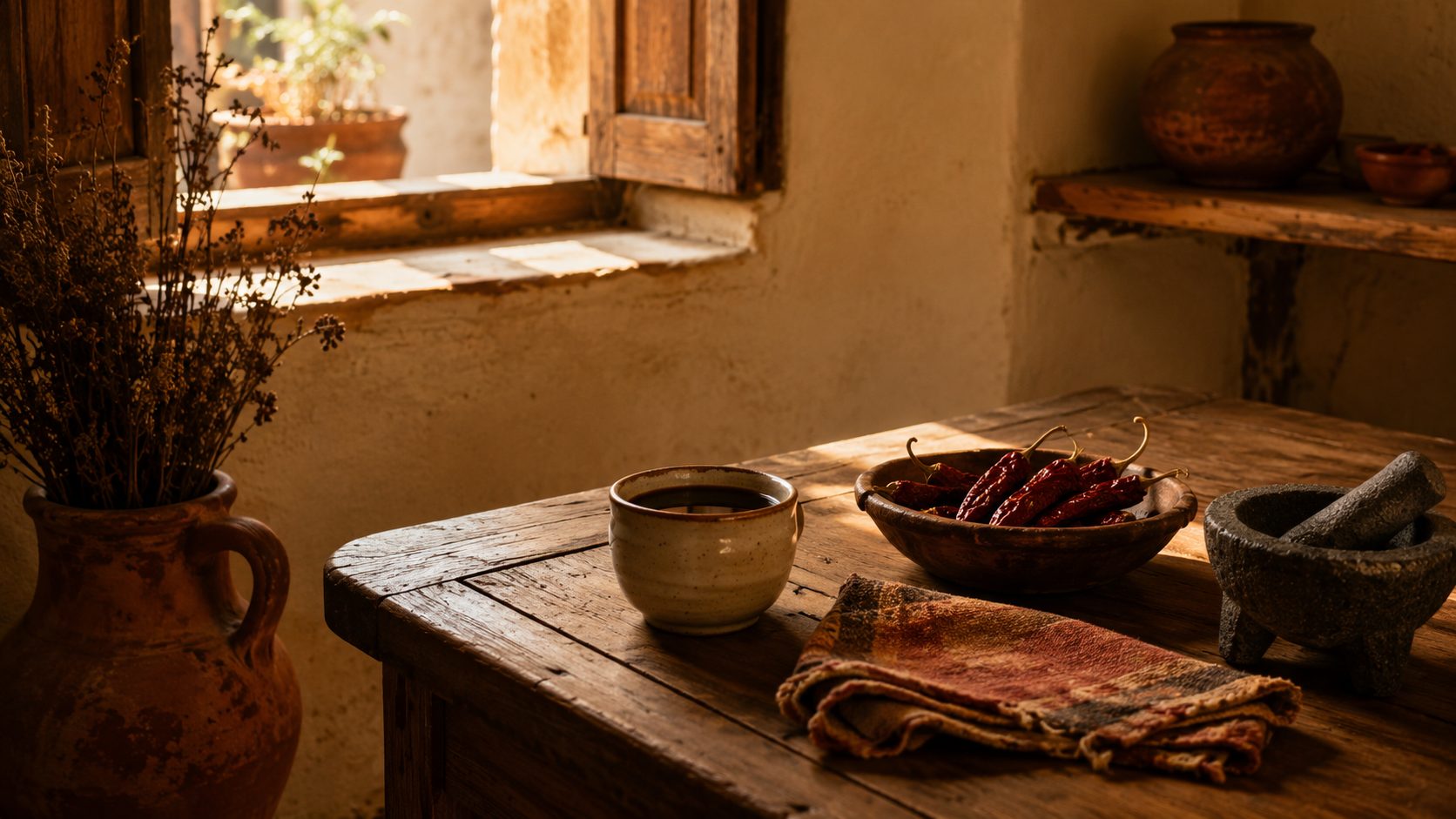
A reference on the Spanish of Mexico — the largest Spanish-speaking country in the world with the most internationally heard variety, shaped by sustained contact with Nahuatl, Maya, and other indigenous languages across centuries; the universal tuteo with the standard formal usted; the moderate phonology with preserved consonants and the characteristic Mexican intonation; the regional variation from the Central Mexican standard through Northern, Yucatecan, Gulf Coast, Pacific, and Southern varieties; the distinctive pragmatic register of indirect politeness where te aviso usually means no; the rich diminutive culture and the pervasive use of affectionate forms; the cultural register that has produced one of the world's great culinary traditions; the cinema, music, and popular cultural production that has reached global audiences; and the Mexican-American community in the United States that has produced one of the largest Spanish-language diasporas in the world.
A Variety That Is Not Neutral
A learner who has studied Spanish from a textbook in the English-speaking world has, in most cases, been studying Mexican Spanish without entirely realising it. The recordings on their language-learning apps were probably made by Mexican voice actors. The vocabulary lists they memorized — carro for car, aguacate for avocado, piña for pineapple — reflect Mexican usage rather than Iberian usage. The grammar examples in their textbook leaned toward what is sometimes called "Latin American Spanish" but is, in practice, Mexican Spanish standing in for the whole.
This is not an accident. Mexican Spanish has long served as the default Latin American variety in language-learning materials produced in the United States, partly because Mexico is geographically adjacent, partly because Mexican film and television dominated Spanish-language media in the twentieth century, partly because the United States has roughly thirty-seven million speakers of Mexican-origin Spanish, and partly because Mexican Spanish has features — the preserved s, the clear consonants, the moderate speech rate — that are particularly accessible to learners. For most English speakers studying Spanish, Mexican Spanish is the variety they have been hearing all along, even when they did not know to call it that.
This produces a small but persistent illusion. Many learners arrive at the study of regional Latin American Spanish thinking they already know Mexican Spanish — or worse, thinking that what they know is "standard" or "neutral" Spanish, and that other varieties are deviations from it. Neither is quite right. Mexican Spanish is one variety among many. It has features that distinguish it from the Spanish of Spain, from the Spanish of Argentina, from the Spanish of Cuba, from the Spanish of the Andes. The features are mostly subtle — Mexican Spanish does not have the sh-sound of Argentina or the disappearing s of Cuba — but they are real, and a learner who treats Mexican Spanish as the unmarked default is missing what makes it distinctively Mexican.
This guide is meant as a reference for that distinction. It treats Mexican Spanish as the specific variety it is — the largest in the Spanish-speaking world, with its own grammar, its own vocabulary, its own phonology, its own pragmatic style, its own internal regional diversity, and its own deep cultural roots. The variety is so large that this guide can only sketch its outlines; entire books have been written about each of its major regional varieties, about Nahuatl loanwords alone, about the Mexican use of the diminutive alone. What is collected here is the orientation a learner needs to move from I have been studying Latin American Spanish to I am specifically studying Mexican Spanish, and here is what that means.
A note on scope. Mexican Spanish in this guide refers primarily to the Spanish spoken in Mexico itself, with attention to its major regional varieties. Mexican-American Spanish — the Spanish of Mexican-origin communities in the United States — is treated in a dedicated section below, given its scale and contemporary importance.
1. The Pronoun Core: Tuteo
The first thing to know about Mexican Spanish is that it is a tuteo variety. Mexico does not use vos as the second-person singular informal pronoun. Tú is universal across the country, in every register, with every relationship.
This is worth stating clearly because it distinguishes Mexican Spanish from much of the rest of Latin America. As discussed in The Voseo Guide, voseo is the dominant pattern across Argentina, Uruguay, Paraguay, most of Central America, parts of Colombia and Venezuela, and Chile in its own particular form. Mexico stands apart from this voseo zone. A learner moving between Mexico and Argentina, or between Mexico and Costa Rica, will need to switch pronoun systems. A learner whose Spanish work is exclusively within Mexico needs only tuteo.
The Mexican tuteo system is standard. Tú hablas, tú comes, tú vives. Present-tense forms follow the textbook patterns, including all the stem-changing irregularities (tú puedes, tú quieres, tú tienes, tú vienes). The familiar imperative uses the standard tuteo forms (habla, come, vive, haz, pon, ven, di). The subjunctive is the standard tuteo subjunctive. None of this should surprise a learner who has studied from a textbook.
The formal-intimate distinction works as the textbook describes. Usted is the formal pronoun, used with elders, strangers, in professional contexts, and to mark respect or distance. Tú is the informal pronoun, used with family, friends, peers, and in casual social situations. This binary is clean in Mexico in a way that it is not in voseo countries or in intimate-ustedeo regions like Costa Rica and the Colombian interior. As discussed in The Ustedeo Guide, Mexico does not have intimate ustedeo. The textbook formal/informal binary holds.
There is no vos and no intimate usted to worry about. A learner working in Mexican Spanish has the simplest pronoun system in Latin America — the same system the textbook teaches, applied as the textbook teaches it. This is one of the practical reasons Mexican Spanish is often the easiest variety for beginners.
A small note on regional variation. In a few specific Mexican regions — most notably Chiapas, where there has historically been some contact with the voseante regions of Central America — voseo can appear in older or rural speech. This is rare, geographically limited, and not characteristic of Mexican Spanish as a whole. A learner can safely treat Mexico as monolithically tuteo for practical purposes.
2. The Sound of Mexico
Mexican Spanish is, on the level of pronunciation, one of the more accessible varieties of Latin American Spanish for English-speaking learners. The systematic phonological treatment is in A Pronunciation Guide to Latin American Spanish; what follows is what is specifically Mexican.
The s is preserved everywhere. Unlike Caribbean Spanish, Mexican Spanish keeps the s at the end of syllables, in fast speech, and in all positions. Los amigos sounds clearly like los amigos. Está sounds like está. Buenos días sounds like buenos días. There is no aspiration, no softening, no loss. For a learner, this means that grammatical information carried by the s — singular versus plural, second-person verb endings — is always audible. This is one of the features that makes Mexican speech feel clearer than Caribbean or Chilean speech to learners.
The j and g before e/i are soft. The Mexican realization of these letters is closer to the English h in hat than to the harsher Iberian back-of-throat sound. Jefe sounds close to hefe. Gente sounds close to hente. Jugar sounds close to hugar. This softening is one of the features that gives Mexican Spanish its characteristically gentle aural quality.
Standard ll/y merger. Mexico participates in the universal Latin American merger of ll and y into a single sound, but the Mexican realization is the standard one — close to the English y in yes. Llama sounds like yama. Yo sounds like yo in English. There is no sh-sound (Argentine) or other regional variant. This is the realization most learners are familiar with from textbook recordings.
Stable consonants throughout. Unlike Caribbean and Chilean speech, where final and intervocalic consonants soften or drop, Mexican Spanish pronounces all consonants clearly. Cansado is pronounced fully (not cansao). Verdad keeps its final d. Universidad sounds fully articulated. This stability contributes to the perception that Mexican Spanish is among the clearest Latin American varieties.
The Mexican intonation. Beyond individual sounds, Mexican Spanish has a characteristic melodic intonation that immediately marks a speaker as Mexican to other Latin Americans. The pattern is sometimes described as having a slight sing-song quality, with rises and falls across phrases that distinguish Mexican speech from the flatter intonation of Spain's Spanish or the Italian-inflected intonation of Buenos Aires. The Mexican intonation pattern is particularly noticeable in questions, which often rise more dramatically than in other varieties, and in expressions of emotion (¡Ay, qué bonito!), which carry distinctive melodic shapes.
Moderate speech rate. Mexican speech, in formal and educated registers, tends toward a moderate pace — slower than Caribbean or Chilean speech, faster than the most careful Castilian Spanish. This makes Mexican Spanish particularly accessible for learners building comprehension. Mexican news broadcasts, in particular, model a clear, paced, carefully articulated Spanish that learners can follow with relative ease.
The Mexican accent within Mexico varies, of course, by region. What is described above is the central Mexican pattern, characteristic of Mexico City and the central highlands. Regional variation is treated in detail below.
3. The Indigenous-Language Inheritance
No discussion of Mexican Spanish is complete without attention to the indigenous-language inheritance that distinguishes it from every other national variety. Mexico has more speakers of indigenous languages than any other Spanish-speaking country — roughly seven million speakers of more than sixty languages, with Nahuatl, Maya, Mixtec, Zapotec, and Otomi as the largest. The presence of these languages, sustained over five centuries since the conquest, has shaped Mexican Spanish in ways no other variety experiences.
Nahuatl loanwords are everywhere. The language of the Mexica (Aztec) empire has contributed an enormous vocabulary to Mexican Spanish — and through Mexican Spanish, to the Spanish-speaking world generally. Many words that English-speaking learners encounter early in Mexican-derived Spanish materials are Nahuatl in origin, often without learners being aware of it.
Some of the most common:
- Aguacate (avocado) — from Nahuatl ahuacatl
- Tomate (tomato) — from Nahuatl tomatl
- Chocolate — from Nahuatl chocolatl or xocolatl
- Chile (chili pepper) — from Nahuatl chilli
- Coyote — from Nahuatl coyotl
- Cacahuate (peanut) — from Nahuatl cacahuatl
- Tianguis (open-air market) — from Nahuatl tianquiztli
- Cuate (twin, close friend) — from Nahuatl cōātl (snake, twin)
- Apapachar (to caress, to comfort lovingly) — from Nahuatl patzoa or related roots
- Popote (drinking straw) — from Nahuatl popotli
- Mecate (rope) — from Nahuatl mecatl
- Petate (woven mat) — from Nahuatl petlatl
- Tequila — from Nahuatl tequitl (work, labor) and tlan (place of)
- Chiclé (chewing gum) — from Nahuatl tzictli
Hundreds more words come from Nahuatl, including place names that map most of central and southern Mexico (Cuernavaca, Tepoztlán, Xochimilco, Tlaxcala) and an extensive vocabulary of food, plants, animals, and everyday objects. A learner of Mexican Spanish is, without quite realising it, learning a Spanish that has been continuously shaped by Nahuatl for five hundred years.
Maya vocabulary in the southeast. In the Yucatán Peninsula, Chiapas, Tabasco, and parts of Quintana Roo, Mexican Spanish carries a layer of Maya vocabulary. Some of these words have spread to general Mexican usage — cenote, the limestone sinkholes of the Yucatán; henequén, the agave variety used for making sisal. Others remain regional, used primarily in Maya-speaking areas. The Maya inheritance is particularly visible in food vocabulary (pibil from Maya pib, the underground oven technique used for cochinita pibil; salbutes and panuchos, types of regional Yucatecan cuisine) and in place names that map the entire region.
Indigenous-language vocabulary from other sources. Mixtec, Zapotec, Tarascan, and other indigenous languages have contributed regionally — particularly in Oaxaca, Michoacán, and Veracruz — though the contributions are smaller than those of Nahuatl and Maya. A learner working in these regions will encounter regional vocabulary that has indigenous-language origins.
Phonological consequences. Beyond vocabulary, sustained bilingualism with indigenous languages has shaped Mexican Spanish phonologically in some regions. The "indigenous-influenced" Mexican Spanish of Oaxaca, Chiapas, and the Yucatán has subtle differences from central Mexican Spanish — different intonation patterns, sometimes different stress placement, occasional consonant variations. These are most pronounced in communities where Spanish is a second language acquired in adulthood, but traces appear in the speech of entire regions.
For systematic treatment of the indigenous-language contribution across Latin American Spanish, see Indigenous Loanwords in Latin American Spanish. For the country profile, what matters is that Mexican Spanish carries this layer in a way no other variety does.
4. Distinctive Mexican Vocabulary
Beyond indigenous-language loanwords, Mexican Spanish has developed an enormous vocabulary that is recognisably Mexican rather than pan-Hispanic. Some of this vocabulary is purely Mexican; some has spread to other countries but remains characteristically Mexican in origin or usage.
A selection of high-frequency Mexican words a learner will encounter:
- Padre — cool, great, awesome. ¡Qué padre! (How cool!) Distinct from its general meaning of father; the slang sense is purely Mexican.
- Chido — cool, nice, good. Está chido. (It is cool.) A widespread Mexican youth and adult slang.
- Güey (sometimes spelled wey) — dude, man, guy. The Mexican equivalent of Argentine boludo in some ways — used between friends as a marker of casual familiarity, between strangers as occasionally pejorative depending on tone. Universally Mexican.
- Chamba — job, work. Mi chamba (my job). Closer to gig than to carrera in connotation.
- Lana — money. No tengo lana. The Mexican equivalent of Argentine guita.
- Feria — money, cash. ¿Tienes feria? Slightly more colloquial than lana.
- Chamaco / chamaca — kid, young person. Esos chamacos (those kids).
- Morro / morra — kid, young person. Particularly used by younger speakers. Esa morra (that girl).
- Carnal — brother, close friend. Mi carnal (my close friend). The most affectionate of the friend-words.
- Compadre / compadrito — formally, the godfather of one's child; informally, a close friend. Mi compadre carries significant warmth and obligation.
- Cuate — twin, close friend. (Nahuatl origin, as noted.)
- Ándale — come on, that's right, go ahead. An enormously productive Mexican expression with many shadings depending on tone. Famously associated with Mexican Spanish.
- Órale — okay, all right, come on. Similar to ándale but slightly more emphatic.
- Sale — deal, okay, agreed. ¿Sale? (Deal?) Sale. (Deal.) Characteristic of Mexican casual agreement.
- Híjole — exclamation of surprise, dismay, or amazement. ¡Híjole, qué problema! Distinctive Mexican interjection.
- Chingón — awesome, badass. The adjective form of the famously productive Mexican verb chingar, which has dozens of meanings and registers. Chingón in casual praise carries a slight edge that padre or chido do not.
- Pinche — emphatic intensifier, often pejorative. Pinche tráfico (damn traffic). One of the most characteristic Mexican intensifiers, with subtle register implications.
- ¿Qué onda? — what's up?, what's going on? Shared with several other Latin American varieties (notably Argentine onda) but central to Mexican casual greeting.
- Mande — what did you say?, yes? Used as a response to being called or as a request to repeat. Distinctively Mexican.
- Chela — beer. Vamos por unas chelas (let's go for some beers).
The list could continue for many pages. What a learner should take from it is that Mexican vocabulary is enormous, productive, and constantly generating new slang. Each generation in Mexico produces its own additions to the vocabulary, and the slang of young Mexicans in 2025 differs noticeably from the slang of young Mexicans in 1995. A learner who acquires the core vocabulary above has access to most everyday Mexican speech; further depth comes from specific exposure to particular regions, generations, or social contexts.
5. The Mexican Diminutive
As discussed in The Diminutive in Latin American Spanish, Mexican Spanish is the most diminutive-rich variety in the Spanish-speaking world. The diminutive in Mexican speech is constant, pragmatically loaded, and central to the variety's character.
What is worth emphasising in the country profile:
The Mexican diminutive is pragmatic, not literal. A Mexican offering un cafecito is not specifying the size of the coffee; they are offering warmth, hospitality, attention. Un momentito is not a small moment; it is a soft request for time. Mi hijito is not a small son; it is a beloved son. The diminutive performs almost any kind of social work — affection, softening, politeness, calibration, intimacy — without doing the work the textbook attributes to it.
The domestic register is diminutive-dense. Food, drink, family terms, terms of endearment, requests, and the speech of hospitality all carry diminutives in Mexican Spanish to an extent that exceeds every other national variety. A Mexican home offering coffee will almost always say cafecito; saying café would sound oddly cold. This domestic-diminutive register is one of the most distinctive features of Mexican speech.
Mexican politeness depends heavily on the diminutive. Requests, complaints, instructions, and other potentially face-threatening speech acts are routinely softened with diminutives. ¿Me das una manita con esto? (give me a little hand with this) is gentler than ayúdame. The diminutive is one of the tools Mexican Spanish uses to maintain its famously elaborate politeness conventions.
A learner of Mexican Spanish must internalize the diminutive's pragmatic functions. Without that internalization, the variety sounds strange in production — too direct, too unsoftened — and confusing in reception, with the constant -ito and -ita endings seeming to make no semantic sense. With it, Mexican Spanish reveals itself as one of the most pragmatically textured varieties in the Spanish-speaking world.
6. Pragmatics: The Mexican Style
Beyond grammar and vocabulary, Mexican Spanish has a pragmatic style — a way of using language in social context — that distinguishes it from other Latin American varieties.
Indirectness as politeness. Mexican Spanish is famously indirect, particularly in formal and semi-formal contexts. A Mexican declining an invitation will rarely say no; the more typical response is déjame ver (let me see), te aviso (I'll let you know), yo te marco (I'll call you), or some other formulation that leaves the door open. A Mexican expressing disagreement will often soften it heavily, signalling the disagreement through implication rather than direct assertion.
For learners trained in more direct cultures — including, often, English-speaking cultures and the Argentine and Spanish varieties of Spanish — Mexican indirectness can feel evasive or even dishonest. It is neither. It is a different politeness convention, one in which directness is reserved for genuine intimacy or for contexts that explicitly call for it. The polite default is indirection, layered hints, softening particles, and the gradual emergence of meaning through context rather than statement.
This style requires considerable adjustment for non-Mexican learners. Reading between the lines is not optional; it is the entire mode of communication. A learner who takes a Mexican te aviso at face value will be surprized when no call comes; a more experienced learner understands that te aviso, in many contexts, means probably not without saying so.
Layered politeness with strangers. Mexican Spanish addresses strangers, service workers, and people across age gaps with notable formality. Usted is used liberally; titles (señor, señora, joven, don, doña) appear regularly; greetings and farewells are elaborated rather than minimized. Walking into a small shop and saying Buenos días — and waiting for the response — is not optional; it is the expected register. Skipping the greeting marks the speaker as foreign or impatient.
This contrasts with the more compressed politeness of urban Argentine or Castilian speech, where greetings can be perfunctory or skipped entirely in casual transactions. Mexican Spanish, even in casual transactions, retains a fuller politeness ritual.
Warmth in addressing women and elders. Mexican Spanish has an extensive vocabulary of affectionate address — mi reina (my queen), mi vida (my life), mi cielo (my heaven), mi amor (my love), mi corazón (my heart) — used not only in romantic contexts but in everyday warmth, particularly toward older women, in family interactions, and in service contexts where workers (often older women) address customers with these terms. Mi reina spoken to a customer by a market vendor is not romantic; it is gracious. Doña before a woman's name is the standard respectful form for older women.
Hierarchical respect. Mexican Spanish maintains strong distinctions in addressing elders, authorities, and people of higher social or professional standing. Don and Doña before first names are common for older neighbors, employers, and figures of community standing. The usted pronoun is used freely with anyone who outranks the speaker in age or position. These distinctions matter, and a learner who collapses them — using tú with an older neighbor, addressing a professional by first name without permission — will be perceived as rude even if the rudeness is unintentional.
The complexity of no. Building on the indirectness point: Mexican Spanish has many ways of saying no without saying it. Tal vez, posiblemente, vamos a ver, cuando se pueda, con ganas pero — all of these can carry the meaning no in context. The skill of reading these signals is one of the things that distinguishes proficient Mexican Spanish from textbook Spanish, and one of the things that takes the longest to acquire.
7. The Political-Historical Context
A serious treatment of contemporary Mexican Spanish requires honest engagement with the political-historical context that has shaped the country. Mexico has been marked by foundational events whose vocabulary, pragmatic patterns, and cultural-political consciousness continue to surface in everyday speech.
The Conquest and the colonial period. The 1519-1521 Conquest of Tenochtitlán under Hernán Cortés ended the Mexica Empire and established three centuries of Spanish colonial rule. The encounter between Spanish and Nahuatl during this period produced the linguistic-cultural foundation of contemporary Mexican Spanish. The complex figure of La Malinche — Malintzin or Doña Marina, the Nahua woman who served as Cortés's interpreter — has become a foundational reference in Mexican cultural-political discourse; the term malinchismo (preference for foreign over Mexican) entered Spanish from this history.
Independence and the long nineteenth century. Mexican Independence (1810-1821) under Miguel Hidalgo and José María Morelos; the loss of roughly half the country's territory to the United States in the 1846-1848 Mexican-American War; the Reform Wars under Benito Juárez; the long Porfiriato dictatorship (1876-1911) under Porfirio Díaz — these events shaped the modern Mexican nation and continue to be foundational references in contemporary speech.
The Mexican Revolution. The 1910-1920 Revolution, with its iconic figures including Emiliano Zapata, Francisco "Pancho" Villa, Francisco Madero, and Venustiano Carranza, is fundamental to contemporary Mexican cultural-political identity. The Revolution produced approximately one million deaths and reshaped Mexican society. Revolutionary vocabulary continues in everyday speech: agrarismo, zapatismo (used productively for various contemporary causes), villismo, revolución, constitucionalismo. The Revolution is foundational to Mexican muralist art, to literature (including Mariano Azuela's Los de abajo, 1916), and continues to shape political-cultural identity.
The PRI era and the 1968 Tlatelolco massacre. The Institutional Revolutionary Party (PRI) governed Mexico for seventy-one consecutive years (1929-2000), creating what Mario Vargas Llosa famously called la dictadura perfecta. The 1968 Tlatelolco massacre, in which government forces killed hundreds of student protesters ten days before the Mexico City Olympics, marked a foundational moment of contemporary political consciousness. The cultural-political work documenting and addressing this history continues.
The contemporary moment. The 2000 transition out of PRI rule; the drug-war violence beginning particularly in 2006 with the Calderón administration's militarized approach; the continuing migration to the United States; the AMLO and Sheinbaum administrations — these shape contemporary Mexican speech. Vocabulary like narco, sicario, cártel, desaparecido, fosa común, feminicidio, and many others reflects difficult contemporary realities. The 2014 Ayotzinapa disappearances of forty-three students remain unresolved and continue to shape political-cultural discourse.
For learners, engaged understanding of contemporary Mexico involves awareness of this historical-political context. The country has been shaped by its history in ways that surface in literature, in everyday conversation, and in the broader cultural-political consciousness.
8. The Mexican-American Community and the U.S. Dimension
A real dimension of contemporary Mexican Spanish is the Mexican-American community in the United States. The community represents one of the largest Spanish-speaking diasporas in the world and operates in continuous transnational relationship with Mexico itself.
The demographic scale. Approximately thirty-seven million people of Mexican origin live in the United States — a population larger than most Latin American countries' total populations. The community is concentrated particularly in California, Texas, Arizona, New Mexico, and Illinois, with Mexican-American communities in essentially every major U.S. metropolitan area. The Spanish-speaking Mexican-American population is approximately twenty-five to thirty million people, making Mexican-American Spanish one of the largest Spanish varieties in the world by speaker count.
The historical context. Mexican migration to the United States has occurred in successive waves: the 1848 incorporation of Mexican territory into the United States (which made existing Mexican populations U.S. residents overnight), the early-twentieth-century migration driven by the Mexican Revolution and U.S. agricultural-industrial demand, the Bracero Program (1942-1964) bringing hundreds of thousands of contract workers, the continuing migration through the latter twentieth century, and the recent migration of the 2000s and 2010s. The relationship between Mexico and the Mexican-American community is fundamentally transnational, with continuous movement, communication, and cultural-economic exchange.
The linguistic reality. Mexican-American Spanish has developed its own features:
- Maintenance of core Mexican Spanish patterns in first-generation communities and to varying degrees in subsequent generations
- Extensive code-switching between Spanish and English, often called Spanglish — patterns governed by topic, register, and interlocutor, and producing real linguistic creativity
- English loanwords integrated into Spanish, including parquear (to park), troca (truck), lonchear (to lunch), bil (bill), quitear (to quit), and many others
- Regional Mexican Spanish features maintained in particular U.S. communities based on migration origin — northern Mexican features in Texas and the Southwest, central Mexican features in Chicago and other Midwestern communities
- Generational variation, with first-generation speakers typically maintaining Mexican Spanish closely, second-generation often bilingual with English-dominant education, and third-generation often with weaker Spanish competence
The cultural production. Mexican-American cultural production has been considerable: the Chicano literary tradition (Sandra Cisneros, Rudolfo Anaya, Tomás Rivera, Helena María Viramontes, Reyna Grande), the Chicano cinema and theatre traditions, and the contemporary Latino musical, artistic, and political production.
The transnational character. Remittances flow between the Mexican-American community and Mexico — Mexico receives one of the largest global remittance flows. Continuous communication, regular travel, and cultural-economic exchange keep the two communities in close contact. Contemporary Mexican Spanish is, in many ways, genuinely transnational, with the U.S. community informing in-country usage and vice versa.
For learners, awareness of the Mexican-American dimension is part of engaged understanding of contemporary Mexican Spanish, particularly for learners in the United States with access to Mexican-American communities.
9. Regional Variation Within Mexico
Mexico is large, and Mexican Spanish is not monolithic. The regional varieties within Mexico are real, mutually intelligible but distinguishable, and a learner working in specific regions will encounter local features that differ from the general pattern.
9.1 — Central Mexican Spanish
The Spanish of Mexico City and the central highlands — the former Distrito Federal (now Mexico City), the State of Mexico, Querétaro, Hidalgo, Tlaxcala, Puebla, Morelos, parts of Guanajuato and Jalisco. This is the variety most commonly heard in Mexican media, most modelled in textbooks, and most familiar to learners. It is, in effect, the unmarked Mexican standard, against which other regional varieties are measured.
Features:
- The Mexican intonation in its central form
- Diminutive-rich speech
- Standard Nahuatl loanword stock
- Moderate speech rate
- Clear consonants, preserved s
- The pragmatic style of layered politeness and indirect speech
The Spanish of Mexico City — sometimes called chilango speech, after the term chilango for residents of the city — is the most internationally influential Mexican variety, exported through cinema, television, and music.
9.2 — Northern Mexican Spanish
The Spanish of the northern states — Sonora, Chihuahua, Coahuila, Nuevo León, Tamaulipas, Sinaloa, Durango, Baja California. The variety differs noticeably from central Mexican Spanish in several ways.
Features:
- A different intonation pattern — flatter, less melodic than central Mexican Spanish, sometimes described as having a more "drawn-out" or "western" quality
- Some vocabulary that diverges from central Mexican usage (morro for kid is northern; pinche is universal but particularly intensified in the north)
- Greater English-language contact, particularly in the border regions, producing more English loanwords and code-switching in some communities
- A speech rhythm sometimes described as faster than central Mexican
- Carnal and bato (dude) are particularly associated with northern speech
- Influence of ranchera and norteño musical traditions on the cultural register
Northern Mexican Spanish has its own cultural presence — through narcocorridos, norteño music, and a powerful regional film and television tradition — and is recognized immediately by other Mexicans.
9.3 — Yucatecan Spanish
The Spanish of the Yucatán Peninsula — Yucatán, Campeche, and parts of Quintana Roo and Tabasco. This variety stands out within Mexican Spanish, partly because of its Maya inheritance.
Features:
- Distinctive intonation, sometimes described as having a lilting or musical quality different from central Mexican intonation
- Substantial Maya vocabulary in everyday speech
- The p-substitution: some Yucatecans replace f with p in certain words (café → cape in some traditional speech), though this is fading
- Glottal stops in some words and contexts, a feature attributable to Maya phonological influence
- Distinctive food vocabulary related to regional Maya-influenced cuisine
- A characteristic word-final stress pattern in some constructions
Yucatecan Spanish is recognized immediately by other Mexicans and is one of the more distinctive Mexican regional varieties.
9.4 — Gulf Coast Spanish
The Spanish of Veracruz, Tabasco (coastal areas), and parts of southern Tamaulipas. This variety shares some features with Caribbean Spanish, reflecting both the geographic proximity to Cuba and the historical maritime contact between the Mexican Gulf coast and the Caribbean.
Features:
- Some softening of the final s (less extreme than Caribbean speech but more than central Mexican)
- A more melodic intonation pattern, sometimes with Caribbean-style rises and falls
- Some Caribbean-style vocabulary
- A faster speech rate than central Mexican
- The influence of son jarocho and other coastal musical traditions
Veracruzano Spanish, the speech of Veracruz, is particularly recognized for its proximity to Caribbean varieties while remaining clearly Mexican.
9.5 — Pacific Coast and Southern Spanish
The Spanish of Oaxaca, Guerrero, Chiapas, parts of Michoacán, and the Pacific coastal regions. These varieties share some features but vary considerably among themselves due to differences in indigenous-language contact.
Features:
- Marked indigenous-language influence (Zapotec in Oaxaca, Tarascan in Michoacán, Maya and Tzotzil in Chiapas)
- Distinctive intonation patterns that vary by specific region
- Regional vocabulary tied to local indigenous-language inheritance
- A speech style that is sometimes more measured or formal than northern Mexican speech
Oaxacan Spanish in particular has a strong cultural identity, associated with the state's rich indigenous heritage and culinary traditions.
9.6 — Internal Mobility and Convergence
A note worth making: Mexico's internal migration over the past several decades, combined with the dominance of central Mexican Spanish in media, has produced some convergence among regional varieties. A young Mexican from Sonora who has lived in Mexico City for a decade will speak a Spanish that is closer to central Mexican than to traditional northern. The regional varieties remain real but are less sharply differentiated than they were a generation ago.
10. The Cultural Register
Mexican Spanish has produced one of the largest and most internationally influential bodies of Spanish-language cultural work in the modern era. For learners, this cultural register is one of the most accessible features of the variety — abundant, varied, and consistently available through media.
Cinema. Mexican cinema has been a continuous force in Spanish-language film since the 1930s. The Golden Age of Mexican cinema (1936-1959) produced films like Los olvidados (Luis Buñuel, 1950) and María Candelaria (Emilio Fernández, 1944), and an entire generation of films that defined Mexican Spanish in the international imagination. Contemporary Mexican cinema — Y tu mamá también (Alfonso Cuarón, 2001), Amores perros (Alejandro González Iñárritu, 2000), Roma (Cuarón, 2018), Güeros (Alonso Ruizpalacios, 2014) — continues this tradition. Mexican filmmakers (Cuarón, Iñárritu, Guillermo del Toro) have dominated Oscar nominations in the 2010s and 2020s, and the Spanish heard in their films is heard worldwide.
For a learner of Mexican Spanish, films are an excellent listening resource. Recommended starting points include Roma (very clear, well-paced Mexican Spanish), Amores perros (a survey of Mexico City social registers), Y tu mamá también (informal teenage and adult speech), Güeros (contemporary Mexico City youth speech), and the older classics for the historical register of Mexican Spanish.
Literature. Mexican literature has produced major figures across the modern era. Octavio Paz, Nobel laureate in 1990, whose El laberinto de la soledad (1950) remains foundational for understanding Mexican cultural-political identity, and whose poetry represents one of the great twentieth-century Spanish-language traditions. Juan Rulfo (1917-1986), whose Pedro Páramo (1955) and El llano en llamas (1953) are among the most influential works in Spanish-language literature, with international impact disproportionate to the small total output. Carlos Fuentes (1928-2012), whose novelistic output including La muerte de Artemio Cruz (1962) and Aura (1962) shaped Latin American literature.
Mexican poetry — particularly Paz, Sor Juana Inés de la Cruz in the seventeenth century (one of the foundational figures of Spanish-language poetry), the modernist generation including Ramón López Velarde, and the contemporary tradition — represents one of the great traditions of Spanish-language verse. Contemporary Mexican literature continues through writers including Elena Poniatowska (Cervantes Prize 2013), Fernando del Paso, Carmen Boullosa, Valeria Luiselli, Yuri Herrera, and many others. The Mexican literary tradition continues into the contemporary moment with new generations of writers engaging with the country's recent history.
The muralist tradition. Mexico has produced one of the most internationally influential visual art traditions through the post-Revolutionary muralist movement. Diego Rivera, José Clemente Orozco, and David Alfaro Siqueiros created murals that engaged with Mexican history, indigenous heritage, and revolutionary themes. The muralist work has shaped contemporary Mexican cultural-political consciousness and continues through contemporary artists. Frida Kahlo, internationally recognized as one of the great twentieth-century painters, was also central to this cultural moment.
Music. Mexican music traditions — ranchera, mariachi, bolero, norteño, banda, cumbia mexicana, son jarocho, música de banda — have shaped how Mexican Spanish sounds in song and have contributed enormously to the global presence of the variety. The mariachi tradition, recognized as UNESCO Intangible Cultural Heritage, has spread Mexican cultural identity globally. Contemporary Mexican music continues this tradition through artists like Carlos Santana (rock), Café Tacuba (rock), Julieta Venegas (pop), Natalia Lafourcade (folk), Lila Downs (folk-fusion), and many others. The narcocorrido tradition and contemporary regional Mexican music have reached substantial global audiences. For learners, song lyrics provide a particular kind of exposure to Mexican Spanish — emotional, condensed, often poetic.
Television. Mexican telenovelas, while increasingly competed with by streaming production, remain a significant cultural force throughout the Spanish-speaking world. Beyond telenovelas, contemporary Mexican streaming productions and traditional television offer varied exposure to Mexican Spanish across registers and regional varieties.
Food vocabulary. A particular feature of Mexican Spanish worth noting: the enormous food vocabulary, much of it indigenous-language in origin, that gives Mexican Spanish its distinctive culinary register. Mole, chile, salsa, guacamole, tortilla, tamale, enchilada, taco, quesadilla, flauta, sope, pozole, cochinita, barbacoa, carnitas, mezcal, tequila — and many more — form a culinary vocabulary that has spread from Mexican Spanish into Spanish worldwide, and into English. Mexican cuisine has been inscribed as UNESCO Intangible Cultural Heritage, and the culinary tradition continues. A learner of Mexican Spanish is, inevitably, also learning a vocabulary of Mexican food.
11. For the Learner
A few practical paths into Mexican Spanish, for those who have studied other varieties or who want to deepen their Mexican-Spanish work.
Recognize what you already know. As discussed at the beginning of this guide, much of what English-speaking learners have studied as "Spanish" or "Latin American Spanish" is, in practice, Mexican Spanish. The vocabulary, the recordings, the cultural references in most U.S.-published Spanish materials lean Mexican. A learner who has been studying Spanish for some time already knows a significant amount of Mexican Spanish without having framed it that way. This is a starting point, not a barrier.
Choose a regional focus if travel or relationships warrant it. General Mexican Spanish — central Mexican, the standard register — is the natural default for learners without specific regional interests. But if you are working with the northern border region, with the Yucatán, with Oaxaca, with the Gulf coast — the regional features become worth attending to. Each region has its own listening resources, vocabulary, and cultural references.
Internalize the diminutive. As discussed in Section 5 and in The Diminutive in Latin American Spanish, the Mexican diminutive is central to the variety. A learner whose Spanish lacks the diminutive habit will sound subtly off in Mexican contexts — too direct, too cold, too transactional. Acquiring the diminutive habit is one of the most important moves for sounding native-like in Mexican Spanish.
Acquire the politeness register. Mexican indirectness and elaborated politeness take time to internalise. Reading widely in Mexican fiction, watching Mexican films attentively, and spending time in Mexican social contexts (online or in person) gradually builds the ear for what is being communicated through indirection. A learner who masters this register has crossed from textbook Spanish into Mexican Spanish in a meaningful way.
Engage with the cultural-historical context. The Mexican historical reality — the Conquest, the Revolution, the PRI era, the contemporary moment — is part of engaged understanding of the country. Reading Octavio Paz's El laberinto de la soledad, watching films that engage with recent history, and developing awareness of the political-cultural context shapes how the language is heard.
Engage with the Mexican-American dimension if relevant. For learners in the United States, the Mexican-American community provides authentic exposure to contemporary Mexican Spanish in its transnational form. Engagement with Chicano literature, Mexican-American cinema, and the cultural production provides additional dimensions of Mexican Spanish understanding.
Find a Mexican tutor. As discussed in the italki review, the platform makes it possible to work with native speakers from specific countries. A Mexican tutor — particularly one from the region whose Spanish you most want to acquire — accelerates the learning faster than any other single resource. For broad-based Mexican Spanish, a tutor from Mexico City or Guadalajara provides the standard central variety. For specific regional interests, choose accordingly.
Read Juan Rulfo. This is not strictly a learning recommendation, but it is a recommendation worth taking seriously. Pedro Páramo is one of the great novels of the twentieth century in any language, and reading it in Mexican Spanish — slowly, with a dictionary, returning to passages — provides exposure to Mexican Spanish at its most elemental and literary. The Spanish is not difficult in its grammar but is deep in its rhythm and reference. A learner who has read Pedro Páramo has spent time inside the soul of Mexican Spanish in a way no textbook can replicate.
Be patient with the regional variation. Mexican Spanish is not one variety; it is a family of varieties. A learner who is strong in central Mexican Spanish may find Yucatecan or northern Mexican Spanish challenging at first. This is normal. Each regional variety can be acquired with focused listening; the central Mexican standard provides the foundation from which the other varieties become accessible.
Travel, if you can. Mexico is large, varied, and culturally generous. Time in Mexico City, in Oaxaca, in the Yucatán, in northern cities like Monterrey or Tijuana — each is its own immersion in a distinct Mexican Spanish. If the option is available, even short trips substantially accelerate the development of a Mexican ear.
Acknowledge the politeness conventions. Use usted generously with strangers and elders. Use Buenos días and Buenas tardes when entering small establishments. Learn con permiso (with permission) for passing in front of someone or leaving a gathering. Use gracias and por favor more than you might think necessary. These politeness conventions are not optional in Mexican Spanish; they are the texture of how the variety operates socially.
Do not take te aviso as a yes. As discussed in Section 6, indirect Mexican politeness produces utterances that can be misread by foreigners. Te aviso, déjame ver, ahorita lo veo — these are often soft nos. Calibrating to this convention takes time but is essential.
A Closing Note
Mexican Spanish is one of the great varieties of Spanish in the world — perhaps the great variety, in terms of speaker numbers, cultural production, and global influence. To learn Mexican Spanish is not to learn a regional dialect; it is to learn a Spanish that has shaped the language's development for five centuries, that carries the deepest indigenous-language inheritance of any Spanish, that has produced literature and cinema among the world's most influential, that operates with a pragmatic richness and politeness texture that takes years to fully inhabit, and that exists in a transnational form through the Mexican-American community in the United States.
For a learner, the reorientation from textbook Spanish to specifically Mexican Spanish is sometimes invisible — much of what they have studied is already Mexican — and sometimes considerable, depending on which textbook tradition they came from. What they encounter, as they move deeper into Mexican Spanish, is a variety of remarkable internal richness: northern and southern accents, indigenous-language layers, regional vocabularies, politeness conventions that operate differently from English-language conventions, a diminutive habit that gradually reshapes how they hear and produce the language, and a cultural-historical context that has shaped the language across centuries.
The reward is access to one of the largest and richest linguistic-cultural communities in the world. Mexican Spanish is the Spanish of 130 million people in Mexico, of 37 million people in the United States, of diaspora communities worldwide, and of an enormous body of literary, cinematic, and musical production that has shaped Spanish-language culture globally. A learner who has crossed into Mexican Spanish — who hears the diminutive without translating it, who recognises the te aviso as a probable no, who feels the warmth of mi reina without confusion — has crossed into a Spanish-speaking world that few learners ever fully inhabit but that those who do find continuously generous.
Bienvenido al español de México. The phrase is one Mexican Spanish would say warmly. The variety repays the welcome.