Paraguayan Spanish: A Learner's Guide
Paraguayan Spanish is unique in the Americas — Spanish shares co-official status with Guaraní, the indigenous language spoken by 90% of the population. The mixed jopará register combines both languages in everyday speech, alongside universal voseo and a distinctive cultural tradition.

A reference on the Spanish of Paraguay — the only country in the Americas where Spanish shares co-official status with an indigenous language (Guaraní), with the bilingualism universal across urban and rural, middle-class and working-class populations; the mixed jopará register that combines Spanish and Guaraní in everyday speech; the universal voseo shared with Argentina and Uruguay; the Rioplatense-adjacent but distinctive phonology; the smaller but real Mennonite German-speaking communities of the Chaco that add a further multilingual dimension; the cultural-historical context shaped by the devastating War of the Triple Alliance and the long Stroessner dictatorship; and the literary tradition that produced Augusto Roa Bastos and others who have engaged with the country's bilingual and political reality.
The Country Where Spanish Is Co-Equal with Guaraní
A learner arriving in Paraguay with assumptions about the relationship between Spanish and indigenous languages in Latin America will find those assumptions challenged from the first conversation. In most of Latin America, Spanish is the dominant national language, with indigenous languages occupying secondary roles — sometimes large (as Quechua does in Peru and Bolivia, or as Nahuatl and Mayan languages do in parts of Mexico and Guatemala), but always subordinate to Spanish in official, educational, media, and professional contexts. In Paraguay, this relationship is different. Spanish and Guaraní share co-official status under the 1992 Constitution. The country is universally bilingual to a degree no other Latin American nation matches. The 2002 national census found that 87% of Paraguayans spoke Guaraní, compared with 87% who spoke Spanish — figures that show the near-universal bilingualism that has characterized Paraguay across centuries. Guaraní is spoken by middle-class urban professionals in Asunción, by farmers in the countryside, by politicians in the National Congress, by children in schools, by mothers to their infants. The language is not a heritage to be preserved or a substrate to be acknowledged; it is a living, everyday language used by virtually the entire population.
The result is a Paraguayan Spanish that has developed for centuries in sustained, daily, intimate contact with Guaraní — and a Paraguayan Guaraní that has correspondingly absorbed Spanish features. The two languages operate together in ways that produce jopará (sometimes spelled yopará, meaning "mixture" in Guaraní), the mixed register that characterizes much of Paraguayan everyday speech. Jopará is not random code-switching; it follows pragmatic patterns where Spanish carries certain types of content (often more formal, technical, or international) and Guaraní carries other content (often more emotional, traditional, or familiar). A typical Paraguayan conversation might shift between Spanish and Guaraní several times within a single sentence, with each language carrying particular pragmatic weight.
This is the linguistic situation that distinguishes Paraguay from every other Latin American country and that shapes how Paraguayan Spanish operates. A learner who studies Paraguayan Spanish without engaging with Guaraní will miss real dimensions of the language. Paraguayan Spanish vocabulary contains hundreds of Guaraní-origin words. Paraguayan Spanish syntax shows Guaraní influences in some constructions. Paraguayan pragmatic norms reflect bilingual cultural patterns. The cultural register of Paraguayan literature, music, and everyday life draws on both languages. To engage with Paraguayan Spanish is to engage with a Spanish that operates within and alongside Guaraní, not above or separate from it.
This guide treats Paraguayan Spanish in its bilingual context, with detailed attention to the Guaraní dimension throughout. The profile addresses the universal voseo that aligns Paraguay with the broader Rioplatense pronoun cluster (shared with Argentina and Uruguay), the moderate phonology distinct from both Caribbean and Andean patterns, the distinctive Paraguayan vocabulary, the cultural-historical context that has shaped contemporary Paraguay, the cultural register that has produced Augusto Roa Bastos and other significant Paraguayan writers, and the smaller but real multilingual dimensions including the Mennonite German-speaking communities of the Chaco.
A note on scope. Paraguayan Spanish in this guide refers primarily to the Spanish spoken in Paraguay, with attention to the major regional varieties — the Asunción metropolitan variety (the dominant variety nationally), the eastern regional varieties (Ciudad del Este and the eastern departments), the Chaco varieties (with their multilingual contexts), and the rural varieties. The bilingual Guaraní context is treated throughout rather than relegated to a single section, since the bilingualism is fundamental to the variety.
1. The Pronoun System: Universal Voseo
Paraguayan Spanish uses voseo universally as the informal second-person singular pronoun. Vos is the standard form across the country, across age groups, across social classes, across rural and urban contexts. The pattern aligns Paraguay with Argentina and Uruguay as the third major country of the Rioplatense voseo cluster, though with some Paraguayan particularities.
The systematic treatment of voseo is in The Voseo Guide. What follows is the Paraguayan-specific picture.
1.1 — The Standard Paraguayan Voseo
The pronoun. Vos replaces tú as the informal second-person singular pronoun. Tú is generally absent in Paraguayan speech, sounding foreign or affected if used.
The verb forms. Paraguayan voseo follows the standard pattern: vos hablás, vos comés, vos vivís, vos sos. The present indicative carries final-syllable stress in the -ar, -er, and -ir verbs, identical to Argentine and Uruguayan voseo.
The imperative. Paraguayan voseo imperatives follow the standard voseo pattern: hablá, comé, viví, andá (the suppletive imperative of ir, replacing ve), sé (from ser), hacé, poné, salí, vení, decí.
The subjunctive. Paraguayan voseo typically uses the tuteo subjunctive (que vos hables) rather than the voseo subjunctive (que vos hablés), aligning with Argentine usage. The voseo subjunctive appears in some informal speech but is less standardized.
The negative imperative. No hables, no comas, no vivas — the negative imperatives use the tuteo subjunctive forms in standard usage, consistent with Argentine patterns.
1.2 — Usted in Paraguay
Usted functions in Paraguay in the standard formal sense — used with elders, in professional contexts, with strangers, with hierarchical superiors. The formal/informal binary holds, with usted and vos covering the two registers respectively.
Paraguay does not have intimate ustedeo as discussed in The Ustedeo Guide. Usted operates as the textbook formal pronoun.
1.3 — The Tuteo Marginality
Tú is generally absent from Paraguayan speech. It can appear in:
- Speech of Paraguayans who have spent considerable time in tuteo countries
- Some media-influenced casual speech
- Song lyrics (where the broader Latin American tuteo convention often prevails)
- Some specific contexts of foreign-influenced expression
But Paraguayan voseo is universal enough that tú sounds foreign in most native Paraguayan speech.
1.4 — The Distinctness from Argentine Voseo
Paraguayan voseo and Argentine voseo share core features but differ in some respects:
- The Paraguayan intonation pattern differs from the Argentine pattern (discussed in Section 2)
- Paraguayan voseo has been less influenced by Italian patterns than Argentine voseo (the large Italian immigration that shaped Argentine and Uruguayan Spanish had less impact in Paraguay)
- The vocabulary differs, with Paraguayan voseo carrying extensive Guaraní-influenced content that Argentine voseo does not have
- The pragmatic register operates in a bilingual context that distinguishes Paraguayan voseo from monolingual Argentine voseo
For learners, Paraguayan voseo is functionally similar to Argentine voseo in its conjugations but operates in a different linguistic-cultural environment.
1.5 — Practical Consequences for the Learner
A learner of Paraguayan Spanish should master voseo as the informal pronoun (the same forms as Argentine voseo) and use usted in formal contexts as the textbook describes. Tú sounds foreign and should generally not be used in Paraguay. Most importantly, the voseo operates in a sustained bilingual context with Guaraní that shapes many other features of the language — without engagement with that context, the pronoun work alone leaves much of Paraguayan Spanish out of reach.
2. The Sound of Paraguay
Paraguayan phonology shares some features with broader Rioplatense Spanish but has its own particular character shaped by sustained Guaraní contact. The systematic treatment of regional phonological patterns is in A Pronunciation Guide to Latin American Spanish. What follows is the Paraguayan-specific picture.
2.1 — The S in Paraguay
The treatment of the final s in Paraguayan Spanish is moderate. In careful and educated speech, the s is preserved fully. In casual speech, some weakening occurs, particularly before consonants, but the s is not dropped as aggressively as in Caribbean varieties. The pattern is closer to Argentine Spanish than to Caribbean Spanish.
Some regional variation exists, with rural and northern Paraguayan speech sometimes showing more s preservation than urban Asunción speech.
2.2 — The Distinctive Paraguayan Yeísmo
Paraguayan Spanish uses yeísmo — ll and y merging — but with a particular realization. Unlike the Argentine sh sound (which extends to Uruguayan Spanish), Paraguayan yeísmo typically uses a sound closer to the standard y of most Latin American varieties (close to the English y in yes).
However, there is variation. Some Paraguayan speakers, particularly those influenced by Argentine media or with sustained Argentine contact, may use the sh realization. Some older or more traditional speakers may preserve a residual ll/y distinction. The dominant pattern in contemporary Paraguay is the standard y sound, distinguishing Paraguayan from Argentine and Uruguayan Spanish in this respect.
2.3 — Stable Consonants
Final and intervocalic consonants are generally preserved in Paraguayan Spanish. Cansado is fully articulated in careful speech, with some softening in fast casual speech but typically less than in Caribbean varieties.
2.4 — The Guaraní-Influenced Intonation
Paraguayan Spanish has a characteristic melodic intonation that distinguishes it from both Argentine and Uruguayan Spanish. The pattern is partly attributable to sustained Guaraní contact — Guaraní has its own prosodic patterns that have influenced Spanish intonation across centuries of bilingualism.
The Paraguayan intonation is sometimes described as having a particular rise-and-fall quality, with notable pitch movement that produces a distinctive melodic profile. Paraguayan speakers identify each other through intonation, and Argentine listeners often immediately recognize Paraguayan Spanish through intonation patterns.
2.5 — Guaraní-Influenced Phonological Features
In speakers with sustained Guaraní dominance or in heavily bilingual contexts, Spanish can carry Guaraní phonological features:
- Some vowel realizations influenced by Guaraní's six-vowel system (including the nasalized vowels of Guaraní)
- Some consonant patterns influenced by Guaraní phonology
- The glottal stop (used in Guaraní) sometimes appearing in Spanish in heavily bilingual speakers
These features vary by speaker, with monolingual Spanish-dominant Paraguayans showing less Guaraní phonological influence and Guaraní-dominant bilingual speakers showing more.
2.6 — Speech Rate
Paraguayan Spanish moves at a moderate pace, similar to Argentine and Uruguayan Spanish, slower than Caribbean varieties but faster than the most measured Andean varieties.
2.7 — Regional Variation
The Spanish of the eastern departments (Alto Paraná, Itapúa) has some particular features reflecting contact with Brazilian Portuguese in the border regions. The Chaco region has its own particular features shaped by the multilingual context including Mennonite German-speakers and various indigenous communities.
3. The Guaraní Dimension: A Bilingual Nation
The relationship between Spanish and Guaraní in Paraguay is unique in Latin America and central to any understanding of Paraguayan Spanish. This section treats the Guaraní dimension as it deserves.
3.1 — The Demographic Reality
Paraguay has approximately 7 million inhabitants. According to census data, approximately 90% speak Guaraní (with varying degrees of fluency, but with real functional ability across most of the population), and approximately 87% speak Spanish (again with varying fluency). The overlap means that the majority of Paraguayans are bilingual.
The bilingualism is not concentrated in particular regions or social classes. Urban Asunción residents are typically bilingual. Rural campesinos are typically bilingual. Middle-class professionals are typically bilingual. The 2002 census found that approximately 27% of Paraguayans spoke only Spanish (largely urban), 27% spoke only Guaraní (largely rural), and 46% spoke both. The figures have continued to shift in subsequent years, with bilingualism remaining widespread and Guaraní monolingualism declining as education has expanded.
3.2 — The Constitutional Status
The 1992 Constitution of Paraguay establishes both Spanish and Guaraní as official languages. This is a unique situation in the Americas — no other country has constitutional equality between Spanish and an indigenous language. The constitutional status reflects the centuries-long reality of universal bilingualism rather than creating it; the law catches up to the linguistic situation.
In practice, Spanish has historically been more dominant in official, educational, and professional contexts, while Guaraní has been more dominant in family, intimate, and rural contexts. The constitutional equality has produced ongoing efforts to expand Guaraní in education, media, and government, with mixed success but real progress.
3.3 — The Historical Background
The unique Paraguayan bilingual situation has historical roots:
The Jesuit period (1609-1767). The Jesuit missions in Paraguayan territory (which extended into what is now Argentina and Brazil) operated primarily in Guaraní rather than imposing Spanish. The Jesuit policy of teaching catechism, conducting religious services, and managing community life in indigenous languages preserved Guaraní in ways that Spanish colonization elsewhere did not preserve indigenous languages. The Jesuits also developed a written Guaraní literature, with grammars, dictionaries, and devotional works produced in the language.
The post-Jesuit period. After the expulsion of the Jesuits in 1767, Guaraní continued to be the dominant language of Paraguay, even as Spanish became more prevalent in official contexts. The mestizaje (mixing of Spanish and indigenous populations) was extensive, and bilingual households became standard.
The independence period (1811 onward). Paraguay achieved independence in 1811. The early Paraguayan governments, particularly under José Gaspar Rodríguez de Francia (1814-1840) and the López family (1840-1870), maintained Paraguay's distinctive bilingual character.
The War of the Triple Alliance (1864-1870). This catastrophic war against Argentina, Brazil, and Uruguay devastated Paraguay, killing perhaps half the population and more than half of the adult male population. The demographic catastrophe shaped subsequent Paraguayan culture, including reinforcing the bilingual character of the country.
The twentieth century. Paraguay maintained Guaraní throughout the twentieth century. The Chaco War with Bolivia (1932-1935) was conducted with Guaraní as a strategic asset (Bolivian forces could not understand the Paraguayan military's Guaraní communications). The long Stroessner dictatorship (1954-1989) had complicated relationships with Guaraní — promoting it as national identity in some ways while restricting its educational expansion in others.
The contemporary period. Since the democratic transition of 1989 and the 1992 Constitution, Paraguay has had real movements to strengthen Guaraní in education, media, and official contexts. Progress has been real if uneven.
3.4 — The Jopará Register
Jopará is the Paraguayan name for the mixed Spanish-Guaraní register that characterizes much of everyday speech. The word jopará itself means "mixture" in Guaraní.
Jopará operates through code-switching that combines Spanish and Guaraní vocabulary, expressions, and sometimes grammatical structures within sentences and across conversations. A typical Paraguayan sentence in jopará might combine Spanish syntactic structure with Guaraní content words, or use Guaraní discourse markers within Spanish sentences, or alternate between the two languages based on the topic and pragmatic register.
Examples:
- Vení nde, vamos a comer un poquito — "Come on (Guaraní nde used as discourse marker), let's go eat a bit" (Spanish syntax with Guaraní marker)
- Me dijo que iría, pero ndaipóri — "He said he would come, but he isn't here (Guaraní ndaipóri meaning 'there isn't / not present')" (mixing the two languages)
- Está medio iko'ẽ ese muchacho — "That boy is kind of strange (Guaraní iko'ẽ meaning 'unusual/strange')" (combining elements)
Jopará is not formal speech and is generally not used in written formal contexts. But in everyday conversation, particularly informal contexts, jopará is the dominant mode of expression for many Paraguayans.
The cultural-linguistic status of jopará has been contested. Some Paraguayans view it as authentic everyday speech that reflects the country's bilingual reality. Others view it as evidence of declining language quality in both Spanish and Guaraní. Some Guaraní purists oppose jopará as contaminating Guaraní with Spanish. Some Spanish purists oppose it from the other direction. But jopará continues as a fundamental feature of Paraguayan speech regardless of these debates.
For learners, engaging with Paraguayan Spanish authentically involves at least awareness of jopará even if active production is not a learning goal. Many everyday Paraguayan expressions, discourse markers, and pragmatic patterns come from Guaraní, and recognizing them is part of understanding Paraguayan Spanish.
3.5 — Guaraní Loanwords in Paraguayan Spanish
Hundreds of Guaraní-origin words appear in Paraguayan Spanish, with many being part of everyday vocabulary:
Food and agriculture:
- Mandioca — cassava, the staple Paraguayan root vegetable
- Chipa — the traditional Paraguayan cheese bread made from cassava flour
- Mbeju — a traditional starchy flatbread
- Sopa paraguaya — the iconic Paraguayan cornbread (note: not actually a soup despite the name)
- Tereré — the cold mate drink central to Paraguayan culture
- Yerba — the yerba mate plant
- Mbocayá — a palm fruit
- Manduvi — peanut
Animals and nature:
- Tatu — armadillo
- Yaguarete — jaguar
- Mboi — snake
- Pira — fish
- Yvyra — wood, tree
- Tava — town, city (used in some place names)
Cultural terms:
- Karai — sir, mister (used as a respectful term of address)
- Cuñataí — young woman
- Karaiete — gentleman, respectable man
- Mitã — child
Place names: Most Paraguayan place names are Guaraní-origin: Asunción (which is Spanish but with the country named in Guaraní as Paraguay, meaning "river of the paraguá birds" or similar), Ñeembucú, Itapúa, Caaguazú, Caazapá, Itauguá, Areguá, and many others.
Discourse markers: Several Guaraní discourse markers are productive in jopará:
- Anga — emphasis or affection marker
- Niko — assertive marker
- Voi — emphatic marker
- Pa — interrogative marker
- Nde — emphatic address
3.6 — Practical Consequences for the Learner
A learner of Paraguayan Spanish has several options for engaging with the Guaraní dimension:
- Awareness only. Understand that Paraguayan Spanish operates in a bilingual context, recognize Guaraní-origin vocabulary, and accept that some pragmatic features have bilingual roots.
- Recognition. Develop ability to recognize Guaraní expressions and discourse markers when they appear in jopará, even without active production.
- Active Guaraní study. For serious learners with sustained Paraguay engagement, beginning study of Guaraní itself is meaningful. Even basic Guaraní competence dramatically deepens engagement with Paraguayan culture and language.
Most learners will operate at the awareness or recognition level. Active Guaraní study is a real additional commitment but one that some learners find rewarding.
4. The Mennonite German-Speaking Communities
Beyond Guaraní, Paraguay has further multilingual dimensions worth noting. The Chaco region (the sparsely populated western part of the country) has Mennonite communities descended from immigrants who arrived in waves from Russia, Canada, and elsewhere in the 1920s, 1930s, and 1940s.
4.1 — The Mennonite Languages
The Paraguayan Mennonite communities speak several languages:
Plautdietsch (Mennonite Low German) — the everyday vernacular language of most Paraguayan Mennonites, descended from Low German varieties brought by ancestors from various regions of Northern Europe through generations of migration.
Standard German — used in religious contexts, in some educational contexts, and in formal communication within Mennonite communities.
Spanish — used in interaction with the broader Paraguayan society and in increasing contexts as Mennonite communities have integrated more with Paraguayan national life.
Some Mennonites also speak Guaraní — particularly those with sustained contact with indigenous communities or with the broader Paraguayan population.
4.2 — The Cultural-Linguistic Distinctness
The Mennonite communities of the Chaco maintain distinctive cultural-religious traditions and have real linguistic distinctness from the broader Paraguayan population. The communities — concentrated in places like Filadelfia, Loma Plata, and Neuland — have developed productive agricultural economies (particularly dairy production), have established their own educational systems, and have maintained their German-speaking cultural identity across generations.
For Paraguayan Spanish as a national variety, the Mennonite communities are a smaller dimension than the Guaraní bilingualism but real. The Paraguayan Spanish of Mennonites, when spoken, often shows some German-influenced features. The integration with broader Paraguayan society has produced increasing Spanish proficiency over generations.
4.3 — Indigenous Communities of the Chaco
The Chaco region also has indigenous populations from multiple language families distinct from Guaraní — including Nivaclé, Enxet, Toba-Qom, Maká, and others. These communities maintain their own languages and often speak Spanish as a second or third language.
The multilingual situation of the Chaco — Spanish, Guaraní, Mennonite German varieties, and multiple indigenous languages — represents one of the most linguistically complex regions in South America.
5. Distinctive Paraguayan Vocabulary
Paraguayan Spanish has developed an extensive vocabulary that is recognizably Paraguayan. Some vocabulary is shared with Argentine or Uruguayan Spanish; some is specifically Paraguayan; a large portion is Guaraní-derived.
5.1 — Core Paraguayan Vocabulary
A selection of high-frequency Paraguayan words a learner will encounter:
- Che — used as a discourse marker for address, similar to Argentine usage. Che, vení (Hey, come here). Shared with Argentine Spanish.
- Vos — the universal informal pronoun
- Pa — interrogative marker (Guaraní origin), used in jopará. ¿Vamos pa? (Are we going?)
- Niko — assertive marker (Guaraní origin)
- Anga — emphatic/affective marker (Guaraní origin)
- Mitãkuña — young woman (Guaraní origin, in jopará)
- Karai — sir, respectful term of address
- Compadre — friend, used productively
- Amigazo — strong friend
- Pelado — bald
- Pendejo / pendeja — kid, younger person (with potential pejorative tone in some contexts)
- Ñembyahyi — hungry (Guaraní, in jopará)
- Ko'ẽti — early morning (Guaraní, often in jopará)
- Vaí — bad, ugly (Guaraní, often in jopará)
- Porã — beautiful, good (Guaraní)
- Aiko — I'm here, I'm doing okay (Guaraní)
- Mbohapy — three (Guaraní, sometimes used in informal counting in jopará)
5.2 — Food Vocabulary
Paraguayan Spanish carries extensive food vocabulary, much of it Guaraní-origin:
- Mandioca — cassava, ubiquitous in Paraguayan cuisine
- Chipa — the iconic cassava cheese bread, made in many varieties
- Sopa paraguaya — the cornbread (not actually a soup)
- Chipa guazú — a corn-based bread similar to sopa paraguaya
- Mbeju — starchy flatbread
- Vori vori — corn dumpling soup
- Tereré — cold mate, central to Paraguayan social culture (distinguished from the hot mate drunk in Argentina, Uruguay, and southern Brazil)
- Cocido — Paraguayan-style mate beverage (different from Argentine usage)
- Asado — grilled meat (shared with Argentine usage)
- Chipa argolla — a ring-shaped chipa
- Pira caldo — fish soup
- Surubí — large Paraná River catfish
5.3 — Cultural Vocabulary
- Paraguayo / paraguaya — Paraguayan
- Hermano lejano — "distant brother," a term sometimes used for Argentines or Brazilians
- Pyharé — night (Guaraní)
- Ko'ẽti — early morning (Guaraní)
- Karai vosá — respectful term combining Guaraní karai (sir) with Spanish vos + suffix
- Cuñataí porã — beautiful young woman (Guaraní phrase used in jopará)
- Mita'i — young child
- Karaiete — distinguished gentleman
5.4 — Historical-Political Vocabulary
- La Triple — the War of the Triple Alliance (1864-1870), foundational to Paraguayan historical consciousness
- Mariscal — the title applied to Francisco Solano López, the Paraguayan president-marshal during the war
- Strocato — used informally for the Stroessner dictatorship period
- Stronato — same
- Colorado — member of the Partido Colorado (the historically dominant political party)
- Liberal — member of the Partido Liberal
- Sandinismo and other regional political vocabulary used in cultural discussion
6. The Diminutive in Paraguayan Spanish
As covered in The Diminutive in Latin American Spanish, Latin American varieties use diminutives at varying frequencies. Paraguayan Spanish uses diminutives at moderate frequency, with both Spanish -ito/-ita patterns and some Guaraní-influenced affective patterns.
The bilingual context produces particular features. Some Guaraní suffixes that carry affective or diminutive-like meaning are sometimes integrated into Spanish words in jopará — using Guaraní's productive affective morphology alongside Spanish diminutives.
The Paraguayan diminutive functions for affection and softening within the standard pragmatic patterns, with the additional dimension of bilingual creativity.
7. Pragmatics: The Paraguayan Style
Beyond grammar and vocabulary, Paraguayan Spanish has pragmatic features that distinguish it from neighboring varieties.
The bilingual pragmatic norm. Paraguayan speakers navigate Spanish and Guaraní pragmatically in ways that bilinguals from other contexts can recognize but that have particular Paraguayan characteristics. Choice of Spanish, Guaraní, or jopará in a given context carries social meaning. A speaker shifting from Spanish to Guaraní in mid-conversation may be marking intimacy, emotion, regional identity, or various other pragmatic shifts.
Warmth and politeness. Paraguayan speech carries real warmth, with affectionate terms of address common in everyday interaction. The pragmatic register tends toward politeness and consideration.
The karai/cuñataí register. Use of Guaraní honorifics like karai (sir) and cuñataí (lady/young woman) in mixed Spanish-Guaraní speech is a feature of pragmatic warmth, particularly in contexts where speakers want to convey respect alongside familiarity.
Indirection. Paraguayan speech often operates through indirection, particularly in service contexts and in formal settings. Direct refusal or direct demand can feel impolite; preferred conventions allow for face-saving.
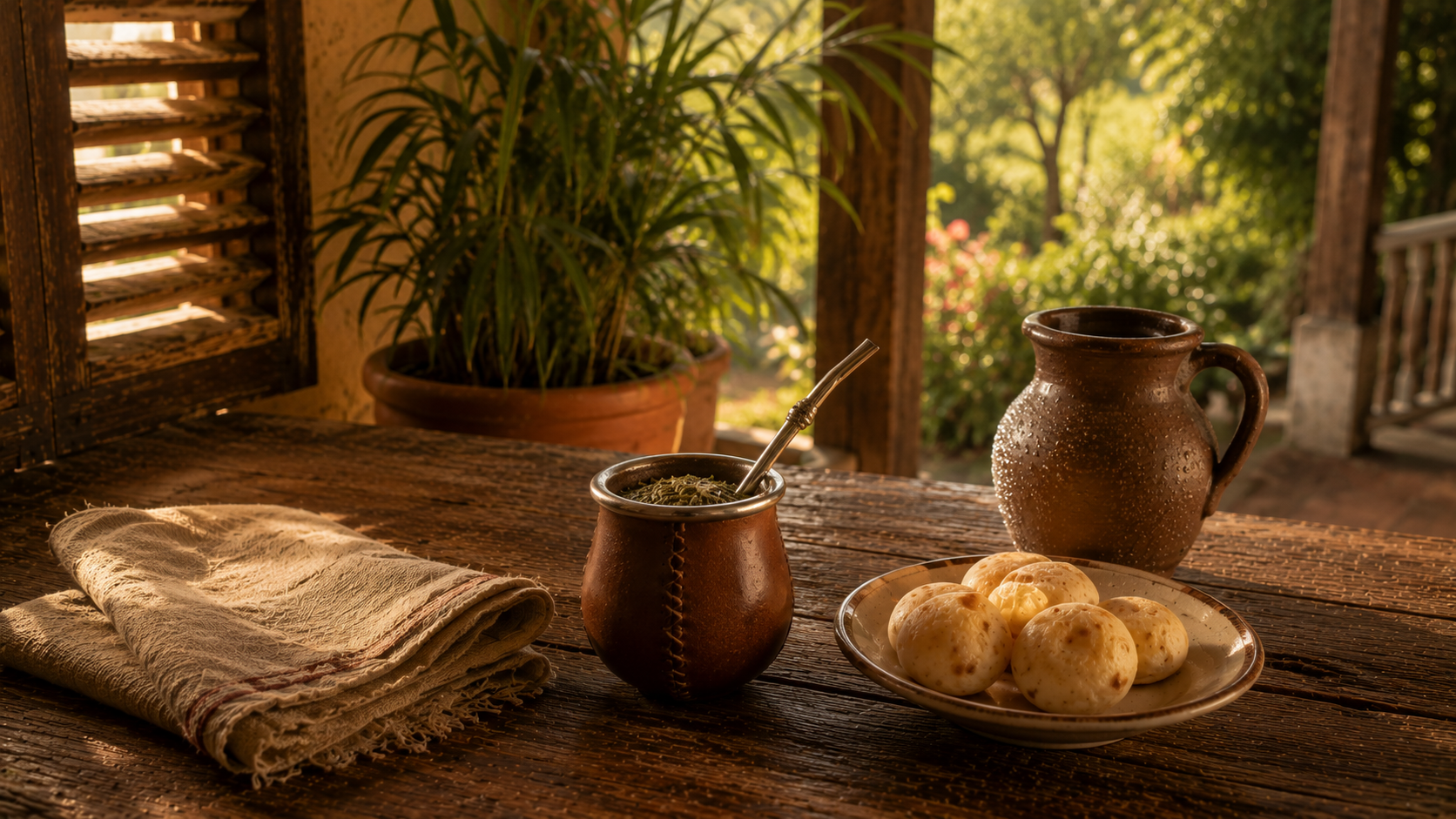
The tereré culture. The cold mate drink tereré is central to Paraguayan social life. Sharing tereré — circulating a guampa (gourd cup) with a bombilla (straw) around a group — is a fundamental social ritual. The pragmatic norms around tereré — when to share, how to participate, how to decline politely — are part of Paraguayan social competence. Tereré is drunk throughout the day in social contexts, in workplaces, in homes, and in public spaces.
The cultural quietude. Paraguayan pragmatic norms tend toward what some observers describe as a quieter, more measured social register than the Argentine or Brazilian patterns. The expressiveness is present but operates differently — through warmth and substance rather than through volume or rapid turn-taking.
8. Regional Variation Within Paraguay
Paraguay has internal regional variation:
8.1 — Asunción and the Central Region
The Spanish of Asunción, the capital, and the surrounding central region (including the departments of Central, Cordillera, and parts of Paraguarí) is the dominant variety in national media and the implicit standard. The capital variety carries cultural-political prestige and represents the variety most international observers encounter.
8.2 — The Eastern Region (Alto Paraná, Itapúa, Canindeyú)
The eastern region, particularly along the Brazilian border, has features shaped by contact with Brazilian Portuguese. Ciudad del Este, the major eastern city, has real trilingual contexts (Spanish, Guaraní, Portuguese, with some English in commercial contexts). The bilingual reality includes Portuguese contact for many residents.
8.3 — The Southern Region (Itapúa, Misiones, Ñeembucú)
The southern region, with the historical Jesuit mission territories and considerable agricultural development, has its own regional features. The Itapúa department has sustained Brazilian-Paraguayan border contact and German-Brazilian immigration history.
8.4 — The Chaco
The Chaco region (Boquerón, Alto Paraguay, Presidente Hayes) represents Paraguay's western half — sparsely populated, geographically distinct (semi-arid scrubland), and culturally multilingual with the Mennonite communities, indigenous communities, and small Paraguayan populations of Spanish and Guaraní speakers.
8.5 — Rural-Urban Variation
Throughout Paraguay, rural-urban variation is real. Rural Paraguayan Spanish often shows more Guaraní influence and more conservative features. Urban Asunción Spanish has been more influenced by international media and by Argentine Spanish contact.
9. The Cultural Register
Paraguay has produced significant cultural work in literature and music, though with smaller international recognition than larger Latin American countries.
9.1 — Literature
Augusto Roa Bastos (1917-2005), the most internationally recognized Paraguayan writer, winner of the Cervantes Prize (1989) and author of Yo el Supremo (1974), one of the great Latin American novels of the twentieth century. Roa Bastos wrote much of his major work in exile during the Stroessner dictatorship. His novels engage with Paraguayan history, the bilingual reality, and the political situation in ways that have made him one of the foundational writers of Latin American literature.
Josefina Plá (1903-1999), the foundational mid-twentieth-century Paraguayan writer working in poetry, fiction, drama, and visual arts. A Spanish-born writer who lived in Paraguay for most of her adult life, Plá shaped Paraguayan literary modernism.
Gabriel Casaccia (1907-1980), important Paraguayan novelist.
Hérib Campos Cervera (1905-1953), important early-twentieth-century poet.
Elvio Romero (1926-2004), notable twentieth-century poet.
Susy Delgado (born 1949), important contemporary writer working in both Spanish and Guaraní.
Renée Ferrer (born 1944), contemporary poet and novelist.
Néstor Amarilla, Esteban Cabañas, Luisa Moreno de Gabaglio and other contemporary Paraguayan writers continue the literary tradition.
The Guaraní literary tradition alongside the Spanish literary tradition represents a real cultural feature. Writers like Susy Delgado have worked in both languages, and the Guaraní literary tradition has its own particular history and contemporary practice.
9.2 — Music
Música paraguaya — the traditional Paraguayan musical tradition centered on the harp (the Paraguayan harp is internationally recognized), the guitar, and characteristic forms including the polka paraguaya, guarania (a slower, more melancholic form), and galopa. Songs are often in Guaraní, sometimes in Spanish, sometimes in jopará.
José Asunción Flores (1904-1972), the composer who created the guarania musical form, one of the foundational figures of Paraguayan music.
Luis Alberto del Paraná (1926-1974), important twentieth-century Paraguayan singer.
Other Paraguayan musical figures including Demetrio Ortiz, Agustín Barboza, and contemporary musicians continuing the tradition.
9.3 — Cinema and Other Arts
Paraguayan cinema has had a smaller international profile than music or literature, but recent productions have reached international festival audiences. Visual arts have produced significant figures including Carlos Colombino (1937-2013).
9.4 — Cultural Themes
Paraguayan cultural identity has been shaped by:
- The unique bilingual Spanish-Guaraní reality
- The Jesuit mission period and its enduring cultural influence
- The catastrophic War of the Triple Alliance and the demographic-cultural trauma
- The Chaco War with Bolivia (1932-1935) and its national-identity significance
- The long Stroessner dictatorship (1954-1989) and its complex cultural legacy
- The 1989 democratic transition and contemporary political development
- The traditional cattle-ranching and agricultural economy and the contemporary economic patterns including extensive soybean production
- The Paraguayan diaspora to Argentina, Spain, and other countries, particularly during the dictatorship period and economic crises
- The Mennonite German-speaking dimension and other multilingual realities
10. For the Learner
A few practical paths into Paraguayan Spanish:
Master voseo as the foundation. The pronoun system is the same as Argentine and Uruguayan voseo, with vos hablás, vos comés, vos vivís, vos sos. Learners who have studied Argentine Spanish have a strong head start on Paraguayan voseo.
Engage with the Guaraní dimension. Even without active Guaraní study, develop awareness of the bilingual context, recognize common Guaraní-origin vocabulary, and understand that jopará is the everyday register for many Paraguayans. The bilingual dimension is not optional for serious engagement with Paraguayan Spanish.
Consider basic Guaraní study. For learners with sustained Paraguay engagement, beginning Guaraní study is a significant additional commitment but transformative for the depth of cultural-linguistic engagement. Even basic Guaraní competence opens dimensions of Paraguayan culture that monolingual Spanish engagement does not reach.
Listen to Paraguayan music. The harp music tradition, the guarania form (with the iconic India by José Asunción Flores), and contemporary Paraguayan musicians provide exposure to Paraguayan Spanish and Guaraní in their musical-cultural contexts.
Read Roa Bastos. Yo el Supremo (1974) is one of the great Latin American novels, engaging with Paraguayan history and the bilingual reality in dense literary Spanish. Hijo de hombre (1960) is more accessible and equally rewarding.
Read contemporary Paraguayan writers. Susy Delgado, Renée Ferrer, and other contemporary writers provide accessible engagement with current Paraguayan Spanish.
Find a Paraguayan tutor. As discussed in the italki review, italki provides access to Paraguayan tutors. Paraguay is represented though less so than larger Latin American countries; finding tutors who can teach the bilingual context is particularly valuable.
Travel to Paraguay. Asunción provides exposure to the capital variety; the eastern region (Ciudad del Este, Encarnación) provides border-region varieties; the Chaco (with logistical preparation) provides exposure to the multilingual western context. Paraguay's tourism infrastructure is less developed than in some neighboring countries but is functional.
Drink tereré socially. The tereré tradition is so central to Paraguayan social life that participation in it is part of engaging with the culture. Learning to share tereré properly, to participate in the circulating gourd, to use the social rituals around it, is part of becoming culturally Paraguayan.
Be aware of the historical context. The War of the Triple Alliance, the Chaco War, the Stroessner dictatorship, and the contemporary political-economic situation shape contemporary Paraguay in ways that engaged understanding involves awareness of.
Approach the bilingualism with respect. Guaraní is not a substrate or a folkloric curiosity in Paraguay; it is a living official national language used by the great majority of the population. Engagement with Paraguay involves respect for Guaraní as a co-equal language with Spanish.
A Closing Note
Paraguayan Spanish, in its universal bilingualism with Guaraní, its mixed jopará register that combines the two languages in everyday speech, its Rioplatense voseo, its moderate phonology shaped by sustained Guaraní contact, its smaller Mennonite German-speaking dimension and indigenous Chaco languages, its cultural production from Augusto Roa Bastos to contemporary writers, its distinctive musical tradition centered on the harp and the guarania, and its complex historical context — is one of the most linguistically distinctive countries in the Spanish-speaking world.
The bilingual situation alone makes Paraguay worth real attention. The country represents the most complete realization of indigenous-Spanish bilingualism in Latin America, with constitutional equality between the two languages and universal bilingual practice across social classes. No other Latin American country approaches this situation. The fact that Paraguay has maintained this bilingual character across centuries — through colonization, through devastating wars, through dictatorship, into the contemporary moment — represents a remarkable cultural-historical achievement that distinguishes the country from any other in the Americas.
Beyond the bilingualism, Paraguayan Spanish offers engagement with a country whose smaller international profile relative to its linguistic and cultural richness is largely a function of geographic position, demographic size, and the accidents of which Latin American cultures have achieved global visibility. The depth is there for learners who commit to engaging with it.
For a learner, Paraguayan Spanish offers exceptional engagement with bilingual reality, with a distinctive cultural-historical tradition, and with a contemporary moment that continues to develop the country's bilingual-multilingual identity. The investment in learning Paraguayan Spanish provides access to a country whose linguistic situation is unique in the Americas and whose cultural depth deserves more international recognition than it has typically received.