Latin American Spanish Is Not One Language
There is a convenient fiction at the center of most Spanish instruction: that Latin American Spanish is one language, learnable from one book, understood the same way everywhere. It is a beautiful idea. It is also not quite true.

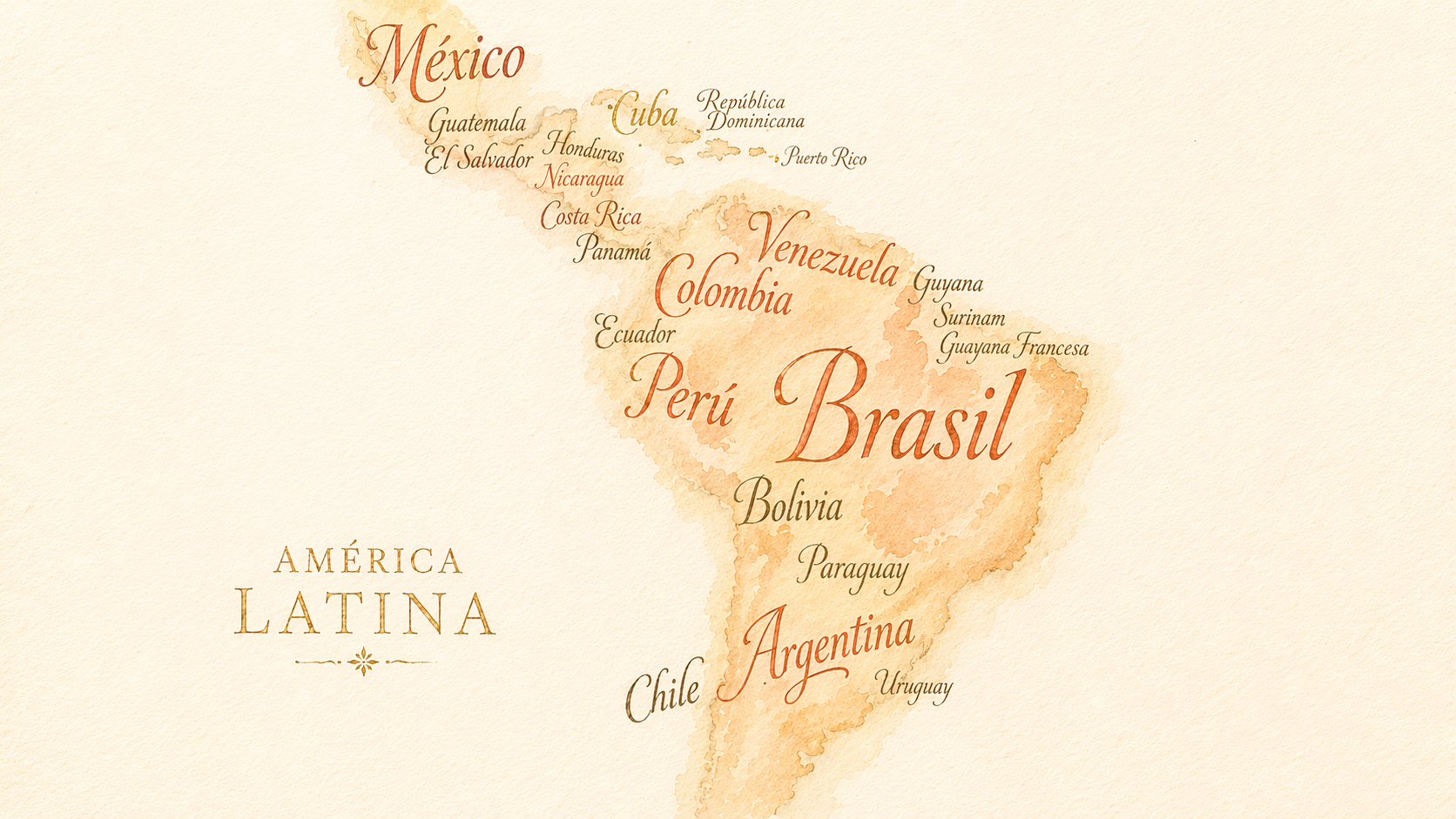
There is a convenient fiction at the center of most Spanish instruction in the English-speaking world. It goes like this: somewhere between the Mexican border and the tip of Patagonia, there exists a language called Latin American Spanish — a single tongue, relatively stable, more or less the same from one country to the next, distinguishable from the Spanish of Spain by a handful of well-known differences but otherwise unified. Learn it, the fiction implies, and you will be understood from Tijuana to Tierra del Fuego.
It is a beautiful idea. It is also not quite true.
What exists, in fact, is twenty nations, hundreds of regional varieties, and a linguistic landscape of such extraordinary range that speakers from opposite ends of it — a Cuban from Santiago, say, and a Bolivian from the Altiplano — can sometimes understand each other only with careful attention, as though speaking to one another across a long distance. Both are speaking Spanish. Both are fluent native speakers. And yet the gap between what each of them is saying, and how each is saying it, is wider than most language courses prepare you for.
This is the first thing to know about Latin American Spanish. It is also the thing that almost no one tells you before you begin.
Consider a small example. The word for a small child. In Mexico, niño. In Argentina, pibe. In Chile, cabro chico. In Cuba, chama. In Venezuela, chamo. In Peru, chibolo. All of these are correct. None of them is the right one. A Spanish course that teaches you niño has taught you a word that will be understood everywhere — though one that will sound, to an Argentine or a Cuban, faintly unfamiliar. Not wrong, exactly. Just not quite from here.
Or the word for a bus. In Mexico, depending on the region, camión or autobús. In Argentina, colectivo. In Cuba, guagua — a word that, in Chile, means something entirely different (guagua means baby). In Peru, micro. In Puerto Rico, guagua again, cousin of the Cuban usage but cousin rather than twin. None of these is wrong. All of them are Spanish. A traveler who knows one of them will step off the plane in any of the others and discover that the most ordinary words of daily life are not the words they learned.
Or the form of address used to speak informally to a single person. In Mexico and much of the Caribbean and the Andes, tú. But in Argentina, Uruguay, Paraguay, most of Central America, and regions of Colombia, Ecuador, and Chile, vos — with its own distinct verb conjugation. Tú hablas becomes vos hablás. An entire verb paradigm, used by more than forty million people every day, that most Spanish classes in the English-speaking world quietly pass over.
These are not eccentricities at the edges of the language. They are the language, as actually spoken, by hundreds of millions of people. The textbook version of Latin American Spanish — the version where everyone uses tú and calls children niños and takes the autobús to work — is a useful simplification for beginners, and an incomplete guide once you step into the real world.
The reason for all this variety is not mysterious. It is history.
Latin American Spanish is the result of a meeting, over five centuries, between the Spanish of the Iberian Peninsula and the civilizations of the Americas — and, crucially, between Spanish and the African languages brought across the Atlantic during three centuries of the slave trade. Each region of what we now call Latin America received a somewhat different mixture of these influences, and each region's Spanish developed, over centuries, along its own trajectory.
In Mexico, Spanish settled into a land whose dominant indigenous language was Nahuatl, the language of the Aztecs. Thousands of Nahuatl words flowed into Mexican Spanish and then outward into global Spanish and beyond. Tomate, chocolate, aguacate, chile, coyote — all Nahuatl. Mexican Spanish carries this inheritance in every sentence.
In the Andes, Spanish encountered Quechua, the language of the Inca. Andean Spanish — spoken in Peru, Ecuador, Bolivia, and parts of Colombia and Chile — is shaped by centuries of contact with Quechua to a degree that affects not only vocabulary but grammar. The unusual Andean use of the pluperfect tense, the characteristic sentence rhythm, the bilingual reality of millions of speakers — all of this is the product of the meeting between two great languages across five hundred years.
In the Caribbean — Cuba, the Dominican Republic, Puerto Rico, coastal Venezuela, coastal Colombia — Spanish was shaped by a different convergence. The islands received millions of Africans through the slave trade, speakers of Yoruba, Kikongo, Fon, and dozens of other West and Central African languages. The influence on Caribbean Spanish is real and profound. It shows up in vocabulary — mambo, conga, bemba, ñame, marimba — and, some linguists argue, in the distinctive phonology of the region: the softening of consonants, the disappearing final s, the musical rhythm that makes Cuban Spanish, to an outside ear, sound almost sung.
In Argentina and Uruguay, the meeting was different again. The indigenous populations of the Río de la Plata region were smaller and, tragically, more fully displaced. But in the late nineteenth and early twentieth centuries, massive Italian immigration reshaped the Spanish of Buenos Aires and Montevideo — giving it the Italian-inflected intonation that visitors immediately notice, and giving it lunfardo, the rich layer of Italian-origin slang that permeates Rioplatense Spanish.
Each of these regional histories produced a different Spanish. Different varieties of the same language, each shaped by its own five centuries of life — in the way that the English of Dublin is different from the English of Alabama, or the French of Quebec is different from the French of Marseille.
What does all this mean for the learner?
It means that the question worth asking, before any other question, is not How do I learn Latin American Spanish but Which Latin American Spanish do I want to learn.
This is a question conventional Spanish instruction does not often ask. Most textbooks, most courses, most apps will offer you a lightly pan-regional Spanish — usually based on Mexican or Colombian varieties, because these are the most commonly heard in international media — and will generally set aside the features that are specific to particular places. You will finish the course with a useful foundation, and you may be surprised, on your first trip to Buenos Aires or Havana or Santiago, at how much of the conversation around you you cannot immediately follow.
The foundation you built is not the problem. The foundation is exactly right as a place to begin. What is worth understanding, from the start, is that the foundation is a foundation — not the whole of the language, not a portable key that opens every Spanish-speaking door with equal ease.
Your destination, sooner or later, is a specific variety. Mexican Spanish, if your interests draw you to Mexican music and film and literature, or to the Mexican-American communities of the United States. Cuban or Caribbean Spanish, if the Caribbean is where your heart sits. Rioplatense, if you are pulled toward the tango and toward Borges and toward Buenos Aires. Andean Spanish, if you are moving to Peru or Ecuador or Bolivia. Chilean Spanish, if you are among the brave.
You do not have to choose forever. Most serious learners eventually develop a good ear for many varieties and speak most comfortably in one. But the choice of where to begin matters — because the music you listen to, the films you watch, the books you read, the tutors you hire, and the conversations you have will all be shaped by it.
This site is built on the premise that the regional variety of Latin American Spanish is not a complication to be glossed over in the beginner's course and picked up later, somehow, on your own. It is the most interesting thing about the language, and the sooner you orient yourself to the fact that you are entering a continent of languages rather than a single language, the richer every subsequent year of your learning will be.
If you are beginning your own journey into Latin American Spanish, or are somewhere along it and have started to sense how much of the language lives beyond what a textbook can hold — this site is for you. The Guides section and the Country Profile series are the places to begin.
Latin American Spanish is not one language. It is twenty nations, hundreds of varieties, five centuries of extraordinary history — and one of the most remarkable linguistic landscapes in the modern world.