Uruguayan Spanish: A Learner's Guide
Uruguayan Spanish is Rioplatense in its core features (universal voseo, the sh-sound for ll and y, Italian-influenced intonation) but with its own distinctive character. The country of 3.4 million people has produced an outsized literary tradition and the candombe musical heritage.

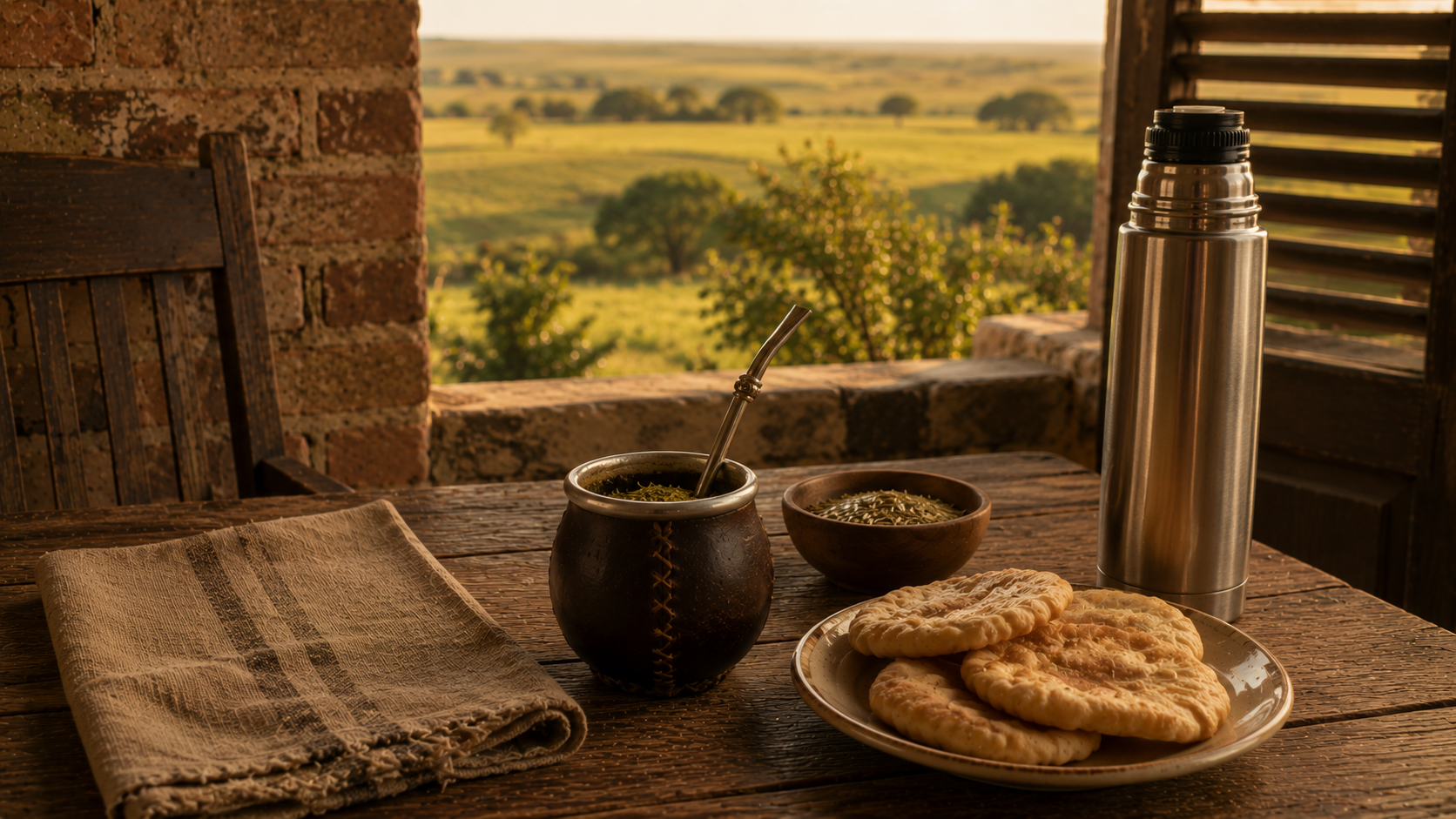
A reference on the Spanish of Uruguay — the Rioplatense variety shared with Argentina in its core features but with its own distinctive character; the universal voseo and the sh-sound for ll and y that mark both varieties of the Río de la Plata; the deep Italian and other European immigrant inheritance; the Afro-Uruguayan and candombe tradition centered on Montevideo; the fronterizo Spanish-Portuguese contact variety of the Brazilian border; the small but disproportionately rich literary tradition that produced Benedetti, Onetti, Galeano, and others; the secular democratic identity that has distinguished Uruguay culturally from its neighbors; the mate culture that is perhaps the most central in any Spanish-speaking country; and the political-historical context that has shaped contemporary Uruguay including the dictatorship period and the contemporary progressive social reforms.
The Río de la Plata, Shared and Distinct
A learner who has studied Argentine Spanish — who has internalized voseo, who has learned to pronounce ll and y with the distinctive sh sound, who has acquired the Italian-influenced intonation, who has absorbed che and boludo and the broader Buenos Aires vocabulary — and who then crosses the Río de la Plata to Montevideo will find a Spanish that is nearly identical in its core features and distinctively different in its overall character. The two cities, separated by the wide river estuary that gives the region its name, share the same fundamental Spanish — the Rioplatense variety. The voseo is the same. The sh sound is the same. The Italian inheritance is the same. The general vocabulary is largely shared.
And yet Uruguayans will tell you, immediately and emphatically, that their Spanish is not Argentine. They will point to small differences in intonation, in vocabulary, in pragmatic register. They will note that Uruguayans speak with what they consider a more measured, less theatrical pace than Buenos Aires speakers. They will mention specific Uruguayan words that do not appear in Argentine usage. They will identify themselves as Uruguayan within seconds of speaking to other Latin Americans, who will typically recognize the distinction. The differences are real if subtle, and they matter — both linguistically and culturally — to the people who navigate them.
This double reality — real shared features with Argentine Spanish, genuine distinctness as a Uruguayan variety — is the central editorial situation of any treatment of Uruguayan Spanish. The variety must be understood within the broader Rioplatense cluster (which includes Buenos Aires, Montevideo, and the surrounding regions of both countries) while also being treated as a distinct national variety with its own character, history, and cultural production. This guide attempts both — acknowledging the family resemblance with Argentine Spanish (which is treated in detail in the Argentine profile) while substantively addressing what makes Uruguayan Spanish distinctively Uruguayan.
Uruguay is a small country in population — approximately 3.4 million people, the second-smallest population among Spanish-speaking South American countries (only Suriname is smaller, though Suriname is not Spanish-speaking). The territory is roughly the size of Washington State or England. The capital, Montevideo, contains nearly half the national population. The country is mostly flat, grassy plains and gentle hills, with a cattle-ranching and agricultural economy historically and increasingly diversified contemporary economy. The political tradition is one of the longest democratic continuities in Latin America (interrupted by the 1973-1985 military dictatorship). The cultural tradition is rich, with the small population having produced literature, music, and cultural production disproportionate to its size.
This guide treats Uruguayan Spanish as the family of varieties it actually is — primarily the Rioplatense Montevidean variety that dominates national life, with attention to the fronterizo Spanish-Portuguese contact variety of the Brazilian border, to the Afro-Uruguayan cultural-linguistic contributions, and to the broader regional and class variations within the country. The profile is centered on Montevideo as the cultural-political center while honoring the diversity of regional and demographic variation within Uruguay.
A note on scope. Uruguayan Spanish in this guide refers primarily to the Spanish spoken in Uruguay, with attention to the major variations — the Montevidean variety (the dominant variety nationally), the interior departmental varieties, the fronterizo border variety with Brazilian Portuguese, and the cultural-linguistic contributions of Afro-Uruguayan communities. The relationship with Argentine Spanish is acknowledged throughout, with the Argentine profile providing extensive treatment of Rioplatense features that this profile assumes familiarity with.
1. The Pronoun System: Universal Voseo with Some Tuteo Survival
Uruguayan Spanish uses voseo as the standard informal second-person singular pronoun, like Argentine and Paraguayan Spanish. Vos is universal across most of Uruguay. The pattern aligns Uruguay with the broader Rioplatense voseo cluster.
The systematic treatment of voseo is in The Voseo Guide. What follows is the Uruguayan-specific picture.
1.1 — The Standard Uruguayan Voseo
The pronoun. Vos replaces tú as the informal second-person singular pronoun in most of Uruguay. The pattern is shared with Argentine and Paraguayan Spanish.
The verb forms. Uruguayan voseo follows the standard Rioplatense pattern: vos hablás, vos comés, vos vivís, vos sos. Final-syllable stress in present indicative. The forms are essentially identical to Argentine voseo.
The imperative. Uruguayan voseo imperatives follow the standard pattern: hablá, comé, viví, andá, sé, hacé, poné, salí, vení, decí.
The subjunctive. Uruguayan voseo typically uses the tuteo subjunctive (que vos hables), aligning with Argentine usage. The voseo subjunctive (que vos hablés) appears in some informal speech but is less standardized.
1.2 — The Distinctive Uruguayan Pattern: Voseo Verb Forms with Tuteo Pronoun
One of the most distinctive features of Uruguayan Spanish, distinguishing it from Argentine voseo, is the partial survival of tú as a pronoun used with voseo verb forms in some contexts. This produces a pattern where speakers say tú hablás, tú tenés, tú podés — using the tú pronoun with the voseo verb conjugation, rather than either the full tuteo pattern (tú hablas) or the full voseo pattern (vos hablás).
This tú + voseo verb pattern is one of the markers that distinguishes Uruguayan Spanish from Argentine Spanish. It appears most prominently in:
- Some formal-but-informal contexts (where the speaker wants warmth without the casual register of vos)
- Some educated registers
- Some regional varieties
- Some speakers who consciously or unconsciously avoid vos for various reasons
The pattern is not universal across Uruguay. Many Uruguayans use vos exclusively, as in Argentine Spanish. But the tú + voseo verb pattern is recognizable enough as Uruguayan that it functions as one of the markers of Uruguayan identity in linguistic context.
For learners, the practical implication is that hearing tú podés (with the voseo verb form) is more likely Uruguayan than Argentine, and the pattern is part of the subtle distinctness of Uruguayan Rioplatense Spanish.
1.3 — Usted in Uruguay
Usted functions in Uruguay in the standard formal sense — used with elders, in professional contexts, with strangers, with hierarchical superiors. The formal/informal binary holds.
Uruguay does not have intimate ustedeo as discussed in The Ustedeo Guide. Usted operates as the textbook formal pronoun.
1.4 — Practical Consequences for the Learner
A learner of Uruguayan Spanish should master voseo as the informal pronoun (the same forms as Argentine voseo) and use usted in formal contexts as the textbook describes. Awareness of the tú + voseo verb pattern as a Uruguayan-distinctive feature is useful, and recognition that voseo is universal enough that tú + tuteo verb conjugations (the textbook tú hablas) will sound foreign rounds out the practical picture.
2. The Sound of Uruguay
Uruguayan phonology shares core features with Argentine Spanish but has its own particular character. The systematic treatment of regional phonological patterns is in A Pronunciation Guide to Latin American Spanish. What follows is the Uruguayan-specific picture.
2.1 — The Shared Rioplatense Features
The sh sound for ll and y. Uruguayan Spanish, like Buenos Aires Spanish, pronounces ll and y with the distinctive sound that resembles the English sh in show or the French j in jour. Llamo sounds close to shamo. Yo sounds close to sho. Pollo sounds close to posho. This sound is shared across the Río de la Plata.
Within Uruguay, there is some variation. The standard Montevidean realization is the sh sound (technically called zheísmo or sheísmo). Some interior regions and some social registers use a less voiced version, closer to a zh (like the French j in jour) or to a y (like in other Latin American varieties).
Generally preserved s. Like Argentine Spanish, Uruguayan Spanish preserves the s in most positions in careful speech, with some weakening in casual speech but typically less aggressive reduction than in Caribbean varieties.
Stable consonants. Final and intervocalic consonants are generally preserved.
The Italian-influenced intonation. Uruguayan Spanish, like Argentine Spanish, has been shaped by large Italian immigration during the late nineteenth and early twentieth centuries. The melodic intonation pattern of Uruguayan Spanish carries Italian influence in its rise-and-fall quality. The pattern shares the broader Rioplatense melodic profile.
2.2 — The Subtle Distinctions from Argentine Spanish
The Uruguayan phonological pattern is distinct from Argentine in several subtle respects:
A more measured speech rate. Uruguayan Spanish is often described — by Uruguayans, by Argentines, by visitors — as slightly more measured in pace than Buenos Aires Spanish. The difference is subtle but real to listeners familiar with both varieties.
Slightly different intonation contours. The Italian-influenced melodic patterns are shared, but the specific intonation contours differ. Uruguayan speech is sometimes described as having a slightly less theatrical quality than Buenos Aires speech, though this is partly a stereotype and partly a real pragmatic difference.
Some regional pronunciation differences. Interior Uruguayan Spanish (the countryside, the smaller cities) has features that differ from Montevidean Spanish, including some patterns shared with Argentine Litoraleño or Cordobés varieties.
2.3 — The Fronterizo Region
The Spanish of the Uruguayan-Brazilian border region — particularly around Rivera (across the border from the Brazilian city of Santana do Livramento) and other border communities — has been deeply shaped by sustained Portuguese contact. The variety, sometimes called fronterizo or portuñol, is a Spanish-Portuguese contact register that operates in border communities where bilingualism is the norm.
This is discussed in detail in Section 5.
2.4 — Speech Rate
Uruguayan Spanish moves at a moderate pace, similar to Argentine Spanish though sometimes perceived as slightly slower. The pace is comfortable for learners coming from most Latin American varieties.
3. The Italian and European Immigrant Inheritance
Uruguay, like Argentina, was shaped by large European immigration during the late nineteenth and early twentieth centuries. The Italian inheritance has been particularly significant, with Italian immigration in some periods exceeding Spanish immigration in absolute numbers.
3.1 — The Italian Inheritance
Italian immigrants to Uruguay came primarily from Northern Italy (Piedmont, Lombardy, Liguria) and from Southern Italy (especially Campania, Calabria, Sicily). They settled throughout Uruguay, with sizeable concentration in Montevideo. The Italian influence on Uruguayan Spanish, society, and culture has been profound:
Lexical influence. Italian-derived vocabulary in Uruguayan Spanish includes:
- Boludo / boluda — used as in Argentine Spanish for "idiot" but with affectionate register in casual peer contexts (from Italian bolada or related)
- Bondi — bus (from Lunfardo, with possible Italian-Portuguese mixed origin)
- Laburar — to work (from Italian lavorare)
- Laburo — work, job
- Bochinche — noise, commotion
- Pibe / piba — kid, young person
- Mango — money (in colloquial sense)
- Plata — money (broader Latin American usage)
- Fiaca — laziness (from Italian fiacca)
- Birra — beer
- Chau — goodbye (from Italian ciao)
Phonological influence. The intonation patterns, as discussed in Section 2, carry Italian influence.
Cultural inheritance. The large Italian-Uruguayan population has shaped cuisine, family structures, sports culture, and broader cultural patterns. Italian surnames are extremely common in Uruguay, as in Argentina.
3.2 — Other European Inheritance
Spanish immigration (particularly from northern Spain and Galicia) was also sizeable. Other European immigrant communities — French, German, Eastern European, Jewish — contributed smaller but real influences. The Russian Old Believers in some Uruguayan agricultural communities, the German-Swiss Mennonites in some agricultural areas, and other smaller immigrant groups have added to Uruguayan demographic diversity.
The European-immigrant character of Uruguayan society is one of the features that distinguishes Uruguay (like Argentina) from countries with larger indigenous populations or African inheritances. This is sometimes celebrated and sometimes critiqued as the basis of a national identity that has minimized the indigenous and African presences in the country's history.
4. The Afro-Uruguayan Inheritance and Candombe
Uruguay has an Afro-Uruguayan population, primarily concentrated in Montevideo, with significant cultural contributions disproportionate to demographic size. The Afro-Uruguayan tradition has been historically marginalized in some Uruguayan official narratives but has become increasingly central to contemporary cultural identity.
4.1 — Historical Background
African slaves were brought to colonial Uruguay (then part of the Spanish Viceroyalty of the Río de la Plata) during the colonial period, particularly the eighteenth and early nineteenth centuries. The Afro-Uruguayan population was concentrated in Montevideo. After the formal abolition of slavery in Uruguay (1842, with full implementation later), the Afro-Uruguayan community continued in Montevideo and surrounding areas.
The Afro-Uruguayan population today is estimated at approximately 8-10% of the Uruguayan population, with concentration in Montevideo neighborhoods historically associated with the community (Barrio Sur, Palermo, Reus Sur).
4.2 — Candombe
The candombe musical-cultural tradition is the most internationally recognized Afro-Uruguayan contribution. Candombe is a drum-based musical tradition with deep African roots, developed in Montevideo over centuries through the Afro-Uruguayan communities. The candombe ensemble (comparsa) features three types of drums — the chico, the repique, and the piano (the term referring to the drum, not the instrument we usually call piano) — playing in interlocking rhythmic patterns.
Candombe is celebrated in particular at the Llamadas parade during Carnival in Montevideo, when comparsas from various Montevidean neighborhoods march through traditional Afro-Uruguayan neighborhoods playing drums. The Llamadas is one of the most distinctive cultural events in Uruguay and one of the most recognizable Afro-Uruguayan cultural traditions in the world.
In 2009, candombe was inscribed in the UNESCO Representative List of the Intangible Cultural Heritage of Humanity, recognizing its cultural significance.
4.3 — The Linguistic Contributions
Afro-Uruguayan linguistic contributions to Uruguayan Spanish include vocabulary related to candombe and the broader cultural tradition:
- Tambor (drum) and various drum-related terminology
- Comparsa (the candombe ensemble)
- Llamadas (the carnival parade)
- Tablado (the temporary stage for carnival performances)
- Murga (a related but distinct carnival musical tradition with both African and European roots)
- Various other carnival-related vocabulary
The Afro-Uruguayan contribution to broader Uruguayan vocabulary is smaller than the Afro-Cuban contribution to Cuban Spanish, but it is real.
4.4 — Contemporary Recognition
In contemporary Uruguay, the Afro-Uruguayan community has gained real public recognition, with cultural celebration of candombe and broader engagement with Afro-Uruguayan history and contemporary reality. The cultural marginalization that characterized earlier periods has shifted, though structural inequalities and ongoing challenges remain.
5. The Fronterizo / Portuñol Region
A distinctive feature of Uruguayan linguistic geography is the fronterizo (or portuñol) Spanish-Portuguese contact variety spoken in northern Uruguayan communities along the Brazilian border. The variety is one of the most studied Spanish-Portuguese contact situations in the world.
5.1 — The Geographic Context
Uruguay shares a long land border with Brazil, running across the northern Uruguayan departments (Artigas, Rivera, Cerro Largo, Treinta y Tres, and the eastern part of Salto). The border is geographically open in many places — sometimes only a street separates a Uruguayan town from a Brazilian town, as in the case of Rivera (Uruguay) and Santana do Livramento (Brazil), which form essentially a single urban area divided by the international border.
This geographic openness has produced sustained, intimate contact between Spanish-speaking Uruguayans and Portuguese-speaking Brazilians for centuries. The contact has shaped local linguistic varieties on both sides of the border.
5.2 — The Linguistic Reality
The Spanish-Portuguese contact in the border region produces several types of linguistic outcomes:
Bilingualism. Many residents of the Uruguayan border departments speak both Spanish and Portuguese with varying degrees of proficiency. The bilingualism is everyday, not exotic.
Code-switching. Speakers move between Spanish and Portuguese within conversations and within sentences, with patterns governed by topic, interlocutor, and pragmatic context.
Fronterizo / Portuñol / DPU (Dialects of Portuguese in Uruguay). A distinctive contact variety has developed, particularly in some communities, with features blending Spanish and Portuguese morphology, vocabulary, and syntax. This variety has been documented and studied extensively by linguists; it is variably called fronterizo, portuñol, or technical names like DPU (Dialectos Portugueses del Uruguay) depending on the analytical framework.
5.3 — The Cultural Status
The fronterizo variety has historically had ambiguous status. It has been:
- Stigmatized in formal Uruguayan educational contexts as deviating from "proper" Spanish or "proper" Portuguese
- Defended by some scholars and cultural activists as an authentic regional variety
- Studied extensively by linguists interested in language contact phenomena
- Used and maintained by border-region populations regardless of formal stigmatization
In recent decades, there has been some increased recognition of the variety as a legitimate regional speech form, though the formal status remains contested.
5.4 — Practical Consequences for the Learner
For most learners of Uruguayan Spanish, the fronterizo region is not a primary focus. The Montevidean Rioplatense variety is the dominant national variety and the practical target for most learners. But awareness of the fronterizo dimension is part of engaged understanding of Uruguayan linguistic geography, and a learner interested in northern Uruguay or in Spanish-Portuguese contact phenomena will find the region genuinely interesting.
6. Distinctive Uruguayan Vocabulary
Uruguayan Spanish has developed an extensive vocabulary that is recognizably Uruguayan, though much of it is shared with Argentine Spanish. The distinctively Uruguayan elements are subtle but real.
6.1 — Vocabulary Shared with Argentine Spanish
A large portion of Uruguayan vocabulary is shared with Argentine Rioplatense Spanish:
- Che — discourse marker for address
- Boludo / boluda — friend marker or insult depending on context
- Pibe / piba — kid, young person
- Laburar — to work
- Laburo — work, job
- Quilombo — mess, problem (vulgar in origin, used productively)
- Mango — money (in some colloquial contexts)
- Plata — money (standard)
- Bondi — bus
- Bárbaro — great, terrific
- Chabón / chabona — guy, dude (informal)
- Buenísimo — great (the same intensifier pattern)
- Birra — beer
- Chau — goodbye
These shared elements reflect the linguistic family resemblance with Argentine Spanish.
6.2 — Distinctively Uruguayan Vocabulary
Some vocabulary is more specifically Uruguayan or has particular Uruguayan resonance:
- Mate — the hot mate beverage, central to Uruguayan culture (also Argentine but particularly intense in Uruguay)
- Cebar mate — to prepare and serve mate in the social sharing tradition
- Yerba — the yerba mate plant; Uruguayan preferences differ from Argentine
- Bondi — bus (shared with Argentine but particularly common in Uruguay)
- Botija / botijita — kid (Uruguayan, less common in Argentina)
- Pichi — small (used affectionately in some Uruguayan contexts)
- Chajá — distinctive Uruguayan dessert (from the chajá bird)
- Asado — barbecue, central to social tradition
- Choto — vulgar term used in various senses (Uruguayan colloquial)
- Garrón — bad luck, drag (informal Uruguayan)
- Cinta — informal term used in various ways
- Pingo — horse (rural Uruguayan, from gaucho tradition)
- Estancia — large ranch (shared with Argentine usage)
- Gauchada — a favor, an act of kindness (from the gaucho tradition)
- Chamuyo — talk, conversation, sometimes flirty talk (Lunfardo, shared with Argentine)
6.3 — Mate Culture Vocabulary
The centrality of mate in Uruguayan culture produces extensive mate-related vocabulary:
- Mate — both the beverage and the gourd cup
- Bombilla — the metal straw for drinking mate
- Yerba mate — the leaves used
- Cebar — to prepare mate by adding hot water
- Cebador / cebadora — the person preparing and serving mate
- Lavado — "washed out" mate that has lost its flavor and needs new yerba
- Termo — thermos of hot water for mate
- Mate amargo — bitter mate (without sugar)
- Mate dulce — sweet mate (with sugar)
- Mate cocido — mate prepared as tea (rather than in a gourd)
- Mate cebado — properly prepared mate
- Tomar mate — to drink mate (often in social sharing context)
6.4 — Food Vocabulary
- Asado — barbecue, central Uruguayan culinary tradition
- Chivito — the iconic Uruguayan steak sandwich
- Milanesa — breaded meat cutlet (Italian origin)
- Dulce de leche — caramelized condensed milk (shared with Argentine)
- Alfajor — sandwich cookie filled with dulce de leche
- Tortas fritas — fried dough served traditionally on rainy days
- Bizcochitos — small pastries
- Mate and yerba mate
6.5 — Cultural-Political Vocabulary
The Uruguayan political-cultural tradition has produced some distinctive vocabulary:
- Frente Amplio — the broad-based progressive political coalition
- Pepe Mujica — President José Mujica (2010-2015), an internationally recognized figure
- Tupamaros — the historical urban guerrilla movement (1960s-1970s)
- Dictadura cívico-militar — the term commonly used for the 1973-1985 military government period
- Plebiscito — used for the various referendums that have shaped Uruguayan politics
- Charrúa — the indigenous people of pre-colonial Uruguay; the term is sometimes used in contemporary Uruguayan identity discourse
- Garra charrúa — "Charrúa grit," a phrase used for Uruguayan competitive spirit, particularly in soccer
7. The Diminutive in Uruguayan Spanish
As covered in The Diminutive in Latin American Spanish, Rioplatense varieties use diminutives at moderate frequency. Uruguayan Spanish uses diminutives at moderate frequency similar to Argentine usage.
The diminutive functions for affection and softening within the standard patterns. Mamita, papito, abuelita — affectionate diminutives in family contexts. Matecito, cafecito, ratito — diminutives in domestic and social contexts.
A characteristic Uruguayan usage is matecito, the diminutive form of mate, often used affectionately to refer to a session of mate sharing. Vamos a tomar unos matecitos (Let's have some mate) carries the casual social warmth that characterizes the mate tradition.
8. Pragmatics: The Uruguayan Style
Beyond grammar and vocabulary, Uruguayan Spanish has pragmatic features that distinguish it from neighboring varieties.
8.1 — Mate Culture as Pragmatic Foundation
The mate sharing tradition is fundamental to Uruguayan pragmatic norms in ways that no comparable practice exists in most other countries. Mate is shared communally — one gourd cup, one bombilla, passed around a group. The cebador (the person preparing the mate) refills the gourd and passes it to one person at a time; each drinker finishes their serving and passes back to the cebador. The process continues, often for extended periods, throughout social interactions.
The pragmatic norms around mate include:
- Knowing when to share mate (essentially all social contexts where time permits)
- Knowing how to drink properly (finish your portion, don't stir with the bombilla, return promptly)
- Knowing how to decline gracefully (say gracias — which in mate context means "no more for me, thanks")
- Understanding that mate is fundamentally social and that sharing it builds and maintains relationships
For learners, mastery of the mate tradition is part of mastery of Uruguayan social pragmatics.
8.2 — Measured Conversational Register
Uruguayan conversational register is often described as more measured than the Argentine pattern. The Italian-influenced expressiveness is present but typically operates at slightly lower volume and slightly less dramatic pacing than in Buenos Aires speech. This is partially stereotype and partially real, and the difference is recognized by speakers from both sides of the Río de la Plata.
8.3 — Self-Deprecating Humor
Uruguayan humor traditions include real self-deprecating elements — joking about Uruguay's small size, its position relative to larger neighbors, the country's particular cultural quirks. This self-deprecating tradition coexists with strong national pride, particularly in domains like soccer, music, and literature.
8.4 — Secular Social Norms
Uruguay has historically been one of the most secular societies in Latin America. Religious vocabulary and references are less present in everyday speech than in some other Latin American countries. The cultural-political tradition of secularism shapes pragmatic norms in subtle ways.
8.5 — Politeness and Warmth
Uruguayan speech maintains real politeness, with greetings extended through inquiries about family and well-being, with affectionate terms in social interactions, and with the general warmth of Rioplatense social culture.
8.6 — Greetings
Uruguayan greetings tend toward physical contact — kisses on the cheek between women and across genders in informal contexts, handshakes among men. The greeting kiss in Uruguay is typically a single kiss on the cheek (similar to Argentine practice), not the two-kiss Spanish practice or other variants.
9. Regional Variation Within Uruguay
Uruguay has internal regional variation, though less dramatic than in larger countries:
9.1 — Montevideo and the Metropolitan Area
The Spanish of Montevideo and the surrounding metropolitan area is the dominant variety, with all the Rioplatense features at their fullest. Montevidean Spanish carries the cultural-political prestige of the national capital and is the variety most international observers encounter.
9.2 — The Interior (Most of the Country)
The Spanish of the Uruguayan interior — the broad agricultural regions, the smaller cities (Salto, Paysandú, Maldonado, Tacuarembó, Melo, Treinta y Tres, and others) — shares core Rioplatense features with Montevidean Spanish but with some particular regional patterns. Interior Uruguayan Spanish is sometimes described as slightly more conservative in some features and as having some particular vocabulary related to the rural and gaucho tradition.
9.3 — The Northern Border Region (Fronterizo)
The northern departments (Artigas, Rivera, Cerro Largo, parts of Salto and Treinta y Tres) along the Brazilian border have the distinctive fronterizo variety discussed in Section 5. The border region is linguistically distinct from the rest of Uruguay.
9.4 — The Coastal Region (Maldonado, Rocha)
The coastal regions, with their established tourism economy (particularly around Punta del Este in Maldonado department), have some particular features shaped by the tourism context, including more frequent contact with Argentine, Brazilian, and international visitors.
9.5 — Rural-Urban Variation
Beyond regional variation, rural-urban variation is real. Rural Uruguayan Spanish — the speech of the gaucho tradition, the cattle-ranching culture, the agricultural communities — has some conservative features and particular vocabulary that differ from Montevidean urban speech.
10. The Cultural Register: A Disproportionate Tradition
Uruguay has produced an outsized literary and cultural tradition relative to its small population. The breadth and quality of Uruguayan twentieth- and twenty-first-century literature is real and remarkable.
10.1 — Literature
Juan Carlos Onetti (1909-1994), one of the great Latin American novelists of the twentieth century. His novels including La vida breve (1950), El astillero (1961), and Juntacadáveres (1964) created the fictional city of Santa María that became one of the iconic settings of Spanish-American literature. Onetti won the Cervantes Prize in 1980 and is among the most internationally recognized Uruguayan writers.
Mario Benedetti (1920-2009), perhaps the most widely read Uruguayan writer in the Spanish-speaking world. Benedetti's prolific output across novels, short stories, poetry, and essays — including La tregua (1960), Gracias por el fuego (1965), Inventario (collected poetry), and many others — has reached enormous audiences. His accessible style and engagement with everyday Uruguayan life and political-social themes have made him one of the most beloved writers in Latin American literature.
Eduardo Galeano (1940-2015), one of the most internationally influential Uruguayan writers. His Las venas abiertas de América Latina (1971), Memoria del fuego trilogy (1982-1986), and many other works have shaped Latin American political-cultural consciousness and reached global audiences.
Felisberto Hernández (1902-1964), one of the great experimental short-story writers in Latin American literature. His strange, dreamlike stories influenced subsequent generations of Latin American writers including Julio Cortázar and Italo Calvino.
Idea Vilariño (1920-2009), important twentieth-century poet, part of the Generación del 45 alongside Benedetti and others.
Mario Levrero (1940-2004), important novelist whose work has gained increased international recognition in recent years.
Cristina Peri Rossi (born 1941), Uruguayan-Spanish poet and novelist who has won the Cervantes Prize (2021).
Other major Uruguayan writers include Carlos Real de Azúa, Carlos Maggi, Juan Carlos Macedonio, Manuel Flores Mora, Sylvia Lago, Tomás de Mattos, Hugo Burel, Carmen Posadas, and many contemporary writers continuing the tradition.
The Uruguayan literary tradition is large enough that no short list can do it justice. The fact that a country of 3.4 million people has produced this much consequential literature is itself a feature of Uruguayan cultural identity.
10.2 — Music
Tango — Uruguay has real claims to tango as a shared Rioplatense musical tradition. Montevideo and Buenos Aires both contributed to the development of tango in the late nineteenth and early twentieth centuries. Major Uruguayan tango figures include Carlos Gardel (whose actual birthplace is contested between Uruguay, Argentina, and France) and many others.
Candombe — as discussed in Section 4, the Afro-Uruguayan drum-based tradition is one of the most distinctive Uruguayan musical contributions.
Murga — the carnival musical tradition with both African and European roots, performed by groups (murgas) during the long Uruguayan Carnival. Murga combines satirical lyrics with melodic music in distinctive Uruguayan style.
Música popular uruguaya — the broader popular music tradition includes figures like Alfredo Zitarrosa, Daniel Viglietti, Jaime Roos, Rubén Rada, and many others spanning folk, popular, and contemporary genres.
Contemporary popular music — Uruguayan musicians have worked across genres, with contemporary figures continuing to produce internationally recognized work.
10.3 — Cinema
Uruguayan cinema has produced significant work in recent decades, with films including Whisky (Juan Pablo Rebella and Pablo Stoll, 2004), 25 Watts (same directors, 2001), Una noche sin luna (2014), Una banda de chicas (2018), and others reaching international festival audiences.
10.4 — Cultural Themes
Uruguayan cultural identity has been shaped by:
- The Charrúa indigenous heritage (largely eliminated through colonization and the nineteenth-century campaigns, but with contemporary cultural recovery efforts)
- The Spanish colonial period and the founding of Montevideo (1726)
- Independence and the nineteenth-century struggles between Argentina and Brazil for influence
- The large late-nineteenth and early-twentieth-century European immigration
- The early twentieth-century progressive political reforms under José Batlle y Ordóñez
- The mid-twentieth-century period of relative stability and the gradual economic decline
- The military dictatorship (1973-1985) and its cultural-political consequences
- The democratic transition and the long Frente Amplio era beginning in 2005
- The pioneering progressive reforms of recent decades (legal cannabis 2013, same-sex marriage 2013, abortion legalization 2012)
- The Uruguayan diaspora, particularly during the dictatorship period
- The contemporary economic and cultural development
11. The Political-Historical Context
Uruguay's twentieth-century history has deeply shaped contemporary Uruguayan cultural and linguistic life.
11.1 — The Batllista Period
The early-twentieth-century reforms under President José Batlle y Ordóñez (in office 1903-1907 and 1911-1915) created one of the earliest welfare states in the Americas, with sweeping social legislation including eight-hour workday, women's suffrage (1932), divorce, and other progressive reforms. The Batllista tradition shaped Uruguayan political consciousness for decades.
11.2 — The Twentieth-Century Decline
Mid-twentieth-century Uruguay experienced relative economic decline as the cattle-and-agriculture-based economy faced challenges. The country went from one of Latin America's wealthiest to facing real economic difficulties by the 1960s.
11.3 — The Tupamaros and the Dictatorship
The Tupamaros (Movimiento de Liberación Nacional-Tupamaros) emerged in the 1960s as an urban guerrilla movement. The military increasingly assumed political control through the 1970s, culminating in the formal coup of 1973. The military government (1973-1985) was characterized by widespread torture, imprisonment of political opponents, and the disappearance of activists. A sizeable Uruguayan diaspora developed in this period, with many Uruguayans living in exile in Mexico, Spain, and other countries.
11.4 — The Democratic Transition
Democracy returned in 1985. The subsequent decades have included real political-cultural development:
Truth and reconciliation processes addressing the dictatorship-era abuses, with mixed outcomes.
Economic development including real recovery and growth.
The rise of the Frente Amplio — the progressive political coalition that came to power in 2005 with the election of Tabaré Vázquez and continued through José Mujica's presidency (2010-2015) and beyond.
Progressive social reforms including the 2012 abortion legalization, the 2013 same-sex marriage law, and the 2013 cannabis legalization (Uruguay was the first country in the world to fully legalize the production and sale of recreational cannabis).
The Mujica presidency brought wide international attention to Uruguay, with President José Mujica becoming internationally recognized for his austere lifestyle, his progressive politics, and his philosophical statements about politics and life.
11.5 — The Contemporary Moment
Contemporary Uruguay continues to navigate political-cultural developments, with various governments since the Frente Amplio era and ongoing engagement with regional and global challenges. The country has maintained real democratic stability and continues to be recognized internationally for its progressive social policies and democratic institutions.
12. For the Learner
A few practical paths into Uruguayan Spanish:
Master Rioplatense voseo as the foundation. If you have studied Argentine Spanish, you already have a strong foundation. Adapt to the slightly more measured pace and the subtle Uruguayan distinctions.
Develop awareness of the tú + voseo verb pattern. This is one of the distinctive Uruguayan features. Hearing tú podés or tú tenés is more Uruguayan than Argentine.
Engage with the mate culture. Master the social rituals of mate sharing. This is fundamental to Uruguayan social pragmatics. The cebar mate tradition, the proper way to drink, the proper way to decline — these are part of Uruguayan competence.
Read Uruguayan literature substantively. Onetti's La vida breve or El astillero for the deep literary tradition. Benedetti's La tregua for accessible engaging novel that captures mid-twentieth-century Uruguayan life. Galeano's Las venas abiertas de América Latina for political-historical-cultural engagement. Felisberto Hernández's strange short stories for the experimental tradition. The Uruguayan literary tradition is one of the great rewards of engaging with the country.
Listen to Uruguayan music. Tango (shared with Argentina), candombe (distinctively Uruguayan), murga (carnival tradition), and contemporary popular music figures including Alfredo Zitarrosa, Jaime Roos, Rubén Rada, and others.
Find a Uruguayan tutor. As discussed in the italki review, italki provides access to Uruguayan tutors. Uruguay is somewhat less represented than Argentina, but Uruguayan tutors are findable. A Uruguayan tutor specifically can help with the subtle distinctions from Argentine Spanish.
Watch Uruguayan films. Whisky, 25 Watts, and contemporary Uruguayan films provide listening practice and cultural engagement.
Travel to Uruguay. Montevideo provides the dominant variety; the interior provides regional variations; the northern border with Brazil provides exposure to the fronterizo region; the coastal areas (particularly Punta del Este) provide tourism contexts. Uruguay is geographically small enough that multi-region travel is feasible in a single trip.
Drink mate socially. Even in tutoring contexts, even with online study, engaging with the mate tradition as an actual social practice is part of engaging with Uruguay. The cultural centrality of mate is hard to overstate.
Understand the political-cultural context. Uruguay's twentieth-century history including the dictatorship, the contemporary progressive reforms, the Frente Amplio era, and the Mujica figure are part of contemporary Uruguayan identity. Engaged understanding involves awareness of this context.
Recognize the cultural disproportion. Uruguay's literary and cultural production is genuinely disproportionate to its small population. A learner who engages with Uruguayan literature, music, and cultural thought encounters far more substantive material than the small population would suggest.
Be patient with the subtle distinctions from Argentine Spanish. Most of Uruguayan Spanish is Rioplatense in the broader sense. The Uruguayan distinctness is real but subtle, and developing the ear for it takes time and exposure.
A Closing Note
Uruguayan Spanish, in its Rioplatense shared character with Argentine Spanish and its subtle but real Uruguayan distinctness, in its deep Italian and other European immigrant inheritance, in its Afro-Uruguayan candombe tradition that has been recognized as world cultural heritage, in its fronterizo Spanish-Portuguese contact variety of the Brazilian border, in its disproportionately rich literary tradition that produced Onetti, Benedetti, Galeano, Felisberto Hernández, and many others, in its mate culture that may be the most pragmatically central in any Spanish-speaking country, in its secular democratic political-cultural tradition and the contemporary progressive reforms that have positioned the country distinctively in Latin America, and in its modest national identity that combines self-deprecation with strong cultural pride — is one of the most distinctive and rewarding Spanish varieties to engage with.
The smaller international profile of Uruguay relative to its cultural-linguistic richness is largely a function of population size and geographic position rather than substance. The country contains a literary tradition that has shaped Spanish-language literature broadly, a musical tradition that has contributed to global culture through candombe and tango, a political tradition that has produced one of the longest democratic continuities in Latin America, and a contemporary moment that continues to develop in distinctive ways.
For a learner, Uruguayan Spanish offers engagement with a Spanish that is both broadly Rioplatense (and therefore accessible if Argentine Spanish has been studied) and distinctively Uruguayan in its subtle features. The investment provides access to a cultural tradition that is rich, to a society that is socially progressive and politically distinctive, and to a country whose small population contains depths that reward extended engagement.