Salvadoran Spanish: A Learner's Guide
Salvadoran Spanish is the language of a transnational country — a small Central American territory with universal voseo, a deep Pipil/Nahuat heritage, and one of the largest Spanish-speaking diasporas in the United States. With the cultural tradition of Roque Dalton and contemporary writers.

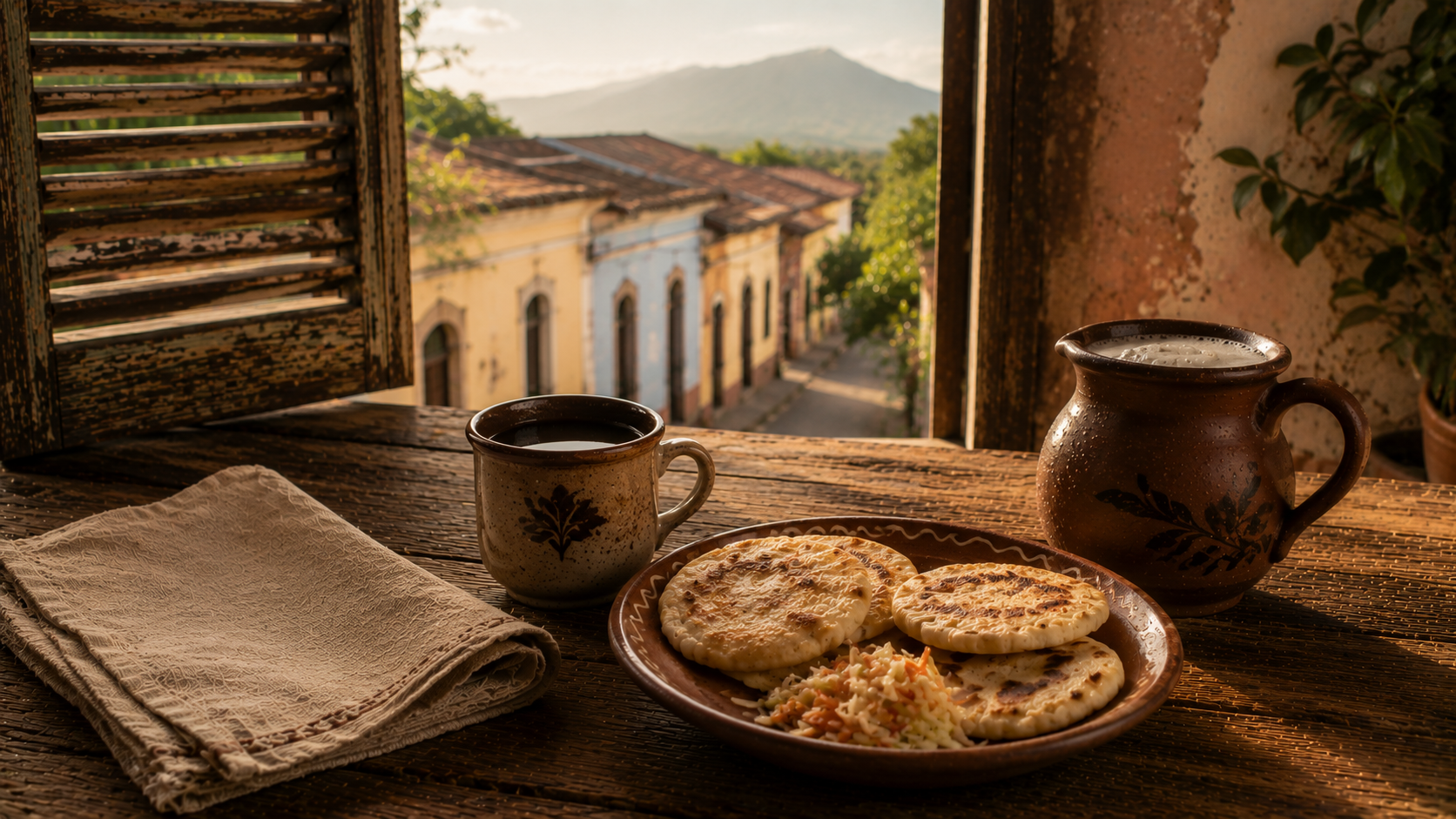
A reference on the Spanish of El Salvador — the most densely populated country in mainland Latin America with one of the smallest national territories; the universal voseo shared with neighboring Central American countries; the moderate phonology with some Caribbean-influenced features; the Nahuat (Pipil) cultural-linguistic inheritance, now severely endangered as a living language; the cultural register that has produced Roque Dalton, Manlio Argueta, and contemporary literary figures; the large diaspora to the United States that has produced one of the biggest Salvadoran-American communities in Los Angeles; the cultural-historical context shaped by the 1979-1992 civil war; the contemporary realities of gang violence and the political-cultural transformations of the Bukele era; and the strong cultural identity that has emerged from a country with a difficult recent history.
A Small Country with a Large Diaspora
A learner approaching Salvadoran Spanish encounters a country whose linguistic-cultural situation is shaped by contemporary realities that distinguish it from most Latin American national experiences. El Salvador occupies a small Central American territory — approximately 21,000 square kilometres, smaller than the U.S. state of New Jersey, the smallest mainland Latin American country. The population of approximately 6.3 million makes it the most densely populated country in mainland Latin America. The territory is geographically dominated by volcanic mountains, the Pacific coastline, and the central valleys. The country shares borders with Guatemala to the west and Honduras to the north and east.
But the largest Salvadoran linguistic-cultural community today does not live in El Salvador. Approximately 2.5 million people of Salvadoran origin live in the United States — a population that represents roughly forty per cent of the size of the in-country Salvadoran population. Los Angeles County alone contains the largest concentration of Salvadoran-Americans, with neighborhoods like Pico-Union historically associated with the community and a wide cultural infrastructure — restaurants, churches, cultural organizations, businesses — operating in Salvadoran Spanish. Smaller but significant Salvadoran-American communities exist in Washington D.C., Houston, Long Island, Boston, and many other U.S. cities. The country with one of the smallest in-country Latin American populations has one of the largest Spanish-language diasporas in the United States.
This diaspora reality fundamentally shapes contemporary Salvadoran Spanish. The migration patterns that produced it — particularly the wave triggered by the 1979-1992 civil war and subsequent waves driven by gang violence, economic conditions, and political instability — have linked Salvadoran Spanish in El Salvador to Salvadoran Spanish in the United States in ways that few other Spanish varieties experience. Money flows from the diaspora to the country; remittances are one of the largest sectors of the Salvadoran economy. Culture flows in both directions. Language develops in conversation between the two halves of the Salvadoran community. The U.S.-based community is not peripheral to Salvadoran Spanish; it is central to its contemporary form.
Beyond the diaspora, Salvadoran Spanish shares core features with neighboring Central American Spanish varieties — universal voseo, moderate phonology with preserved consonants, distinctive Central American vocabulary and pragmatic patterns. The country also has its own distinctive cultural-historical context: the Pipil (Nahuat) heritage that has shaped national identity even as the Nahuat language itself has become severely endangered, the difficult twentieth-century political-historical context including the civil war, the contemporary realities of gang violence and the Bukele-era political transformations, and the smaller but significant literary tradition that has produced figures like Roque Dalton and Manlio Argueta.
This guide treats Salvadoran Spanish in its full complexity — the in-country variety, the U.S. diaspora variety, the relationship between them, the historical-political context that has shaped both, and the contemporary realities of a country undergoing real transformation. The profile addresses universal voseo as it operates in Salvadoran Spanish, the distinctive Salvadoran vocabulary, the literary and cultural register, and the practical paths for learners engaging with the variety.
A note on scope. Salvadoran Spanish in this guide refers primarily to the Spanish spoken by Salvadorans both in El Salvador and in the U.S. diaspora, with attention to the major regional varieties within El Salvador and to the distinctive features of diaspora Salvadoran Spanish. The Salvadoran-American community is treated as part of the broader Salvadoran linguistic-cultural community rather than as a separate variety, recognising that the two halves continuously inform each other.
1. The Universal Voseo
Salvadoran Spanish uses voseo universally in casual contexts, like neighboring Guatemalan and Nicaraguan Spanish. The pattern aligns El Salvador with the Central American voseo cluster.
The systematic treatment of voseo is in The Voseo Guide. What follows is the Salvadoran-specific picture.
1.1 — The Standard Salvadoran Voseo
The pronoun. Vos is the standard informal pronoun in casual Salvadoran speech across all social classes and regions.
The verb forms. Salvadoran voseo follows the standard Central American pattern: vos hablás, vos comés, vos vivís, vos sos. Final-syllable stress in present indicative.
The imperative. Hablá, comé, viví, andá, sé, hacé, poné, salí, vení, decí.
The subjunctive. Salvadoran voseo typically uses the voseo subjunctive (que vos hablés) in casual speech, particularly in working-class and rural varieties. Educated and urban speech sometimes uses the tuteo subjunctive (que vos hables), with the pattern varying.
1.2 — The Three-Pronoun System
Like Guatemalan and Costa Rican Spanish, Salvadoran Spanish operates with three second-person singular pronouns in distinct contexts:
Vos — informal/casual, the dominant informal pronoun
Tú — intermediate register, used in some semi-formal or media-influenced contexts. The tú register is less central in Salvadoran Spanish than vos but more present than in Nicaraguan Spanish. Tú appears in:
- Some media and commercial contexts
- Speech of Salvadorans returning from extensive stays in tuteo countries
- Some intermediate professional contexts
- Some specifically formal-but-not-fully-formal interactions
Usted — formal, used with elders, in clearly professional contexts, with strangers, and in some traditional intimate ustedeo contexts in certain rural or traditional families (though less universally than in Costa Rica)
1.3 — The Salvadoran Voseo as Identity Marker
Like Nicaraguan voseo, Salvadoran voseo carries cultural-political weight beyond its grammatical function. The pronoun functions as a marker of Salvadoran identity, particularly in diaspora contexts where Salvadorans interact with Mexican-American or other tuteo-using Latino communities. It is maintained by diaspora Salvadorans across generations as an identity feature. It sometimes carries class or regional connotations within El Salvador. And it has been celebrated in cultural-political discourse as authentic Salvadoran speech.
1.4 — Diaspora Voseo
Salvadoran-Americans in Los Angeles, Washington D.C., and other diaspora communities typically maintain voseo as a marker of Salvadoran identity, distinguishing themselves from Mexican-American tuteo speakers. The voseo is maintained even in heritage speakers (second-generation Salvadoran-Americans) and even in code-switched English-Spanish contexts. The pronoun has become one of the most resilient features of Salvadoran-American Spanish.
1.5 — Practical Consequences for the Learner
A learner of Salvadoran Spanish should master voseo as the universal informal pronoun, develop awareness of tú in intermediate contexts, and master usted in clearly formal contexts. The recognition that voseo functions as a Salvadoran identity marker — and that diaspora Salvadoran Spanish maintains voseo across generations — is part of engaging with the variety as it operates rather than as the textbook describes it.
2. The Sound of El Salvador
Salvadoran phonology is moderate, sharing core features with Central American Spanish. The systematic treatment of regional phonological patterns is in A Pronunciation Guide to Latin American Spanish. What follows is the Salvadoran-specific picture.
2.1 — Generally Preserved Consonants
The s. Salvadoran Spanish generally preserves the final s in careful and educated speech. Some weakening occurs in casual speech, particularly in working-class urban and rural varieties, with aspiration to h in some positions. The pattern is less aggressive than Caribbean reductions but more pronounced than in Mexican Spanish.
Stable consonants generally, with softening in casual speech.
Past participle d softens in casual speech (cansado → cansao), consistent with broader Latin American patterns.
2.2 — Some Caribbean-Influenced Features
Some Salvadoran speech, particularly in coastal regions and in working-class urban varieties, shows Caribbean-influenced consonant patterns:
- More pronounced s aspiration
- Some final consonant weakening
- Some Caribbean-influenced intonation patterns
These features are not universal across Salvadoran Spanish but are present enough to be recognisable in certain regional and class registers.
2.3 — Distinctive Salvadoran Intonation
Salvadoran Spanish has a characteristic melodic intonation that distinguishes it from neighboring Central American varieties. The pattern is recognisable to other Central Americans, sometimes described as having a particular rise-and-fall quality.
2.4 — Standard Yeísmo
Salvadoran Spanish uses standard yeísmo — ll and y both pronounced with the standard y sound.
2.5 — Soft J and G Before E/I
The Salvadoran realization is close to the English h sound, similar to broader Central American patterns.
2.6 — Speech Rate
Salvadoran Spanish moves at a moderate pace, similar to broader Central American patterns.
2.7 — Diaspora Phonological Influences
Salvadoran-American Spanish, particularly in heavily English-contact contexts, shows some English-influenced phonological features in some speakers. Code-switching patterns and English loanwords integrated into Spanish appear in diaspora speech.
3. The Nahuat (Pipil) Inheritance
The pre-colonial El Salvador had large Nahuat-speaking populations — the Pipil people, whose language was a variant of Nahuatl linguistically connected to broader Mesoamerican Nahuatl traditions. The Pipil were the dominant pre-colonial group in much of western and central El Salvador.
3.1 — The Historical Population
The Pipil arrived in what is now El Salvador in waves beginning around the ninth century CE from the broader Mesoamerican Nahuatl-speaking world. They established significant settlements and developed agriculture, religion, and culture closely related to broader Mesoamerican traditions. The pre-conquest Pipil population was large, with the area sometimes called Cuzcatlán (the Pipil name for the region, still used as a poetic name for El Salvador).
3.2 — The Decline of Nahuat as a Living Language
The Pipil/Nahuat language has declined dramatically:
- Heavy population losses during the colonial period
- Continuing marginalization through the nineteenth and twentieth centuries
- The 1932 matanza (massacre) under the Martínez government, which killed an estimated 30,000 indigenous people primarily in western El Salvador, devastated Nahuat-speaking communities. The massacre also produced widespread suppression of indigenous identity, with many Nahuat speakers abandoning indigenous dress, language, and customs to avoid persecution.
- By the late twentieth century, Nahuat had become severely endangered, with only a small number of fluent speakers remaining, primarily older adults in specific communities (Santo Domingo de Guzmán in Sonsonate, and a few other locations)
- Contemporary efforts to revitalize Nahuat through educational programmes and cultural recovery have produced some results but the language remains severely endangered
The contemporary number of fluent Nahuat speakers in El Salvador is variously estimated from fewer than two hundred to a few hundred. The number of people with some Nahuat heritage or cultural identification is much larger, but the linguistic transmission has been severely disrupted.
3.3 — Nahuat Loanwords in Salvadoran Spanish
Despite the dramatic decline of Nahuat as a spoken language, a wide stock of Nahuat-origin vocabulary remains in Salvadoran Spanish:
Foods:
- Chocolate (Nahuat origin)
- Tomate — tomato
- Aguacate — avocado
- Chile — pepper
- Tamal — tamale
- Atol — corn-based drink
- Cacao — cocoa
- Pupusa — the iconic Salvadoran stuffed corn tortilla, with the word possibly of Nahuat origin (the etymology is contested)
- Chipilín — leafy green used in cuisine
- Loroco — edible flower used in Salvadoran cuisine
- Yuca — cassava (though this word is Taino in origin, used pan-regionally)
- Comal — flat cooking surface
Cultural and traditional vocabulary:
- Cuate — twin, friend (Nahuat origin)
- Petate — woven mat
- Pipían — pumpkin seed sauce
- Tepache — fermented drink
- Achiote — annatto (the cooking spice)
- Chompipe — turkey (in some usage)
- Tecuini — turkey (also in some usage)
- Cucharro — vessel (in some traditional usage)
Place names — Many Salvadoran place names are Nahuat-origin: Cuzcatlán (the Pipil name for the area, still used poetically for El Salvador), Sonsonate, Ahuachapán, Chalatenango (with hybrid Nahuat-Mayan origins), Santa Ana, Cojutepeque, Apopa, Soyapango, Suchitoto, Apaneca, Atiquizaya, Salcoatitán, Comazagua, and many others.
3.4 — The Cultural Identity
Pipil/Nahuat heritage has become increasingly important in contemporary Salvadoran identity discourse, with cultural recovery movements, educational programmes, and political-cultural initiatives aimed at reconnecting with the indigenous heritage. The recovery has been complicated by the 1932 massacre's lingering effects and by the broader marginalization of indigenous identity throughout the twentieth century, but contemporary movements continue.
3.5 — Other Indigenous Inheritances
Beyond the Pipil/Nahuat heritage, El Salvador had other indigenous populations:
Lenca — a non-Nahuat indigenous group in eastern El Salvador, related to broader Lenca populations in Honduras. Lenca cultural-linguistic inheritance has been heavily marginalized, with limited contemporary linguistic survival.
Kakawira (Cacaopera) — a small indigenous group in eastern El Salvador with its own linguistic heritage.
These smaller indigenous inheritances contribute to the broader Salvadoran cultural-linguistic complexity, though their contemporary linguistic presence is even more reduced than the Pipil/Nahuat heritage.
4. The Civil War and Its Aftermath
The Salvadoran Civil War (1979/1980-1992) is fundamental to understanding contemporary Salvadoran society, linguistic-cultural reality, and the diaspora. The profile addresses this honestly as a foundational context for contemporary Salvadoran Spanish.
4.1 — The Historical Context
The Salvadoran Civil War emerged from long-standing structural inequalities, the suppression of political dissent (the 1932 matanza had set a precedent for state violence against the left), the 1979 coup, and the broader Cold War dynamics in Central America. The conflict pitted the U.S.-backed Salvadoran military government against the leftist FMLN (Farabundo Martí National Liberation Front) guerrilla coalition.
The war lasted approximately twelve years, resulting in:
- Approximately 75,000 deaths (in a country of fewer than five million people at the time)
- Approximately 8,000 disappeared
- Massive internal displacement and external migration
- Sustained U.S. military and economic involvement supporting the Salvadoran government
The 1980 assassination of Archbishop Óscar Romero (canonized as a saint in 2018) by a right-wing death squad while celebrating mass, the 1980 rape and murder of four U.S. churchwomen, the 1981 El Mozote massacre by the U.S.-trained Atlacatl Battalion (killing approximately 800 villagers including hundreds of children), the 1989 assassination of six Jesuit priests and their housekeeper and her daughter at the Central American University — these events brought sustained international attention to the conflict.
4.2 — The Peace Accords and Aftermath
The 1992 Chapultepec Peace Accords formally ended the conflict. The FMLN became a legal political party, the military was restructured, and a Truth Commission documented many of the war's abuses. The post-war period has continued to navigate the war's legacy.
4.3 — The Migration Consequences
The civil war produced one of the largest Central American migrations to the United States:
- Massive refugee flows during the conflict, particularly in the 1980s
- Many migrants received Temporary Protected Status (TPS) in the United States, which has been variously extended and threatened over decades
- The diaspora communities became major centres of Salvadoran cultural-linguistic continuation
- The remittances flowing from the diaspora to El Salvador have been one of the foundations of the post-war Salvadoran economy
4.4 — The Linguistic Consequences
The civil war and its aftermath shaped contemporary Salvadoran Spanish in fundamental ways:
- The large diaspora has produced parallel Salvadoran Spanish communities, with continuous communication between the two halves
- Vocabulary related to the war and its aftermath has become part of contemporary Salvadoran speech
- The cultural-political consciousness shaped by the war appears in contemporary literature, music, and everyday discourse
- The post-war reconstruction and the contemporary political-cultural realities have continued to shape the variety
5. The Gang Phenomenon and Its International Dimension
A specific dimension of contemporary Salvadoran reality is the gang phenomenon, particularly the MS-13 (Mara Salvatrucha) and the 18th Street Gang (Barrio 18). These gangs originated among Salvadoran-American youth in Los Angeles in the 1980s and were subsequently transplanted to El Salvador through U.S. deportation policies, where they have become major social problems.
5.1 — The Origin in Los Angeles
MS-13 was founded in the Los Angeles neighborhoods (particularly Pico-Union) where Salvadoran refugees from the civil war settled in the 1980s. The gang emerged partly as a response to existing Mexican-American gangs that were perceived as hostile to the new Central American immigrants. The 18th Street Gang, which predates MS-13, similarly grew in Los Angeles and incorporated Salvadoran and other Central American members.
5.2 — The Transplantation to El Salvador
Beginning in the late 1980s and continuing through the 1990s and 2000s, the United States deported large numbers of gang-affiliated Salvadorans (often after they had been convicted of U.S. crimes). The deportees brought gang culture, gang structures, and gang networks to El Salvador, where they took root and grew dramatically in the post-civil-war context.
By the 2000s and 2010s, the gangs had become major social problems in El Salvador, with sustained violence, territorial control of urban neighborhoods, extortion economies, and deep influence over daily life in affected communities. El Salvador had among the world's highest homicide rates during much of this period.
5.3 — The Bukele Crackdown
Beginning in 2022, the Bukele government implemented a massive crackdown on gangs, declaring a state of exception that suspended various legal protections and arresting tens of thousands of suspected gang members. The crackdown has dramatically reduced visible gang activity and the homicide rate, while raising serious human rights concerns about mass arrests, prison conditions, and the suspension of legal protections.
5.4 — The Linguistic-Cultural Dimensions
The gang phenomenon has produced its own vocabulary and cultural-linguistic reality:
- Mara — the term for gang (originally from "mara salvatrucha")
- Pandillero / pandillera — gang member
- Marero / marera — gang member (from mara)
- Calmado / calmada — gang member status terminology
- Mano dura — "hard hand" policies, the term used for tough anti-gang policies
- Plan Mano Dura — the policy initiatives
- Régimen de excepción — the state of exception declared in 2022
- Various other vocabulary specific to the gang context
5.5 — The Cultural-Political Context
The gang phenomenon has shaped contemporary Salvadoran cultural-political discourse deeply, with debates about causes (poverty, post-war conditions, U.S. deportation policy, gang culture transmission), about appropriate responses (the Bukele crackdown approach versus rights-based approaches), and about the implications for Salvadoran democracy and human rights.
For learners, awareness of this context is part of engaged understanding of contemporary El Salvador, with the recognition that the gang reality is one dimension of a complex country rather than the defining feature.
6. The U.S. Diaspora
The Salvadoran-American community deserves substantive treatment as central to contemporary Salvadoran Spanish.
6.1 — The Demographic Scale
Approximately 2.5 million people of Salvadoran origin live in the United States. This represents one of the largest Spanish-speaking communities outside the country of origin and one of the largest Central American-origin Latino communities in the U.S. The geographic concentration is heaviest in:
- The Los Angeles metropolitan area (the largest concentration, with hundreds of thousands of Salvadoran-Americans)
- The Washington D.C. metropolitan area (one of the largest Central American communities in the U.S.)
- Houston, Texas
- The New York metropolitan area (particularly Long Island and parts of New Jersey)
- The Boston metropolitan area
- Many other U.S. cities
6.2 — The Migration Patterns
Salvadoran migration to the United States has occurred in major waves:
The civil war period (1979-1992) — Massive refugee migration during the conflict, often through clandestine border crossings since formal refugee status was difficult to obtain.
The post-war period (1992-present) — Continuing migration driven by economic conditions, family reunification, gang violence, and other factors.
The recent migration crisis — Significant migration of unaccompanied minors and families during the 2010s and 2020s, often fleeing gang violence and economic distress.
6.3 — The Cultural-Linguistic Reality
Salvadoran-American Spanish has developed its own features:
Maintenance of core Salvadoran features — The universal voseo, the distinctive vocabulary, the pragmatic patterns, and the cultural register are maintained closely in first-generation Salvadoran-American communities and to varying degrees in subsequent generations.
Code-switching patterns — Extensive English-Spanish code-switching characterises much Salvadoran-American speech, with patterns governed by topic, register, and interlocutor.
English loanwords integrated into Spanish — Various English-origin terms appear in Salvadoran-American Spanish, ranging from technical vocabulary to casual expressions.
Generational variation — First-generation Salvadoran-Americans typically maintain Salvadoran Spanish patterns closely. Second-generation speakers (born in the U.S. to Salvadoran parents) often grow up bilingual, with English as the dominant educational language and Salvadoran Spanish as a heritage language. Third-generation speakers often have weaker Spanish-language competence, though cultural identification frequently remains strong.
Cultural maintenance through institutions — Salvadoran churches, restaurants, cultural organizations, music venues, and community institutions maintain Salvadoran Spanish in active use across the diaspora.
6.4 — Pupusas and the Cultural Cuisine
A specific cultural-linguistic dimension of the Salvadoran-American community is the wide Salvadoran cuisine presence, particularly through pupuserías — Salvadoran restaurants specialising in pupusas, the national dish. Pupusas have become one of the most internationally recognized Salvadoran cultural exports, with pupuserías operating in Salvadoran-American communities throughout the U.S. and increasingly in non-Salvadoran communities as well.
6.5 — Remittance Economy
Salvadoran-American remittances to El Salvador are one of the largest sectors of the Salvadoran economy. Remittances:
- Represent roughly a quarter of Salvadoran GDP (one of the highest percentages globally)
- Provide direct economic support to many Salvadoran families
- Maintain continuous linguistic-cultural contact between the diaspora and the country
- Shape contemporary Salvadoran consumer culture and family economic patterns
6.6 — The Linguistic Conversation
The diaspora produces a continuous linguistic-cultural conversation between El Salvador and the U.S. Salvadoran-American community. Innovations move in both directions. Media, music, religious practice, family connections, and back-and-forth movement keep the two communities in close contact. The result is a Salvadoran Spanish that operates transnationally in ways that few other Spanish varieties experience at this scale.
7. Distinctive Salvadoran Vocabulary
Salvadoran Spanish has extensive vocabulary that is recognisably Salvadoran. Some is shared with neighboring Central American varieties; some is specifically Salvadoran.
7.1 — Core Salvadoran Vocabulary
A selection of high-frequency Salvadoran words a learner will encounter:
- Vos — universal informal pronoun
- Salvi — informal Salvadoran (used affectionately, particularly in diaspora contexts and increasingly in El Salvador)
- Cipote / cipota — kid, child (shared with Honduran and Nicaraguan usage)
- Patojo / patoja — kid (less common in El Salvador than in Guatemala but used)
- Vergón / vergona — great, awesome (vulgar in origin, used in casual register; vergón is one of the most identifying Salvadoran slang terms for "great")
- Vergueada — beating, mess (vulgar)
- Chimbo / chimba — cool, fun (informal). ¡Qué chimbo! (How cool!)
- Bicho — kid, young person (informal)
- Bicho de tu padre — your son (informal)
- Mae — guy, dude (similar to Costa Rican usage, used productively in Salvadoran casual speech)
- Maje — guy, dude (similar usage)
- Pisto — money (shared with Guatemalan and Nicaraguan usage)
- Bayunco / bayunca — silly, foolish
- Cuilio / cuila — police officer (informal, sometimes derogatory)
- Cumbo — bald
- Chero / chera — friend, dude
- Chivo — cool, great (informal). Está chivo (it's cool).
- Chiquito / chiquita — kid (affectionate)
- Cabrón / cabrona — used in various senses depending on context (universal Latin American Spanish but particularly common in Salvadoran casual speech)
- Estar a verga — to be drunk (vulgar)
- Tener huevos — to have nerve, to be brave (vulgar; universal Latin American expression)
- Ñis — money (slang)
- Bolo / bola — drunk
- Pisado / pisada — fellow, dude
- Babosada — nonsense, silly thing
- Birria — beer
- Birriondo / birrionda — drunken
- Sho — discourse marker, "shut up" or attention-getter
- Vergajo / vergaja — used in various senses (vulgar in origin)
- Bayuncada — silly behaviour
- Echarse — to leave (informal)
- Aguamiel — sap of agave (used in some traditional contexts)
7.2 — Diaspora-Influenced Vocabulary
A range of vocabulary in Salvadoran-American Spanish reflects English contact:
- Parquear — to park (from English park)
- Rentar — to rent
- Janguear — to hang out (from English hang)
- Brodel / broder — brother (term of address)
- Lonchera — lunchbox
- Frizar — to freeze
- Marqueta — market
- Various other English-influenced terms
7.3 — Food Vocabulary
Salvadoran cuisine has produced an extensive vocabulary:
- Pupusa — the iconic Salvadoran stuffed corn tortilla (the national dish, with many filling varieties)
- Pupusería — restaurant specialising in pupusas
- Loroco — edible flower used in pupusa fillings
- Quesillo — soft cheese filling
- Chicharrón — pork
- Curtido — pickled cabbage relish served with pupusas
- Salsa de tomate — tomato sauce served with pupusas
- Yuca frita — fried yuca
- Pastelitos — meat-filled pastries
- Tamal de elote — sweet corn tamal
- Tamal pisque — bean-filled tamal
- Atol de elote — corn-based drink
- Atol shuco — fermented corn-based drink
- Horchata — Salvadoran-style horchata (made with morro seeds and other ingredients, distinct from Mexican rice horchata)
- Chumpe — turkey
- Sopa de gallina india — country chicken soup
- Marquesote — sweet bread
- Empanadas de plátano — plantain empanadas filled with beans or milk
- Quesadilla — Salvadoran version (sweet cheese bread, different from Mexican usage)
- Café — Salvadoran coffee, particularly from the highland regions
7.4 — Cultural-Political Vocabulary
- FMLN — Frente Farabundo Martí para la Liberación Nacional, the historical leftist coalition
- ARENA — Alianza Republicana Nacionalista, the traditional right-wing party
- Nuevas Ideas — President Bukele's party
- La firma de la paz — the peace agreement (1992)
- Régimen de excepción — the state of exception declared in 2022
- El proceso — "the process," sometimes used for the post-war reconstruction
- Cuzcatlán — Pipil name for El Salvador, used poetically and as identity marker
- Compatriota — fellow countryman
- Hermano lejano — "distant brother," sometimes used for diaspora Salvadorans
8. The Diminutive in Salvadoran Spanish
As covered in The Diminutive in Latin American Spanish, Latin American varieties use diminutives at varying frequencies. Salvadoran Spanish uses diminutives at moderate to high frequency, comparable to broader Central American patterns.
The Salvadoran diminutive functions for affection and softening within the standard patterns. Mamita, papito, abuelita, hijita, mijito — affectionate diminutives in family contexts. Pupusitas, cafecito, ratito — diminutives in everyday social contexts.
9. Pragmatics: The Salvadoran Style
Salvadoran Spanish has pragmatic features that distinguish it from neighboring Central American varieties.
9.1 — Warmth and Casual Register
Salvadoran speech tends toward warmth in social contexts, with affectionate terms of address common in everyday interaction. The voseo pragmatic register produces conversational closeness.
9.2 — Verbal Expressiveness and Humor
Salvadoran speech values verbal expressiveness, humor, and wit. The cultural tradition includes a rich vein of joke-telling and wordplay.
9.3 — The Diaspora Pragmatic Reality
The diaspora has produced pragmatic patterns that include code-switching, bilingual navigation, and identity maintenance through language choice. Diaspora Salvadorans frequently shift between Spanish and English based on context, interlocutor, and pragmatic purpose.
9.4 — Resilience and Practical Orientation
Salvadoran culture has been shaped by the challenges of the country's recent history. The pragmatic register often emphasises resilience, practical problem-solving, and the social warmth that sustains communities through difficult conditions.
9.5 — Religious Cultural Dimension
El Salvador retains a strong Catholic cultural presence alongside growing Protestant evangelical movements. Religious vocabulary and references appear regularly in everyday speech.
9.6 — Greetings
Salvadoran greetings tend toward warmth and physical contact (kisses on the cheek between women and across genders in informal contexts), with extended inquiries about family and well-being.
10. Regional Variation Within El Salvador
Despite the small size of the country, El Salvador has internal regional variation.
10.1 — San Salvador and the Central Region
The Spanish of San Salvador, the capital and largest city, is the dominant variety in national media. The capital variety carries cultural-political prestige.
10.2 — The Western Region (Santa Ana, Ahuachapán, Sonsonate)
The western region, including Santa Ana (the second-largest city) and the historically Pipil-dominant areas, has its own regional features. The Sonsonate department contains the communities where remaining Nahuat speakers are concentrated.
10.3 — The Eastern Region (San Miguel, Usulután, Morazán, La Unión)
The eastern region, anchored by San Miguel, has its own distinctive Spanish with some features that share with broader Honduran linguistic patterns to the north.
10.4 — The Coastal Region
The Pacific coastal communities have features sometimes shaped by the regional fishing economy and coastal cultural patterns.
10.5 — The Highland Coffee Region
The highland coffee-growing regions (parts of Santa Ana, Sonsonate, Chalatenango) have features shaped by the historical coffee economy.
10.6 — Rural-Urban Variation
Rural Salvadoran Spanish has some conservative features that differ from urban speech, with some Nahuat-influenced patterns more visible in rural western regions.
11. The Cultural Register
El Salvador has produced significant cultural work in literature, music, and the arts, though with smaller international recognition than some larger Latin American countries.
11.1 — Literature
Roque Dalton (1935-1975), considered by many to be the most important Salvadoran poet, whose work combined political engagement with poetic innovation. His major works include Taberna y otros lugares (1969), Las historias prohibidas del Pulgarcito (1974), Pobrecito poeta que era yo (1976, posthumous), and many others. Dalton was killed in 1975 during an internal conflict within the Salvadoran leftist movement, a tragic loss to Latin American literature. His work continues to be widely read and celebrated.
Manlio Argueta (born 1935), important Salvadoran novelist whose Un día en la vida (1980) and other works engage with Salvadoran rural and political reality. The novel has been widely translated and reaches international audiences.
Claribel Alegría (1924-2018), important Salvadoran poet (born in Nicaragua but Salvadoran by identification) whose work shaped Central American literature.
Salvador Salazar Arrué (Salarrué) (1899-1975), foundational Salvadoran writer whose Cuentos de barro (1933) and other works engaged with rural Salvadoran life and Pipil cultural heritage.
Horacio Castellanos Moya (born 1957), contemporary novelist whose work has reached international audiences. His novels including El asco (1997, a controversial work satirising Salvadoran society), Insensatez (2004), and many others have a broad international readership.
Mauricio Marquina and other contemporary writers continue the literary tradition.
Diaspora literature — Salvadoran-American writers have produced a growing body of literature in English and Spanish, with writers like Javier Zamora (Solito, 2022, a memoir of migration), Roberto Lovato (Unforgetting, 2020), and others bringing Salvadoran-American experience to broader audiences.
11.2 — Music
Música popular salvadoreña — the broader popular music tradition includes various regional forms.
Cumbia salvadoreña — Salvadoran cumbia variations have developed within the broader Latin American cumbia tradition.
Pisbal y la Joven Sensación and other figures — Salvadoran musicians have worked across genres.
Contemporary urban music — Salvadoran-American artists have contributed to Latin urban music, with the diaspora communities providing a steady stream of musical production.
11.3 — Cinema
Salvadoran cinema has been a smaller tradition than literature, with some recent productions including Sobreviviendo Guazapa and others addressing the civil war and its aftermath.
11.4 — Cultural Themes
Salvadoran cultural identity has been shaped by:
- The Pipil/Nahuat civilizational heritage and contemporary recovery efforts
- The Spanish colonial period
- The post-independence political instability and economic patterns
- The 1932 matanza and its long shadow on indigenous identity
- The civil war and its cultural-political consequences
- The U.S. diaspora and the cultural-economic relationship between the country and the diaspora
- The gang phenomenon and its complex relationship to migration patterns
- The Bukele era and the contemporary political transformations
- The pupusa as cultural-culinary symbol
- The religious dimension including Catholic, Protestant evangelical, and other traditions
- The continuing resilience of communities through historical challenges
11.5 — The Religious-Cultural Dimension
El Salvador has a strong religious cultural presence:
Catholicism — Historically dominant, though declining in some demographics. The legacy of Archbishop Óscar Romero (canonized 2018) and the broader Salvadoran Catholic tradition is deep.
Protestant evangelical movements — Have grown rapidly, particularly since the 1980s. Various evangelical denominations have a strong Salvadoran presence both in the country and in the diaspora.
Indigenous spiritual traditions — Have undergone recovery work, particularly in connection with Pipil cultural recovery.
12. For the Learner
A few practical paths into Salvadoran Spanish:
Master voseo as the universal informal pronoun. Vos hablás, vos comés, vos vivís — the same Central American voseo pattern shared with Guatemala and Nicaragua.
Develop awareness of the three-pronoun system. Vos (casual), tú (intermediate), usted (formal). The three pronouns operate in distinct contexts.
Recognize that voseo is identity-marking. Maintaining voseo is part of maintaining Salvadoran identity, particularly in diaspora contexts where Salvadorans interact with tuteo-using communities.
Read Roque Dalton. Taberna y otros lugares, Las historias prohibidas del Pulgarcito, Pobrecito poeta que era yo — Dalton's work represents one of the most important bodies of Central American poetry, accessible and politically engaged in ways that reward extended reading.
Read contemporary Salvadoran fiction. Horacio Castellanos Moya's novels (El asco, Insensatez, and others) provide accessible engagement with contemporary Salvadoran Spanish. Manlio Argueta's Un día en la vida offers the rural-political tradition. Diaspora writers including Javier Zamora and Roberto Lovato provide the transnational perspective.
Engage with pupusa culture. Pupusas are not just food but cultural identity. Visiting Salvadoran pupuserías (in El Salvador or in diaspora communities), learning to make them, and engaging with the broader culinary culture is part of engaging with the variety.
Find a Salvadoran tutor. As discussed in the italki review, italki provides access to Salvadoran tutors. El Salvador is represented, with tutors offering various regional and diaspora backgrounds. For learners interested in either in-country or diaspora Salvadoran Spanish, tutors can be found accordingly.
Engage with the diaspora. For learners in the United States, particularly in Los Angeles, Washington D.C., Boston, or other cities with large Salvadoran-American communities, in-person engagement with the diaspora community provides authentic exposure to Salvadoran Spanish. Pupuserías, cultural organizations, religious communities, and many other venues offer engagement.
Travel to El Salvador. San Salvador provides exposure to the capital variety; Santa Ana and the western region offer regional varieties and Pipil heritage; the eastern region provides additional regional features; coastal areas offer the surfing and tourism context. The country has been deeply transformed in recent years and tourism infrastructure has expanded.
Be aware of the historical context. The civil war, the gang phenomenon, the Bukele-era transformations — engaged understanding involves awareness of these contexts without taking partisan positions on the contemporary politics.
Acquire the core vocabulary. Cipote, vergón, chivo, chero, cuilio, sho, and the other distinctively Salvadoran words and expressions are part of authentic Salvadoran speech.
Listen to Salvadoran music. Contemporary Salvadoran popular music and diaspora music provide listening practice across registers.
Recognize the transnational character. Contemporary Salvadoran Spanish is genuinely transnational, with the U.S.-based community informing in-country usage and vice versa. Engaged understanding involves awareness of this transnational reality.
A Closing Note
Salvadoran Spanish — in its universal voseo, its moderate Central American phonology, its Nahuat/Pipil cultural heritage even as the language itself has become severely endangered, its complex political-historical context shaped by the civil war and the contemporary Bukele era, its cultural production through Dalton, Argueta, Castellanos Moya, and others, its transnational reality with one of the largest Spanish-speaking diasporas in the United States, and its strong cultural identity that has emerged from a small country with a difficult recent history — is one of the most distinctive Spanish varieties relative to the size of the country.
The transnational character alone makes Salvadoran Spanish worth serious study. The fact that El Salvador's small in-country population (approximately 6.3 million) is complemented by a large U.S. diaspora (approximately 2.5 million) produces a Spanish that operates simultaneously in El Salvador and in the United States, with continuous communication between the two halves. The cultural-linguistic reality is fundamentally transnational in ways that few other Spanish varieties experience at this scale.
Beyond the transnational dimension, Salvadoran Spanish offers engagement with a country whose recent history — the civil war, the post-war reconstruction, the gang phenomenon, the contemporary political transformations — is consequential and ongoing. The cultural production despite the country's small size and difficult history represents real achievement. The continuing resilience of Salvadoran communities both in El Salvador and across the diaspora demonstrates real cultural-linguistic vitality.
For a learner, Salvadoran Spanish offers exceptional engagement with a transnational Spanish variety, with a culture shaped by both recent challenges and recent transformations, and with a contemporary moment that continues to develop in distinctive ways. The investment provides access to a country whose linguistic and cultural distinctness is real, whose diaspora reality is fundamental rather than peripheral, and whose pupusa-and-coffee culture, literary tradition, and continued vitality reward the learner who commits to engagement.