The Diminutive in Latin American Spanish
Every Spanish textbook teaches the diminutive as a marker of smallness. Native speakers use it for almost everything else — for affection, softening, hospitality, irony, politeness, intimacy. A reference on the most undertaught and most useful feature of Latin American Spanish.

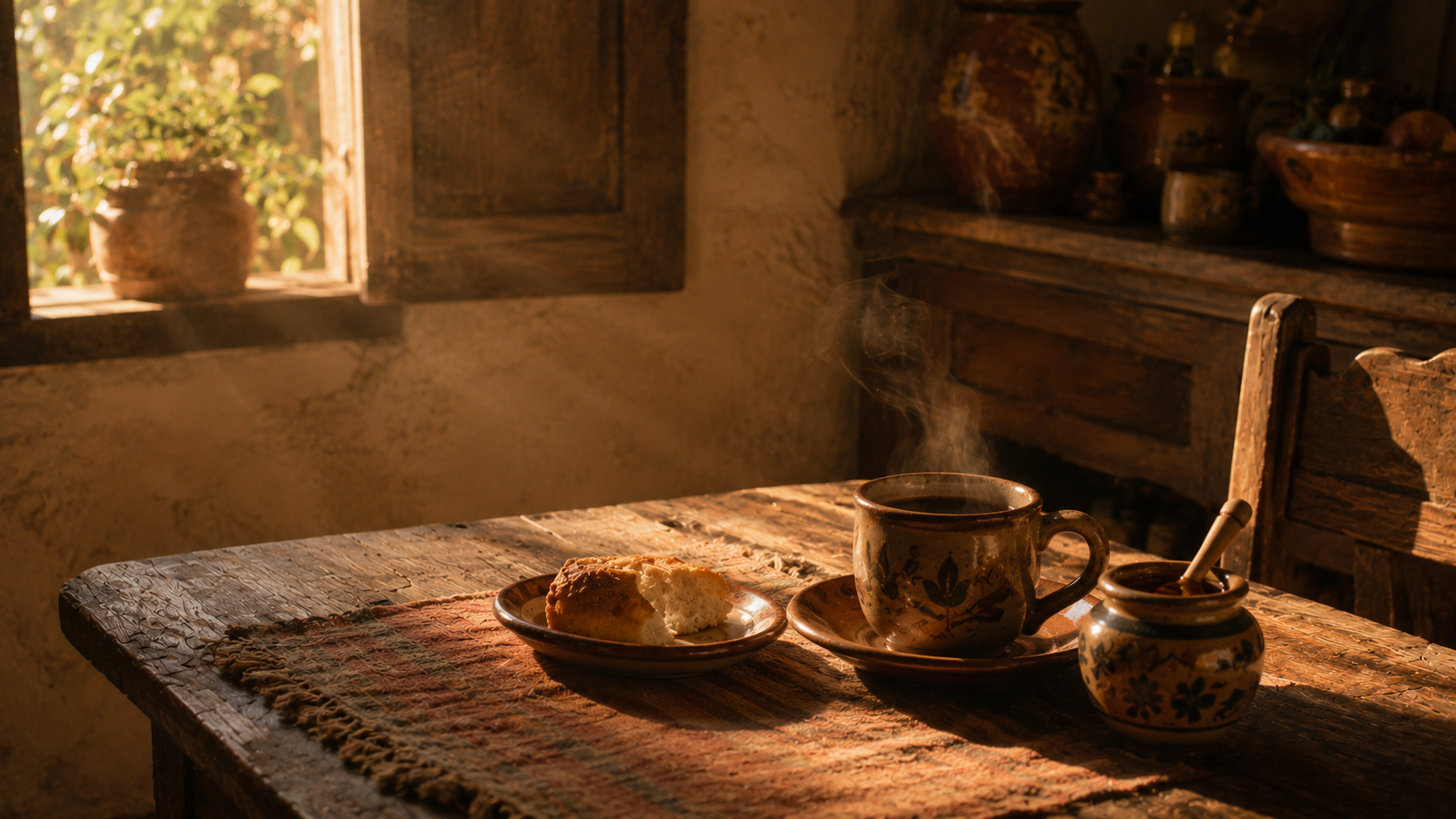
A reference on the most undertaught feature of Spanish — the suffix that the textbook calls a marker of smallness and that native speakers use, in everyday life, for almost everything else.
What the Diminutive Is Not
Every Spanish textbook in the English-speaking world introduces the diminutive in approximately the same way. The suffix -ito or -ita is presented as a grammatical operation that conveys smallness. Casa becomes casita, a small house. Perro becomes perrito, a small dog. Mesa becomes mesita, a small table. The treatment is brisk, the rule is clean, and the textbook moves on.
This is true, in the same way that it is true that a coat keeps you warm. It is not the whole truth, and it is not even the most useful truth. Native speakers of Latin American Spanish use the diminutive constantly, and most of the time, smallness is not what they are doing. Mamita is not a small mother. Cafecito is not necessarily a small coffee. Ahorita is not a small now. Despacito is not a small slowness. The diminutive in Latin American Spanish is one of the most pragmatically loaded morphological devices in the language, doing dozens of kinds of work that have nothing to do with size, and the textbook treatment leaves learners genuinely unable to interpret what they are hearing when they encounter it in the wild.
This guide is meant as a reference for that gap. It treats the diminutive as the multipurpose pragmatic tool it actually is — affectionate, softening, polite, ironic, intimate, sometimes diminishing, occasionally even literal — and tries to lay out the system as it is used across Latin America. The grammar is small. The pragmatics are vast. As with voseo, the work of the guide is to introduce both.
1. The Suffixes
Latin American Spanish has four productive diminutive suffixes, each with regional distribution.
-ito / -ita is the dominant form across nearly all of Latin America. It is the default suffix in Mexico, Central America, the Andes, the Southern Cone, and most of the Caribbean. The vast majority of diminutives a learner will encounter use this suffix. Casa → casita. Perro → perrito. Niño → niñito. Café → cafecito (note the inserted -c-, which we will return to).
-illo / -illa is more characteristic of Iberian Spanish but appears in some Latin American varieties, particularly Mexico in lexicalized forms (bocadillo — sandwich; cuchillo — knife, no longer felt as a diminutive). In productive use, -illo is rare in most of Latin American everyday speech, but it survives in fixed expressions and place names. A learner does not need to produce -illo but should recognize it when it appears.
-ico / -ica is regional and distinctive. It is used productively in Costa Rica (to the point that Costa Ricans are nicknamed ticos, derived from this very suffix), in parts of Colombia, in the eastern Caribbean (especially Cuba, the Dominican Republic, and the Caribbean coast of Venezuela), and in a few other pockets. Momento → momentico. Ratito → ratico. The -ico form often appears specifically after roots ending in -t-, where Castilian Spanish would use -illo — a phonological motivation rooted in the sound combination.
-ín / -ina is rare in Latin American speech but appears in some lexicalized forms and in the speech of some communities, particularly with Asturian or Galician heritage in Argentina, Uruguay, and the Caribbean. Pequeño → pequeñín (a small one, used affectionately with children). The form is not productive across the region in the way -ito is.
For most learners, -ito is the suffix to internalize first. -ico is the second most important to recognize, particularly if travel or study will involve Costa Rica, Cuba, or interior Colombia. -illo and -ín can be recognized when encountered but rarely need to be produced.
2. The Morphology
The suffix attaches to nouns, adjectives, adverbs, and occasionally to other parts of speech. The attachment follows a small set of patterns that are worth knowing.
Words Ending in a Consonant or in -e
Most words ending in a consonant or in the vowel -e take the suffix in a straightforward way:
| Base | Diminutive |
|---|---|
| árbol | arbolito |
| reloj | relojito |
| café | cafecito |
| coche | cochecito |
| pez | pececito |
Notice the cafecito and pececito forms. When the base ends in a stressed vowel or in certain final consonants, an inserted -c- appears before the suffix. This is the phonological pattern, and it is automatic once one has heard enough examples — native speakers do not derive it consciously.
Words Ending in -a or -o
Words ending in -a or -o simply drop the final vowel and add the suffix:
| Base | Diminutive |
|---|---|
| casa | casita |
| perro | perrito |
| mesa | mesita |
| niño | niñito |
| problema | problemita |
The gender of the diminutive matches the gender of the base — casa is feminine, so casita is feminine. Perro is masculine, so perrito is masculine. There is no exception to this pattern.
Words Ending in -ío or -ía
These follow the general pattern but retain the accent:
| Base | Diminutive |
|---|---|
| río | riíto (or rito in some regions) |
| tío | tiíto / tito |
| María | Mariíta / Marita |
Many of these have alternate shortened forms in everyday use (tito, marita) that arose through frequent use.
Stem Changes
A small number of bases undergo stem changes that interact with the diminutive:
| Base | Diminutive |
|---|---|
| viejo | viejito (not *viejecito) |
| nuevo | nuevecito (in some regions) or nuevito |
| pueblo | pueblecito or pueblito |
| Carlos | Carlitos (note the irregular form) |
The irregularities are limited and lexically specific. A learner does not need to memorize them so much as encounter them in use; the regular forms will work as defaults.
Words That Take the -c- Insertion
A pattern worth flagging because it confuses learners: certain bases insert -c- or -ec- before the suffix. The pattern is not entirely predictable but follows tendencies based on syllable structure and final sound:
| Base | Diminutive |
|---|---|
| café | cafecito |
| flor | florecita |
| madre | madrecita |
| padre | padrecito |
| sol | solecito |
| pan | panecito |
| amor | amorcito |
| pez | pececito |
The general rule is that words with a single syllable, or stressed final syllables, often take the -c- or -ec- insertion. A learner will internalize the pattern through exposure; the cost of error is small (a native speaker will understand florita even if florecita is more idiomatic).
Adjectives, Adverbs, and Other Parts of Speech
The diminutive is not restricted to nouns. It attaches productively to adjectives, adverbs, and even some other categories:
| Base | Diminutive |
|---|---|
| pequeño (adj) | pequeñito |
| cerca (adv) | cerquita |
| ahora (adv) | ahorita |
| poco (adv) | poquito |
| despacio (adv) | despacito |
| pronto (adv) | prontito |
| solo (adj/adv) | solito |
| nada (pron/adv) | nadita |
This productivity is what makes the diminutive central to Latin American Spanish. It is not a morpheme reserved for nouns; it is a pragmatic device that modifies almost anything that carries meaning.
3. The Pragmatic Functions
Here is where the textbook account fails most thoroughly. The diminutive in Latin American Spanish does not chiefly mean small. It does many other kinds of work, and the work it does depends on context, tone, and the relationship between speakers. Let me lay out the main functions.
Affection
The most common function. The diminutive expresses warmth, tenderness, care, intimacy. A mother calling her child mi hijito is not addressing a small child but a beloved one. A speaker referring to mi perrito is not specifying the size of the dog but the affection toward it. A grandmother offering a guest un cafecito is not describing the volume of the coffee but the warmth of the hospitality.
This affectionate use extends to almost any noun that can be loved or held in regard. Mi amorcito — my little love. Mi vidita — my dear life. Mi corazoncito — my dear heart. The English translation that captures the warmth is usually dear or little dear rather than small.
Softening of Requests
A request made in the diminutive lands more lightly than a request made plain. Espérame un momentito sounds gentler than Espérame un momento. ¿Me puedes ayudar un ratito? asks less than ¿Me puedes ayudar un rato? The temporal duration is unchanged; the social weight is reduced. The diminutive functions as a politeness marker, signaling that the speaker is not imposing heavily.
This is one of the most useful pragmatic functions for learners to internalize. A direct request in plain Spanish can sound brusque in contexts where the same request in diminutive would sound friendly. Pásame la sal is a command. Pásame la salita is a friendly request between people who know each other.
Domestic Register
Food and drink in domestic settings almost always appear in the diminutive. Un cafecito. Un agüita (water, with the -c- inserted before -ita). Una sopita. Un panecito. Una galletita. The diminutive marks the domestic, the homemade, the served-with-care. To say un café in a home setting can sound oddly formal, even cold. The diminutive is the warm form.
This is particularly pronounced in Mexico, where the domestic-diminutive register is one of the language's most characteristic features. A Mexican home offering coffee to a guest will almost certainly say un cafecito. To say un café would imply something more transactional — coffee at a café, perhaps, rather than coffee in someone's kitchen.
Politeness in Service
Service workers — waiters, salespeople, drivers, anyone whose work involves interacting with the public — use the diminutive heavily as a politeness marker. Su agüita, señor. Su mesita está lista. El cambiecito. The diminutive frames the service as personal, attentive, and warm, rather than impersonal and transactional.
A learner moving through Spanish-speaking America will hear this constantly and may at first find it strange — why is the waiter offering me a small water? — until the pragmatic function becomes intuitive.
Irony and Diminishment
The diminutive can also be ironic, conveying that something is unimportant, dismissive, or contemptible. Su carrito (his little car) can be affectionate or condescending depending on tone. Su libro described as librito by a critic implies a slight, trivial work rather than a substantial book. Su gobiernito in political commentary diminishes the government.
This use is less common than the affectionate function, but it exists, and the distinction lies entirely in tone and context. The same form can mean dear or contemptible; the form does not announce which.
Emphasis and Intensity
In some uses, the diminutive does not soften but intensifies. Está calientito (it is nicely warm — note that calientito often implies just-right warmth, not lukewarm). Está fresquito (it is pleasantly cool). The diminutive can mark the ideal state of a quality rather than a diminished version of it. The coffee is calientito when it is at the right temperature — neither cold nor too hot, but warm in the just-right way.
This use is particularly common with sensory adjectives. Suavecito (nicely smooth). Tibíoto (pleasantly warm). Dulcecito (just sweet enough). The diminutive marks calibration rather than diminution.
Approximation and Indeterminacy
This is the function that ahorita embodies. The adverb ahora means now. Ahorita, in many Latin American varieties, means now-ish — sometime soon, eventually, perhaps not at all. The diminutive removes precision, marks the time as flexible, signals that the speaker is not committing to a specific moment.
The same pattern appears in other expressions of time and quantity. Un poquito means a little bit, but the little is approximate — it could be tiny or moderate. Despacito means slowly-ish, not at any specific speed. Cerquita means near-ish. The diminutive softens precision in a way that is useful in everyday speech.
Marking Stages of Life
The diminutive is used for children, for the elderly, for pets, for anything that occupies a tender or vulnerable place in domestic life. A baby is bebito or bebita. An elderly woman might be called viejecita affectionately by her family. A pet, regardless of size, is almost always referred to in the diminutive. This is not about smallness but about how the speaker is positioned in relation to the referent — protectively, affectionately, with care.
Indicating Familiarity with Place
In speech, places that are familiar or warmly held often appear in the diminutive even when they are not small. A person speaking fondly of a town they grew up in might call it mi puebliito — not because the town is small (it might not be) but because it is mine, known, loved. The diminutive marks the speaker's intimacy with the place.
4. Regional Distinctions
The diminutive is used across all of Latin American Spanish, but its frequency and characteristic patterns vary by region.
Mexico
Mexican Spanish is famously diminutive-heavy. The suffix attaches to almost everything in casual speech, and the domestic register is dense with diminutives. Visitors to Mexico often remark on how often the diminutive appears — un cafecito, un momentito, ahorita, un poquito, un ratito. The Mexican variety treats the diminutive as a basic register of warmth, attention, and care.
The Mexican diminutive is also particularly associated with the famously indirect speech style of Mexican politeness. A direct request in Mexico can feel brusque; the diminutive softens it. Me das una manita con esto (give me a little hand with this) lands softer than ayúdame con esto (help me with this). The pragmatic function carries social weight.
Costa Rica
Costa Rica is the home of -ico. The suffix -ico (with its feminine form -ica) appears productively in Costa Rican speech, especially after roots ending in -t-: momentito → momentico, ratito → ratico, gatito → gatico. The pattern is so characteristic that Costa Ricans are popularly called ticos, derived from this suffix.
Costa Rican speech also pairs the diminutive heavily with the intimate-ustedeo system. The combination produces a register of warm formality unusual in the Spanish-speaking world — ¿Cómo está usted, mi vidita? between an elderly couple captures a tone that the Mexican or Argentine systems do not quite produce.
The Andes
Andean Spanish — especially the highland varieties of Ecuador, Peru, Bolivia, and southern Colombia — uses the diminutive intensively. The pattern is associated in part with Quechua influence; Quechua has its own affective suffix system that may have reinforced the Spanish diminutive in bilingual communities. Speech in Quito, Cuenca, Cusco, La Paz, and other Andean cities can feel particularly diminutive-rich to outside ears.
Andean Spanish also has some forms unusual to other regions, including some double diminutives — chiquitito, cerquititita — that mark intensified affection or emphasis.
Colombia
Colombia varies sharply by region. The Caribbean coast uses fewer diminutives than the interior; Bogotano speech is moderate; the Paisa region around Medellín is diminutive-heavy and often combines diminutives with the intimate-ustedeo system in a register similar to Costa Rica's. Mijito (a contraction of mi hijito) is one of the warmest forms in Paisa speech.
The Caribbean
Cuban, Dominican, and Puerto Rican Spanish use the diminutive less heavily than Mexican or Andean Spanish, but it remains productive. -ico appears in eastern Cuba and parts of the Dominican Republic, where it is used in the same phonological environments as in Costa Rica. The Caribbean diminutive is less omnipresent than the Mexican one but still part of everyday speech.
The Southern Cone
Argentine, Uruguayan, and Chilean Spanish use the diminutive less frequently than the regions to the north. The -ito form is still productive, but it appears less densely in casual speech. A Mexican greeting might be Buenos días, amiguito; an Argentine greeting in the same situation would more likely use the plain form. The diminutive in the Southern Cone is present but moderated.
This is one of the small phonological-pragmatic differences that mark Southern Cone Spanish to listeners from northern regions, and that mark northern Spanish to listeners from the Southern Cone. Argentines sometimes hear Mexican diminutive use as excessive; Mexicans sometimes hear Argentine speech as cooler than they would prefer.
5. Lexicalized Diminutives
Many forms that began as diminutives have become independent words in Latin American Spanish, no longer felt as diminutives by speakers. A few examples worth recognizing.
Common lexicalized forms:
| Lexicalized form | Original meaning | Current meaning |
|---|---|---|
| bolso | bolsa (bag) | handbag, purse |
| pañuelo | paño (cloth) | handkerchief |
| zapatilla | zapato (shoe) | sneaker, slipper |
| ahorita | ahora (now) | now-ish, soon, eventually |
| cigarrillo | cigarro (cigar) | cigarette |
| bocadillo | bocado (mouthful) | sandwich (in Spain), snack |
| tortilla | torta (cake) | flat round bread (Mexico) or omelette (Spain) |
| señorita | señora (married woman) | unmarried woman, miss |
| amorcito | amor (love) | dear, darling (idiomatic) |
These forms are no longer derived in real time by speakers — they are simply the words for the things they name. Recognizing them as historically diminutive helps a learner understand the morphology, but using them in conversation requires no awareness of their origin.
6. The Diminutive of Names
Names take the diminutive freely in Latin American Spanish, and the resulting forms are often used as everyday nicknames. The pattern is one of the most distinctive features of the spoken language.
| Name | Diminutive forms |
|---|---|
| María | Mariíta, Marita, Mari |
| Juan | Juanito |
| Carlos | Carlitos |
| Roberto | Robertito, Beto |
| Francisco | Panchito, Pancho |
| Guillermo | Guillermito, Memo |
| Manuel | Manuelito, Manolo |
| Eduardo | Eduardito, Lalo |
| Jorge | Jorgito |
| Pedro | Pedrito |
The diminutive name often functions as the everyday form, used among family and friends, with the full name reserved for formal contexts or for moments of seriousness. A Mexican named José is likely to be called Pepe, Pepito, or Joselito by his family. A Colombian named Andrés may be Andresito or simply Andrés depending on family tradition.
This is also where some of the most affectionate forms of the language live. Mi Marita. Mi Pedrito. The combination of possessive and diminutive is a register of warmth that the formal name does not produce.
7. For the Learner
A few practical paths into the diminutive, for those who have studied tuteo or voseo and want to extend their Spanish toward native-feeling speech.
Begin with recognition before production. The first task is to hear diminutives in context and to register that they do not chiefly mean small. A Mexican film, a Costa Rican conversation, a Colombian Paisa podcast — these provide the input that recalibrates the textbook expectation. A learner who can hear Espérame un momentito and understand that this is a soft request, not a request involving smallness, has made the central move.
Notice the domestic register. In any home setting, food and drink in the diminutive are normal. Train the ear to hear un cafecito, un agüita, una sopita, un panecito. These are not literal descriptions of small portions; they are warm framings of hospitality.
Use the diminutive sparingly at first. The diminutive carries strong social meaning, and overuse can sound performative or ingratiating. A learner who newly discovers the diminutive may overcorrect, attaching -ito to everything in sight. Native speakers calibrate their diminutive use to context, register, and relationship — the calibration is acquired through exposure rather than rule.
Recognize the regional differences. Mexican and Costa Rican Spanish are diminutive-rich; Southern Cone Spanish is diminutive-moderate. Adjust the frequency of your own use to the region you are engaging with. A learner who speaks like a Mexican in Argentina will sound charming but not local; one who speaks like an Argentine in Mexico will sound slightly cool.
Pay attention to the inserted -c-. The pattern of cafecito, florecita, amorcito is one of the harder phonological details to internalize. A native speaker produces the correct form automatically; a learner has to listen, notice, and gradually absorb the pattern. The cost of error is small (everyone will understand cafito), but the right form sounds native and the wrong form sounds learned.
Let the affectionate uses come last. Mi vidita, mi corazoncito, mijito — these are warm forms used in intimate contexts. A learner who deploys them too early, with people they do not know well, will sound either presumptuous or unintentionally comic. Let these forms emerge in your speech as your relationships justify them.
A Closing Note
The diminutive is among the most powerful evidence that Latin American Spanish is not a slightly different version of Iberian Spanish but a distinct linguistic culture. The Mexican domestic diminutive, the Costa Rican -ico, the Andean intensifying diminutive, the Paisa mijito — these are not regional quirks. They are the central pragmatic devices of how Spanish in the Americas marks warmth, hospitality, request, intimacy, irony, and the textures of everyday relationship.
For a learner trained on Spanish from Spain or on textbook Mexican Spanish, the diminutive is one of the gradual discoveries that move a Spanish ear from competence toward fluency. The grammar fits in a long afternoon. The pragmatics take much longer, because they involve learning when to use a particular diminutive, with whom, and what it will signal. That work happens in the company of speakers, with patience on both sides — and it produces, in the end, a Spanish that feels Latin American rather than translated.