Sobremesa — The Word That Has No English Equivalent
The meal is finished. Nobody moves to clear. Nobody reaches for their phone. An hour passes. Another. There is no English word for this. In Spanish, there is.

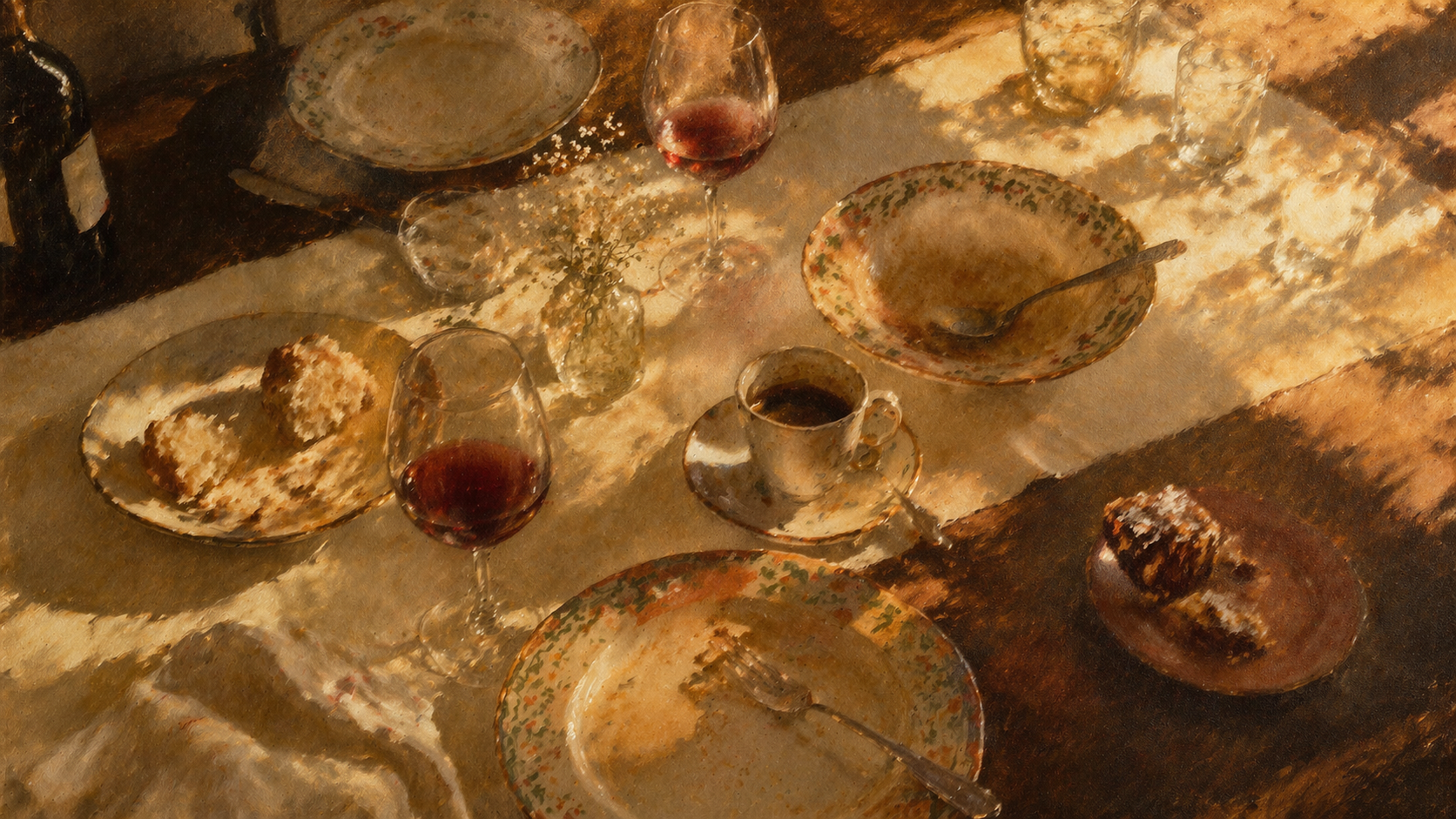
A short study of a word that has no English equivalent.
You have probably experienced it without having a word for it.
The meal is finished. The plates are still on the table, now mostly empty, coffee cups at half. Nobody moves to clear. Nobody reaches for their phone. Nobody, in fact, seems to be doing anything in particular. The conversation, which earlier drifted across weather and work and the children and the price of tomatoes, has now settled into something more unhurried — a slow, warm, meandering talk that has no destination and feels in no particular need of one. An hour passes. Another. The afternoon light changes across the table.
There is no English word for this.
There is no English word for the specific thing that happens after a meal is over but before anyone has decided the gathering is finished. No English word for the conversation that lingers because the people in it have no better place to be than at this table, with each other, with the remains of what they have just eaten, with the small residue of pleasure that a shared meal leaves behind.
In Spanish, there is a word for it. The word is sobremesa.
Literally, sobre la mesa means "over the table" or "on the table." Sobremesa, as a single compound noun, names the interval that takes place there — the time after the food but still at the table, the conversation that fills that time, the small unhurried social ritual that is, in much of the Spanish-speaking world, as much a part of the meal as the meal itself.
The word is used across Spain and Latin America, though the practice varies. In Argentina, the sobremesa after a Sunday family asado can stretch for hours into the afternoon. In Mexico, the sobremesa of a long weekday lunch in a cantina carries the same meaning in a different key. In Colombia, in Cuba, in Chile, in Spain, the word names the same phenomenon: the meal has ended, but nobody has left, and what happens in the interval has its own weight, its own name, its own protected place in the day.
The absence of an English equivalent is worth thinking about. It tells you something about the cultures in question — and, by extension, about what you are entering when you enter the Spanish-speaking world.
English has no word for sobremesa. This is not a failure of English imagination. English lacks the word because the cultures that produced English — the cultures of northern Europe, and then the cultures of North America that those cultures seeded — have not, for a long time, organized themselves around the meal in a way that requires such a word. Meals in those cultures tend to be more functional events. The food is eaten, the meal is concluded, and the participants move on to whatever is next. An unhurried lingering at the table, of the sort that produces sobremesa, is the exception rather than the rule.
In the Spanish-speaking world, it is the rule. The meal is not only the food. The meal is the whole event — the preparation, the eating, and the talking afterward, considered as a single continuous thing with a single continuous name.
To learn Spanish seriously is, eventually, to be invited into a sobremesa. And when that happens — when you find yourself at a table, the plates still there, the coffee cooling, the conversation winding into its second hour — you will understand, more quickly than any textbook could teach you, that you have entered a culture whose relationship with time, with food, and with one another is different from the culture you came from.
And you will be glad there is a word for it.