The Spanish of Cuba — Where the Language Sings
The Spanish of Cuba has its own rules of softness, its own logic of compression, its own music — and once you have spent time inside it, the rest of Spanish sounds different too.

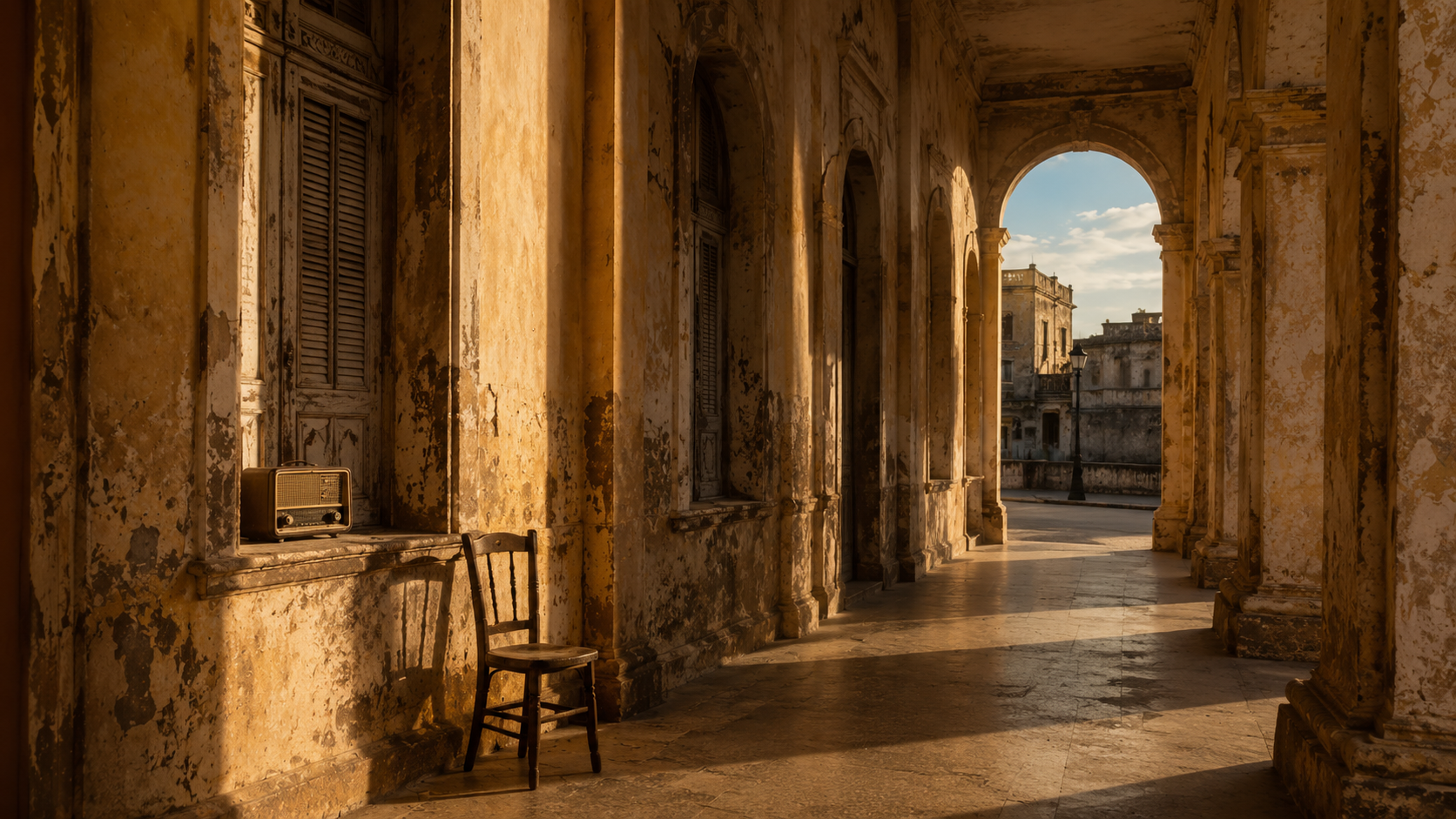
On the softened consonants, the Atlantic histories, and the music of one of the great varieties of the Spanish-speaking world.
The first time you hear it, you may not be sure you are hearing Spanish at all.
I remember my own first encounter with it. After several years of study — careful conjugations, patient vocabulary, the steady Spanish of the textbook recordings — I came across a Cuban film one evening, and the dialogue began to play. The words did not arrive the way the words on my flashcards had. They came in a kind of stream, soft at the edges, and by the time I had located the verb the speakers had already moved on. I wondered, briefly, whether the careful Spanish I had been studying for years was the same Spanish I was now hearing.
It was. What I was hearing was something else: the Spanish of Cuba, which has its own rules of softness, its own logic of compression, its own music. It is one of the most distinctive varieties in the Spanish-speaking world, and one of the most beautiful — and it can take some getting used to.
What follows is a small introduction to it. Not a complete one. Cuban Spanish is too rich for any single essay to do it justice. But perhaps enough that, the next time you hear it, you can listen with more curiosity and less worry.
The disappearing consonants
The first thing that strikes most learners about Cuban speech is what is not there.
The /s/ at the end of a syllable, especially before another consonant, often does not arrive as a full /s/. It softens into something like an /h/ — a breath rather than a hiss — and sometimes it slips away altogether. Los amigos becomes something closer to loh amigoh, and at the speed of ordinary conversation, lo amigo. The grammatical information that English speakers expect to hear in a final consonant is still there in the syntax. It has simply left the surface of the sound.
The /d/ between vowels behaves similarly. Cansado — tired — becomes cansao. Pescado becomes pescao. Hablado becomes hablao. The participial endings, which the textbook insists you pronounce fully, are softened until they are little more than a continuation of the vowel before them.
Final consonants in general have a tendency to thin. Verdad might end as verdá. Usted might be heard as usté. Comer might come out as comé. The consonants have not vanished from the language. They have stepped back to let the vowels through.
This is sometimes described, unkindly, as fast or careless speech. It is neither. It is a coherent phonological system with deep historical roots, and it is shared, with variations, across much of the Caribbean — by Dominican Spanish, by Puerto Rican Spanish, by the Spanish of coastal Venezuela and coastal Colombia. To hear it for the first time is to understand that what your textbook called "Spanish pronunciation" was one possibility among many.
Why it sounds the way it sounds
To understand why Cuban Spanish moves the way it does, it helps to look at where the speakers came from.
Most of the Spaniards who settled Cuba in the colonial centuries did not come from Madrid. They came from Andalusia, from the south of Spain, and from the Canary Islands. Andalusian Spanish had already, by the time of colonization, developed many of the features we now associate with the Caribbean — the aspiration of /s/, the weakening of final consonants, the softening of /d/. The Canary Islands shared and amplified these tendencies. The speech that crossed the Atlantic was not the speech of Castile. It was already, in a sense, on its way to becoming Cuban.
Then came the second great influence — the Africans brought in chains over three centuries of the slave trade. Cuba was one of the major destinations of that trade, and the African presence on the island was vast: Yoruba, Bantu, Fon, Mandé, and others. They learned Spanish under conditions no one would choose, and they shaped it as they spoke it. Their phonological habits, their syntactic preferences, their words for the things of daily life — all of these entered the Spanish of Cuba and made it more itself.
There is also a third, quieter influence: the speech of the ports. Havana was, for centuries, one of the great hinge points of the Spanish empire. Sailors, merchants, soldiers, slavers, and freed men passed through it constantly, carrying their words and their accents with them. Port cities tend to produce languages that flow rather than separate, that smooth rather than stand apart. Cuban Spanish is, among many other things, the language of a great Atlantic port that listened to the world and answered it.
The result is a variety that belongs to two long histories meeting on one island, and to the Atlantic crossings that connected them: the Spanish of southern Spain, the Spanish of West Africa, and the Spanish of ships and harbors, transformed into something that belongs to none of them alone.
Words and life
Vocabulary is the easiest dimension of a regional variety to notice and the most fun to learn. Cuban Spanish has many words that are its own.
Asere is one of the most distinctive. It means, roughly, friend — brother — dude. It comes from a Yoruba expression that crossed into Cuban Spanish through the Afro-Cuban religious traditions and from there into ordinary speech. To call someone asere is to claim a particular kind of warmth: not as formal as amigo, not as generic as the English dude. It is a Cuban word, and Cubans know it.
Compay — short for compadre — does similar work in older or rural speech. Mi compay — my friend, my old friend. The word carries the dust of the countryside in it.
Guagua is the Cuban word for bus. It is shared with the Canary Islands, which is itself a clue: the word probably crossed back and forth across the Atlantic with the speakers who shaped both varieties. To Mexicans and Argentines, guagua may mean a baby. To Cubans, it is the thing that takes you to work.
Yuma is what Cubans sometimes call a foreigner, especially an American. The word came, by some accounts, from the title of an old Western — 3:10 to Yuma — and it became, in Cuba, a way of naming the country across the water. It is rarely unkind. It is more like a recognition: you are a yuma; we are not.
Pinchar is to work. Jaba is a plastic bag. Fula is the dollar — and also, depending on context, a problem. The vocabulary of Cuban Spanish carries the particular shape of Cuban life: the humor of it, the difficulty of it, the music in even the difficult parts.
The music of it
There is a reason Cuban Spanish is sometimes described as sung.
The phonological features we have just looked at — the softening of consonants, the prominence of vowels, the smoothing of word boundaries — produce speech that flows in a way most varieties of Spanish do not. Listen to a Cuban speaker for any length of time and you will hear long ribbons of vowel held together by light, almost decorative consonants. The rhythm is not the staccato rhythm of Mexican highland Spanish or the crisp rhythm of educated Bogotá. It is closer to a rolling line.
This is part of why Cuba's musical traditions feel so inseparable from Cuban speech. Son, bolero, guaracha, son montuno — the music that emerged on the island in the late nineteenth and twentieth centuries — works in part because the language already moves like that. The lyrics of a great bolero are often only just above the rhythm of ordinary Cuban conversation. The conversation, in turn, often hovers just below the level of song. When Beny Moré sang or Celia Cruz spoke between songs, you can hear the same line of speech, taken up a little or set down a little, but always the same line.
Cuban writers have been listening to it too. Guillermo Cabrera Infante built whole novels — Tres tristes tigres most famously — out of the rhythms of Havana speech, the puns and slippages and softnesses of it, transcribed onto the page with such fidelity that reading him is almost like overhearing. Nicolás Guillén did something similar in poetry, weaving the cadences of Afro-Cuban speech into a literary form that could carry them. The literature of Cuba is, in part, an extended attempt to set down on the page what the language sounds like in the air.
There is regional variation within all of this, of course. The Spanish of Havana is not quite the Spanish of Santiago de Cuba, in the east. Oriente, the eastern provinces, have their own patterns — including, in some speech, a tendency for /r/ to soften toward /l/ in certain positions, so that puerta might lean toward puelta. There are accents within the accent, as there are in every variety. A Habanero will hear an Oriental as immediately and unmistakably as a Londoner hears a Glaswegian.
And there is the Cuba of the diaspora — Miami above all, but also New York, Madrid, Mexico City. The Spanish of the Cuban diaspora is its own subject, shaped by exile, by the long American twentieth century, by contact with other varieties of Spanish and with English. The Spanish of Calle Ocho is not exactly the Spanish of Centro Habana. Both are Cuban, in different ways, and both are part of what the variety has become.
A small closing thought
If your Spanish was learned from textbooks, Cuban Spanish may at first feel like a place where the rules have been suspended.
They have not. They are simply different rules — or rather, the same rules expressed through a different system of sound. Once you learn to hear the aspiration of /s/, once you understand that cansao is cansado, once you stop expecting every consonant to arrive in full, the language opens. What sounded like a stream becomes a sequence of words again. The grammar is all still there. It has simply been set to music.
This is the gift the Caribbean gives the Spanish learner: a reminder that the language you have been studying is larger than any one variety of it. Castilian Spanish is one beautiful thing. Mexican highland Spanish is another. The Spanish of the Río de la Plata is a third. Cuban Spanish is a fourth — and once you have spent time inside it, the others sound different too.
Don't strain to recover the consonants. Listen to the river of vowels and the soft, decorative consonants riding on it. There is a music there, and it is one of the great musics of the Spanish-speaking world.
Asere, welcome to it.