Review: Spanish Voices 1 & 2
There is a moment in every Spanish learner's progress when the coursebook audio stops being useful — when the textbook voice, slow and clear, has given everything it can. Lingualism's two-volume Spanish Voices arrives for exactly that moment. On the books that take the next step seriously.

On the rare language-learning resource that lets Spanish speakers be themselves.
The most useful thing a Spanish learner can do, after a certain point, is to stop listening to courses. The textbook audio has accompanied them long enough. They know what a Spanish voice actor sounds like — clear, slow, neutralized toward some imaginary central register. They have absorbed about as much as that register can give. What they have not yet heard, in most cases, is the spoken Spanish of daily life: the language as it leaves the mouths of people who grew up inside it, with its hesitations, its mistakes, its accents, its idioms, its sudden changes of mind. The two volumes of Spanish Voices, published in 2015 and 2021 by the small specialist house Lingualism, exist to deliver exactly that. They are among the most useful books a learner at the intermediate-to-advanced threshold can own.
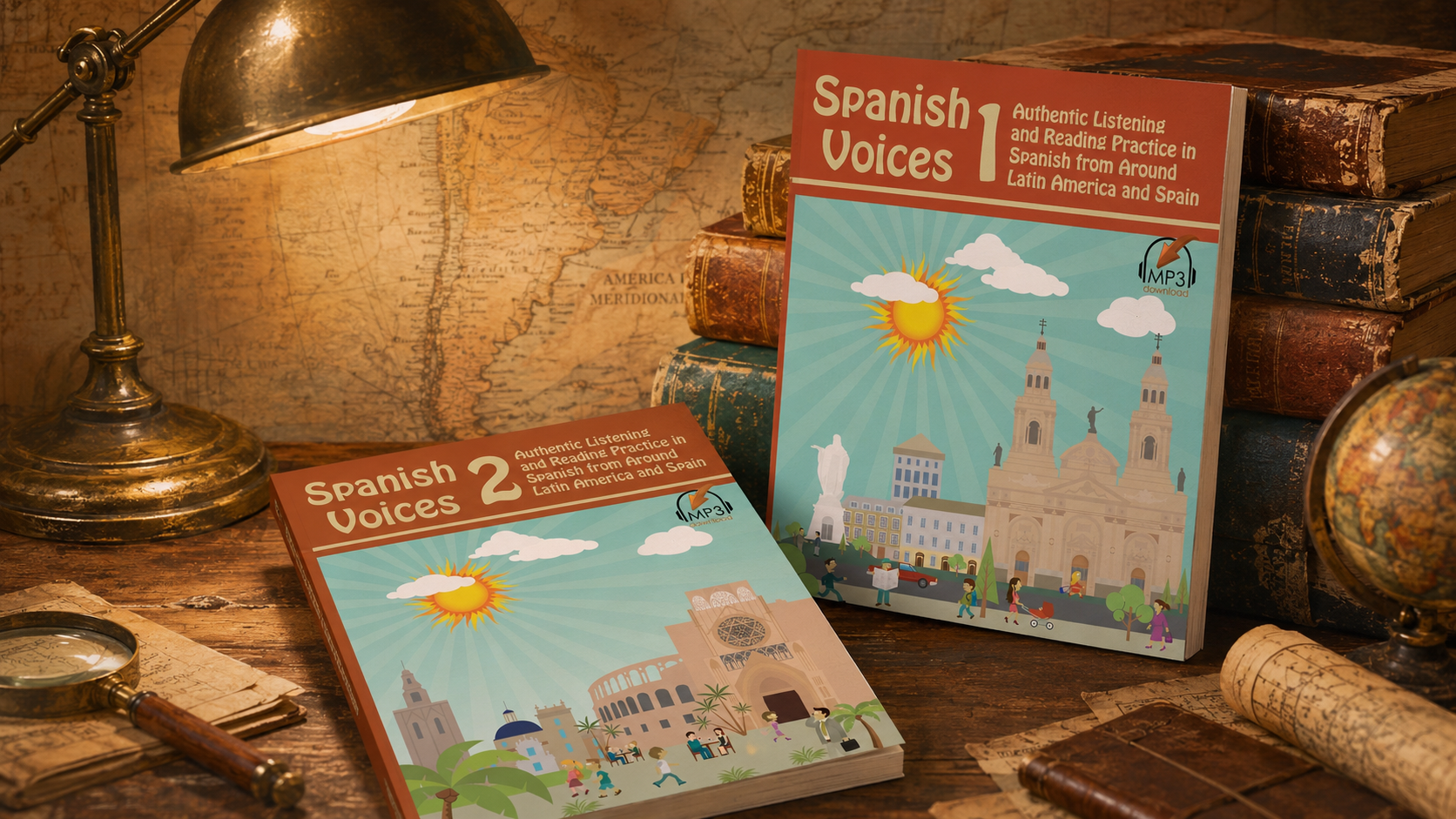
The structure of each book is simple. Six native speakers from different parts of the Spanish-speaking world record five short essays each — a self-introduction, a daily routine, a childhood memory or vacation, a description of their hometown, a piece on culture, and a piece on a social issue from their country. Each essay is reproduced as a transcription with side-by-side English translation, accompanied by listening exercises (true or false, expression matching, multiple choice, vocabulary, translation drills). The accompanying audio — free to download from lingualism.com — runs to roughly half an hour of speech per speaker. Across both volumes that is twelve speakers, sixty essays, and several hours of unscripted Spanish from eleven countries.
What distinguishes the project, and what justifies its place in the small library of resources I would actually press into a serious learner's hands, is the editorial decision underlying everything else. The recordings are not performances. The speakers were given topics and a microphone and left to speak as themselves. They hesitate. They say eh and este and bueno. They mispronounce words. They start sentences they do not finish. They reach for a word, miss it, settle for a near synonym, then move on. They use vos if they are Argentine, ustedes by default if they are Latin American, vosotros if they are from Spain. The published transcripts mark every false start with an ellipsis, every disfluency in place — so that the reader can see exactly how the speech unfolded in time. This is the opposite of what coursebook audio does, and the difference is not cosmetic. It is the difference between Spanish-as-performed and Spanish as people actually use it.
The pedagogical apparatus around the recordings is more conservative than the recordings themselves, and I think this is correct. Matthew Aldrich has built a careful framework of pre-listening, listening, and post-listening exercises designed to push the learner toward comprehension before granting them the safety net of the transcript. The book repeats, in its instructions, a discipline I would call the Aldrich rule: do not read the text until you have wrung as much understanding as you can from the audio alone. The exercises support this. The true-or-false questions are answerable from the audio at a high level; the multiple-choice questions push further; only after these has the learner earned the right to look at the text. It is a deliberate sequence, and the learners I know who have used these books seriously report that following it is harder than expected and more rewarding than expected.
The translations are worth a separate note. They are deliberately literal — line by line, fragment by fragment, sometimes with the awkwardness of word-for-word equivalence preserved rather than smoothed away. A casual reader might find them stiff; a learner discovers within five segments that this is the point. The translation is not for reading. It is a key, glossing what the Spanish does in real time, so that the learner can map the foreign syntax onto something. The publisher has sacrificed English style for transparency, and I have come to think this is the right sacrifice.
The eleven countries represented across both books — Colombia, Mexico, Dominican Republic, Spain, Venezuela, Chile, Argentina, Costa Rica, Peru, Honduras, and a second voice from Spain — give the listener something a single-speaker resource cannot: variety within the larger family of Spanish. Felipe in Bogotá does not sound like Jared in Santo Domingo, who does not sound like Gisela in Caracas, who does not sound like Jaime in Santiago. Florencia, who appears in both books, gives the rare gift of a single speaker recorded years apart, in which the patient listener can hear how an idiolect settles over time. Speech rates vary from a deliberate 107 words per minute up through 150 and beyond, so that the learner can begin with the slower speakers and graduate to the faster ones as their ear develops. The words-per-minute figure is printed at the head of each segment — a small editorial gesture that turns out to matter.
The limitations are real and worth naming. Eleven countries is more than most resources offer, but it is still fewer than the twenty-one of Latin America plus Spain, and the gaps are noticeable. There is no Cuban speaker, no Puerto Rican, no Ecuadorean, no Bolivian, Paraguayan, or Uruguayan, no representative from Central America other than Honduras and Costa Rica. For a learner specifically focused on Caribbean Spanish — the variety with the most distinctive phonology and the highest barrier to entry for non-natives — this resource is helpful but not sufficient. The Caribbean voice the books do offer is Jared's Dominican Spanish, which is excellent but cannot stand in for all of Cuban, Puerto Rican, and coastal Venezuelan together.
The other limitation worth naming is structural. Each country is represented by one speaker — and one speaker is an idiolect, not a national variety. Felipe is a Colombian, but he is not Colombia. His Bogotá is not the Bogotá of every other speaker the learner will eventually encounter, and his Spanish carries his particular vocabulary, his particular speed, his particular tics. The books cannot generalize from a single voice, and they do not pretend to. A serious learner will need to supplement Spanish Voices with other recordings — podcasts, films, conversations with real speakers — to triangulate what is national and what is personal in each voice.
Lastly, the maximum speech rate in the books tops out around 150 to 160 words per minute, which is fast but not the fastest spoken Spanish goes. Caribbean speakers in particular can sustain 180 to 200 wpm in casual conversation. The books prepare a learner for ordinary conversational pace; they do not prepare them for the fastest registers the language is capable of. This is an honest gap rather than a flaw, and it is closed only by the kind of listening to real native speakers that the books are designed to introduce a learner to.
What Spanish Voices ultimately offers is permission. Permission to encounter Spanish as the speakers themselves use it, mistakes included, hesitations included. Permission to find that real spoken Spanish is harder than coursebook Spanish — and to discover, slowly, that the difficulty was the point all along. Permission to assemble a sense of the language from twelve real people rather than one neutralized voice. For the right learner at the right moment, this is one of the more useful objects a Spanish library can hold. The books are not expensive. The audio is free. The work they ask of the learner is substantial, and the reward is proportional.
I have both volumes on my shelf. I expect to keep them there for a long time.
— A.C. Maas