Three Centuries Forgotten: The African Inheritance in Latin American Spanish
The African linguistic and cultural inheritance in Latin American Spanish is one of the foundations of the language, particularly in the Caribbean and the coastal regions.

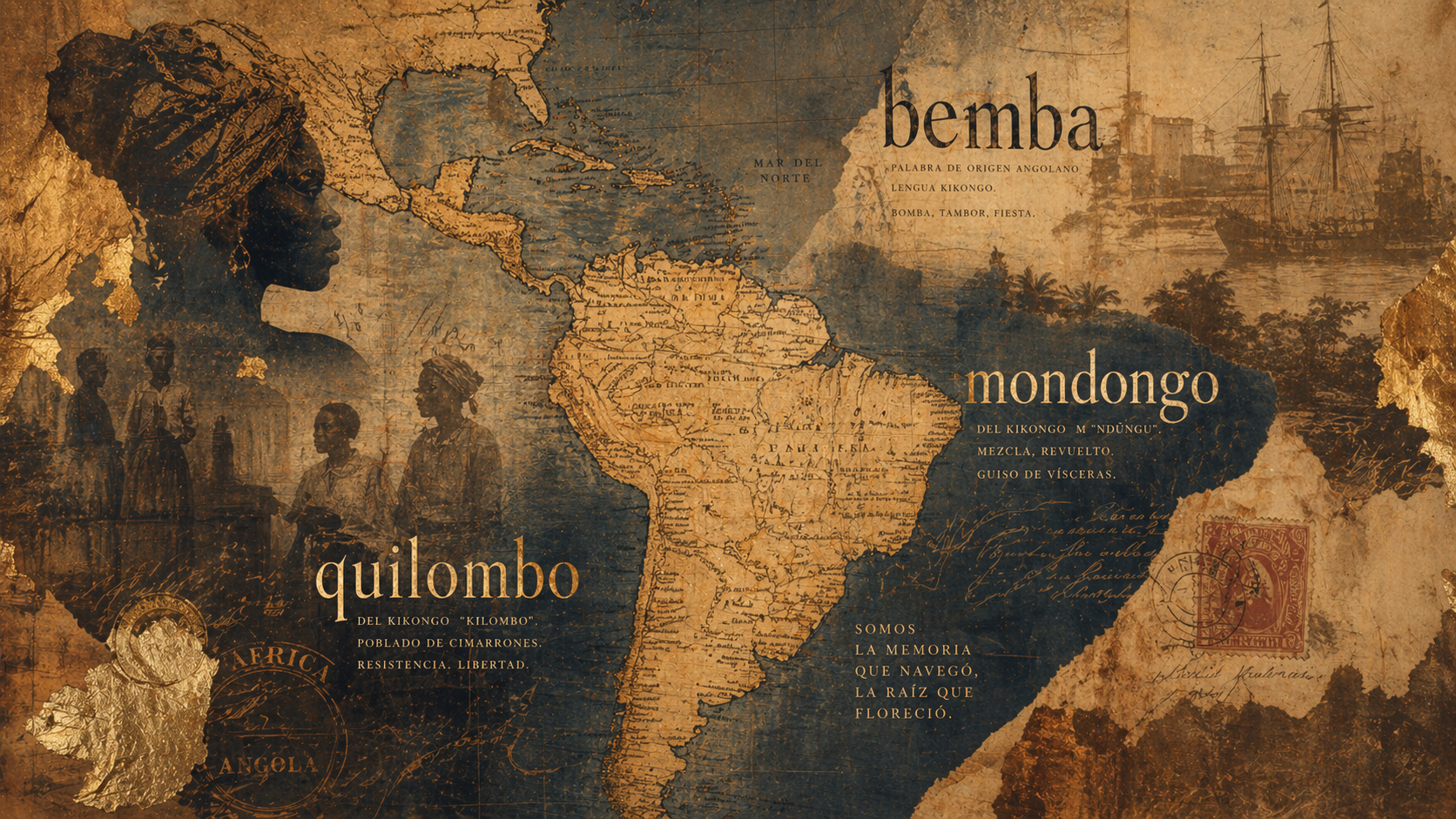
A piece that has waited too long to be written, on a dimension of Latin American Spanish that most treatments quietly leave aside.
When I write about the history of Latin American Spanish, I usually mention three sources. The Spanish that arrived from the Iberian Peninsula in the late fifteenth century. The indigenous languages of the Americas that Spanish encountered when it arrived. And, more briefly, more cautiously, more rarely — the African languages brought across the Atlantic during three centuries of the slave trade.
The third source deserves more than a mention. It is one of the foundations of Latin American Spanish, particularly the Spanish of the Caribbean and the coastal regions of Latin America, and it has been quietly sidelined in most English-language treatments of the language for too long.
This article is an attempt to give that inheritance the attention it deserves.
The history first, briefly, because the language cannot be understood without it.
Between roughly 1500 and 1860, an estimated twelve to fifteen million Africans were forcibly transported across the Atlantic Ocean as part of the transatlantic slave trade. The exact numbers are contested by historians, but the scale is not. This was the largest forced migration in human history, and its destinations included virtually every region of the Americas.
The geographic distribution mattered. The largest single destination of enslaved Africans was Brazil, which received roughly five million people — more than any other country in the Americas, and more than ten times the number that arrived in the territory that became the United States. After Brazil, the Caribbean colonies received the next largest shares: Cuba alone received over a million enslaved Africans, the British Caribbean nearly two million, the French Caribbean nearly a million and a half, and the Spanish-speaking islands of Puerto Rico and Hispaniola substantial numbers. Coastal South America — particularly the Pacific and Atlantic coasts of Colombia, Venezuela, and Peru — received hundreds of thousands more.
The people who arrived came from many regions and many language communities. Yoruba speakers from what is now Nigeria. Kikongo and Kimbundu speakers from what is now Angola and the Democratic Republic of Congo. Fon and Ewe speakers from what is now Benin and Togo. Mandinka, Wolof, and many other West African language speakers. They brought with them, in their mouths and minds, an extraordinary linguistic and cultural inheritance.
What they did not bring with them were the conditions to preserve their languages intact. Slavery worked, among many of its other violences, by separating people from their language communities. Africans of different linguistic backgrounds were deliberately mixed together, partly to prevent communication and rebellion. Their languages were suppressed. Their children, born into slavery, grew up speaking the languages of their enslavers — Spanish, Portuguese, English, French, Dutch — with whatever fragments of African languages survived in family memory and community ritual.
But fragments did survive. Words. Sounds. Rhythms. Cultural and religious frameworks. Musical traditions. Cosmologies. They survived in the speech of the descendants of the enslaved, and they entered the broader Spanish of the regions where Africans were most numerous. Today, those fragments are part of Latin American Spanish itself.
The most visible inheritance is in vocabulary.
A surprising number of words used across the Spanish-speaking world have African origins. Some have spread far beyond their original communities and are now part of global Spanish.
Mambo — the musical genre, and the dance — is a Kikongo word, originally referring to a religious or spiritual conversation. Conga — both the drum and the music — has Kongo origins. Marimba — the percussion instrument central to Afro-Latin music — comes from Bantu languages. Samba — though it lives most famously in Brazilian Portuguese — has African etymology with cousins in Spanish-speaking regions. Bemba — meaning lip, especially a thick lip — comes from Bantu sources. Ñame — the yam, a staple food across the African diaspora — entered Spanish from West African languages. Bachata, the Dominican musical genre, has debated origins but draws heavily on African musical traditions and possibly carries African etymology.
Some words are more region-specific. Mucama — a domestic worker — is used across Latin America with Bantu origins. Quilombo — a term whose meaning shifted from "African settlement" or "maroon community" to "mess" or "chaos" in Argentine Spanish — carries the layered history of escaped slaves who built free communities in the interior of South America. The Argentine usage of quilombo preserves, however unconsciously, the memory of that resistance.
In Cuba and the Dominican Republic, the African vocabulary runs deeper still. Words for foods, for body parts, for emotional states, for spiritual concepts, for dance, for music — many trace to specific African languages. The music of Cuba is constructed on African rhythmic foundations, and the language of that music — son, guaguancó, yambú, columbia — is the language of African musical inheritance.
Even outside the Caribbean, the African presence shows up in unexpected places. The Spanish word banana, used widely across Latin America, has West African origins. So does zombie, which entered English through Caribbean Spanish from Bantu sources.
These words are not trivia. They are evidence — small linguistic monuments — to a history that English-language treatments of Spanish too often skim past.
Beyond vocabulary, the African inheritance shaped the very sound of Caribbean Spanish.
The phonological features that make Cuban, Dominican, Puerto Rican, and coastal Caribbean Spanish so distinctive — the softening of consonants, the disappearance of final s, the assimilation of certain consonant clusters, the musical rising-and-falling intonation, the rhythmic drive that makes Caribbean Spanish sound, to outside ears, almost sung — many linguists argue these features bear the imprint of West and Central African phonological systems.
The argument is not that Caribbean Spanish is an African language. It is that the population that came to speak Spanish in the Caribbean was overwhelmingly African in origin, and that population reshaped the Spanish they were forced to learn into something new — something that sounded to their ears the way Spanish should sound, which was different from how Spanish sounded in Castile or Madrid. Over generations, the variety they produced became the dominant Spanish of the islands. It is the Spanish of millions of speakers today.
This phonological inheritance is harder to point at than vocabulary. You cannot quote it the way you can quote a word like mambo. But you can hear it — in any Cuban song, any Dominican conversation, any Puerto Rican greeting. The music of Caribbean Spanish is, in significant part, the residual music of the African languages that were spoken in those islands before they were silenced.
There is a third dimension to this inheritance that goes beyond language proper, and it is perhaps the most consequential: the cultural and religious frameworks that came with the African languages and that shaped how Spanish itself came to be used.
In Cuba, the religious tradition of Santería preserves Yoruba religious vocabulary, ritual practices, and conceptual frameworks within a Spanish-language matrix. The names of the orishas — Yemayá, Changó, Oshún, Obatalá — are spoken in Spanish sentences, in Spanish prayers, in Spanish songs. Spanish has absorbed not only African words but African ways of thinking about the world, expressed in Spanish.
In Brazil, the equivalent traditions — Candomblé, Umbanda — exist in Portuguese rather than Spanish, but the structural pattern is the same: a fundamentally African religious vocabulary spoken in a European language. In coastal Colombia, in Haiti's Vodou (cousin to traditions in the Spanish-speaking islands), in the music and dance traditions of the broader Caribbean — the African inheritance is preserved not as a museum piece but as living practice, conducted in Spanish (or Portuguese, or French, or Creole) but rooted in African foundations.
The Spanish-speaking world, in other words, is not only Spanish-speaking. It is a place where Spanish is one of several layered languages — formal language sitting on top of indigenous and African inheritances that continue to shape how Spanish is spoken, what Spanish is used for, and what cultural worlds Spanish opens onto.
Why is this inheritance so often left out of English-language treatments of Latin American Spanish?
There are several reasons, and they are uncomfortable.
Some of it is the legacy of older scholarly traditions that focused on European linguistic sources and treated indigenous and African contributions as marginal or curious rather than foundational. Some of it is the difficulty of tracing African etymologies precisely — when languages were forcibly suppressed, the trail of evidence is incomplete, and conservative scholarship sometimes hesitates to claim what it cannot fully prove.
But some of it, frankly, is that the African dimension of Latin American Spanish raises uncomfortable questions about colonialism, about slavery, about the human cost of how this language came to its current form. A textbook treatment that mentions "indigenous influences" briefly and "African influences" even more briefly is doing something other than describing the language. It is editing the history.
This site tries to do better. It will not always succeed, but the effort matters. The Spanish of Latin America is a language whose richness comes, in significant part, from people who were brought to the Americas in chains and whose linguistic and cultural inheritance survived everything that was done to suppress it. To learn this language seriously is to inherit, at one remove, a debt to those people. The least we can do, as careful learners and writers, is to acknowledge that.
For the learner, the practical implications are several.
If you are drawn to Caribbean Spanish — to the music of Cuban son, to the warmth of Dominican conversation, to the rhythms of Puerto Rican poetry — you are drawn, whether you know it or not, to the African inheritance in Latin American Spanish. The features that make those varieties distinctive are not eccentricities. They are the language as shaped by the people who made it what it is.
If you find yourself listening to salsa or bachata or son cubano and feeling that the rhythm and the language belong together in a way that is hard to articulate, you are correct. The music and the language share a foundation. They were, in significant part, built by the same people, out of the same inheritance.
And if you ever travel to Cuba, to Santo Domingo, to San Juan, to the Caribbean coast of Colombia — listen for the African presence in the language. It is everywhere. It is in the words, in the rhythm, in the laughter, in the prayers. It is, more than almost anything else, what makes those Spanishes so beautiful.
The textbook is unlikely to tell you any of this. The site is here partly to make sure that someone does.