Review: The Story of Spanish
Jean-Benoît Nadeau and Julie Barlow's The Story of Spanish attempts a comprehensive biography of the Spanish language — from its prehistoric origins on the Iberian Peninsula to its current global presence. A review of what the book delivers, what it misses, and who should read it.

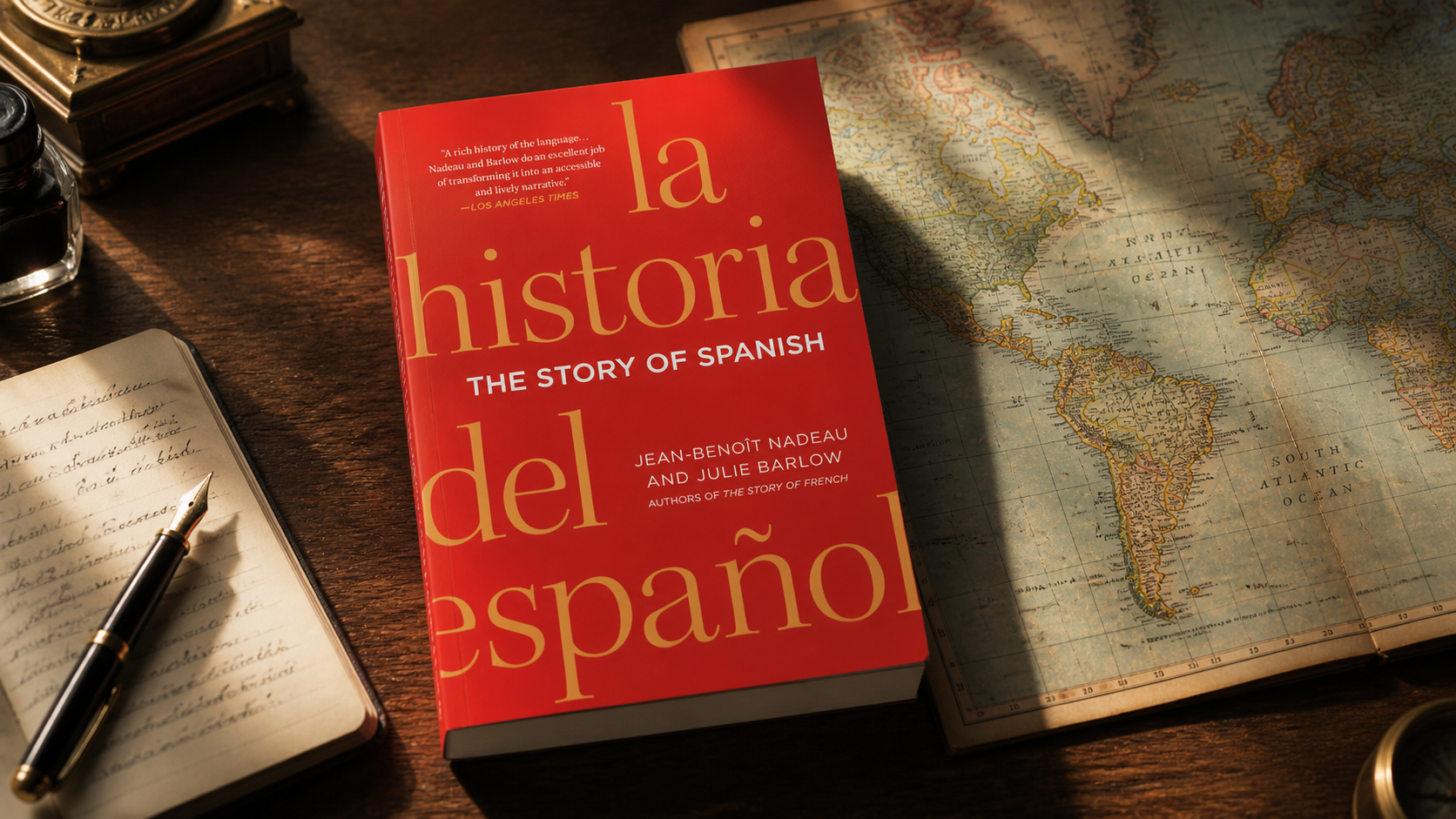
On Jean-Benoît Nadeau and Julie Barlow's three-thousand-year biography of a language
There is a particular kind of book that I find myself returning to as the years of my engagement with Spanish accumulate — books that try to hold the whole language at once, in something approaching its full historical and geographic dimension, and that refuse to settle for either the academic register of professional linguistics or the marketing register of "fun facts about Spanish." Jean-Benoît Nadeau and Julie Barlow's The Story of Spanish, first published in 2013 by St. Martin's Press, is one of those books. It runs to 449 pages across thirty-three chapters and an extensive set of appendices, and it attempts something genuinely ambitious: a comprehensive biography of the Spanish language from its prehistoric origins on the Iberian Peninsula to its current status as one of the most widely spoken languages in the world.
I want to recommend the book — with some real qualifications, which I'll get to — and I want to do that recommendation a kind of honest service by spending a few thousand words explaining what the book does, what it does well, what it does less well, and who I think will benefit from reading it.
The first thing worth saying is that Nadeau and Barlow are not academic linguists. They are Canadian journalists — bilingual in English and French, with substantial but not native-level Spanish — who previously wrote The Story of French (2006), a similarly comprehensive treatment of the French language. Their stated approach in The Story of Spanish is what they describe as "biographical": they treat Spanish as a character, with a life story, influences, accomplishments, and ongoing concerns. They draw on linguistics where it serves the story, but their primary tools are journalism and history, not phonology and morphosyntax.
This matters because it determines what kind of book you are reading. The Story of Spanish is not a reference work about Spanish grammar. It is not a learner's resource. It will not help you with the subjunctive or the difference between ser and estar. What it offers instead is a sustained narrative account of how a particular language emerged, spread, evolved, and arrived at its present form — written for the curious reader rather than the specialist.
If that is the kind of book you want, The Story of Spanish delivers it with considerable skill.
The structure of the book is straightforward and essentially chronological. The early chapters cover the pre-Roman peoples of the Iberian Peninsula — Phoenicians, Iberians, Celts, Basques — and the surprisingly small but durable contributions each made to what would eventually become Spanish. The Phoenicians, we learn, named the peninsula I-shepan-ha, "land of hyraxes," after the rabbits that astonished them when they arrived around 800 BC. The Romans Latinized this to Hispania. Centuries later, Hispania became España. Spain's name, as Nadeau and Barlow put it with characteristic dry charm, originally meant something like "land of the rabbits."
This kind of detail is what The Story of Spanish does best. Across thirty-three chapters, the authors accumulate a remarkable inventory of small, specific, memorable facts about how Spanish developed: that cansar (to tire) is a Latin word that survived in Spanish only because it disappeared from Rome's spoken Latin shortly after Spain was colonized; that the trilled r of Spanish probably came from Basque influence; that Castilian Spanish became a written language earlier than most European vernaculars largely because of King Alfonso X "the Wise" in the thirteenth century, a monarch who set an extraordinary precedent by writing in his own language rather than in Latin; that Antonio de Nebrija's 1492 Gramática castellana — the first systematic grammar of any modern European language — was published in the same year as Columbus's first voyage and was explicitly pitched to Queen Isabel as a tool of imperial policy ("language is the perfect instrument of empire").
These details accumulate into a narrative that is, in the best sense, popular history: well researched, clearly written, generous with its readers' time, and consistently interesting. If you want to come away from a single book with a working narrative of how Spanish became what it is — from Phoenician trading colonies to King Alfonso's medieval translation workshops to the Spanish conquest of the Americas to Andrés Bello's nineteenth-century crusade for a unified Latin American literary standard to today's debates over Spanish in the United States — The Story of Spanish will give you that narrative.
Where the book is weakest, in my view, is in its treatment of Latin American Spanish as a genuinely plural reality. This is partly a structural problem: any book attempting to cover three thousand years of one language across two continents in 315 pages must compress somewhere, and Latin America inevitably gets compressed. But it is also, I suspect, a perspective problem. Nadeau and Barlow are not Latin Americans, and they are not native speakers. Their account of Latin American Spanish often reads as a survey of the concept of Latin American Spanish — the linguistic and political project of unification, the figures like Andrés Bello who fought to keep the continent's Spanish from splintering, the Real Academia's twentieth-century efforts to establish a panhispanic standard — rather than a felt account of how Latin American Spanish actually exists in the mouths of its speakers.
Twenty nations across two continents speak Spanish. Each one has its own phonology, its own vocabulary, its own grammatical preferences, its own cultural inheritance shaping the way the language is used. The Spanish of Mexico City is genuinely different from the Spanish of Buenos Aires, which is genuinely different from the Spanish of Bogotá, which is genuinely different from the Spanish of Havana, which is genuinely different from the Spanish of Lima. The Story of Spanish acknowledges this diversity in the abstract but rarely brings it alive in the specific. Readers who come to the book hoping for a vivid sense of how the regional varieties of Latin American Spanish actually sound and feel — what vos does in Argentina that tú doesn't, why Caribbean Spanish is famously hard for foreign learners, what sobremesa tells us about Mexican social life — will find the book gestures at these realities without ever fully entering them.
To be fair, this is not the book Nadeau and Barlow set out to write. They are telling the story of a language as a singular entity moving through history, and they are mostly successful at that. But the cost of that approach is that the regional plurality of Latin American Spanish — the thing that, for me, is one of the most genuinely compelling features of the language — sits at the edges of the book rather than at its center.
The book's central thesis is one I find genuinely useful, even where I disagree with parts of it. Nadeau and Barlow argue that Spanish has three enduring features that explain its global presence: a strong "culture of language" (the long tradition, going back to Alfonso X and Nebrija, of treating Spanish as a thing worth standardizing and cultivating); a "centrifugal" tendency to spread and to absorb new influences as it spreads; and a "depth" of presence in the territories where it lives, with large populations of native speakers producing a rich and prolific cultural market.
The first two of these are well argued. The argument about the culture of language is particularly interesting: Spanish has had institutional standardization efforts running for nearly a thousand years, and the Real Academia Española and its sister academies across the Spanish-speaking world have been remarkably successful at maintaining a sense of shared linguistic identity across enormous geographic dispersion. The argument about centrifugal spread captures something real about how Spanish has expanded — through the colonial empire initially, but then, more interestingly, after the empire's collapse, when newly independent Latin American nations chose to maintain their linguistic ties rather than break from them.
The third feature — depth without breadth — is more contested, and I suspect Nadeau and Barlow somewhat underestimate the speed at which this is changing. They published the book in 2013, and they note that Spanish has had limited success spreading beyond contiguous territories. A decade later, with the rise of Spanish-language streaming on global platforms, with Mexican telenovelas reaching Eastern Europe, with reggaeton and Latin trap dominating global music charts, with Spanish overtaking French as the second-most-studied second language in the United Kingdom, the picture is somewhat different. The "centrifugal" force the authors describe is operating on a different terrain now, and Spanish appears to be acquiring exactly the kind of beyond-the-diaspora reach that the book treats as historically elusive.
One section of the book deserves special mention: the treatment of Andrés Bello, the Venezuelan-born scholar who spent two decades in London during the Latin American independence period and then settled in Chile, where he produced the Gramática de la lengua castellana destinada al uso de los americanos (1847). Bello's work is foundational to the modern conception of Latin American Spanish as a unified linguistic entity rather than a collection of dialects splintering away from a Spanish norm. Nadeau and Barlow tell his story carefully and well, and they make a persuasive case that Bello deserves to be ranked alongside Alfonso X and Nebrija as one of the three most consequential figures in the history of Spanish — a writer, jurist, and statesman whose vision of Latin American linguistic unity has shaped the panhispanic identity of Spanish-speaking nations for nearly two centuries.
This is the kind of contribution that The Story of Spanish makes that I have not found elsewhere in popular books about the language. The professional literature on Bello is substantial, but he is mostly invisible in the English-language public discourse about Spanish, and Nadeau and Barlow do real service by bringing him into view.
The book's final chapter, "Traces of the Future," is necessarily speculative, and I think the authors acknowledge this honestly. They identify a few near-certainties: that the future of Spanish is increasingly in the Americas, that Latin American influence on the language will continue to grow relative to peninsular Spain, that the United States will play a disproportionately large role in shaping the language's future trajectory. These predictions seem, twelve years on from publication, broadly correct. The Hispanic population of the United States has continued to grow as predicted. The Real Academia's panhispanic standardization efforts have continued and deepened. Latin American cultural exports have continued to expand their global reach.
What Nadeau and Barlow could not have fully anticipated — and what makes the book feel slightly dated in 2026 — is the speed and scope of the digital transformation of Spanish. The book was written in the early years of social media and streaming. It does not address the role of platforms like YouTube and TikTok in spreading regional varieties of Spanish to global audiences, or the way that Spanish-language content creators have built genuinely international audiences through algorithmic distribution rather than through the older networks of broadcast television and commercial publishing. These are now central forces shaping how Spanish lives in the world, and a 2026 reader will notice their absence.
Who should read The Story of Spanish?
If you are a serious learner of Spanish — beginner, intermediate, advanced — and you want to deepen your relationship with the language by understanding where it came from, this book will give you a remarkable amount in a single volume. You will come away knowing things about Spanish that most native speakers do not know about their own language, and that knowledge will subtly enrich every subsequent encounter you have with Spanish speakers and Spanish texts.
If you are a teacher of Spanish, the book is an excellent source of well-told historical material that you can draw on for context-setting in your classes. The chapters on Alfonso X, Nebrija, and Bello in particular contain the kind of stories that bring the language alive for students.
If you are interested in language history more broadly — if you have read books like The Story of English or Nadeau and Barlow's earlier The Story of French — this volume will fit comfortably into that reading. It is written in the same accessible register and follows similar narrative conventions.
If you are looking for a vivid, regionally specific account of how Latin American Spanish actually sounds and lives across its twenty nations, The Story of Spanish is not quite the book you want. It will give you the architecture of Latin American Spanish; it will not give you its full texture.
For my own purposes, The Story of Spanish sits on the shelf next to other books about Spanish that I return to: McWhorter's general writings on language change, the scattered essays I have collected over the years on Latin American regional varieties, John Lipski's more academic Latin American Spanish for the linguistics, and the works of Real Academia members for the institutional perspective. Nadeau and Barlow's contribution is the popular narrative — the readable, accessible, well-paced story that gives you the sweep of three thousand years in a single sitting and that you can recommend to a curious friend without warning them about technical vocabulary.
That is a real and valuable contribution. The book does what it sets out to do. The fact that it does not also do other things — the close regional ethnography of Latin American Spanish, the felt account of what it is like to live inside the language — is not a failure of the book. It is just a description of its genuine scope.
I would recommend it to anyone serious about Spanish who has not yet read it. And I would pair it, in a complete reading list, with works that take up where it leaves off — works that go deep into the specific regional varieties of Latin American Spanish, that bring alive the cultural texture of the twenty nations the book gestures at, and that build, on the historical foundation Nadeau and Barlow provide, the more particular knowledge that genuine engagement with Latin American Spanish requires.
The Story of Spanish is available in paperback, hardcover, and Kindle editions.
— A.C. Maas