Review: SpanishPod101
Several thousand audio lessons across five proficiency levels and four Spanish dialect tracks make SpanishPod101 the largest Spanish library on the open internet. A review of what the platform actually delivers and who it actually serves.

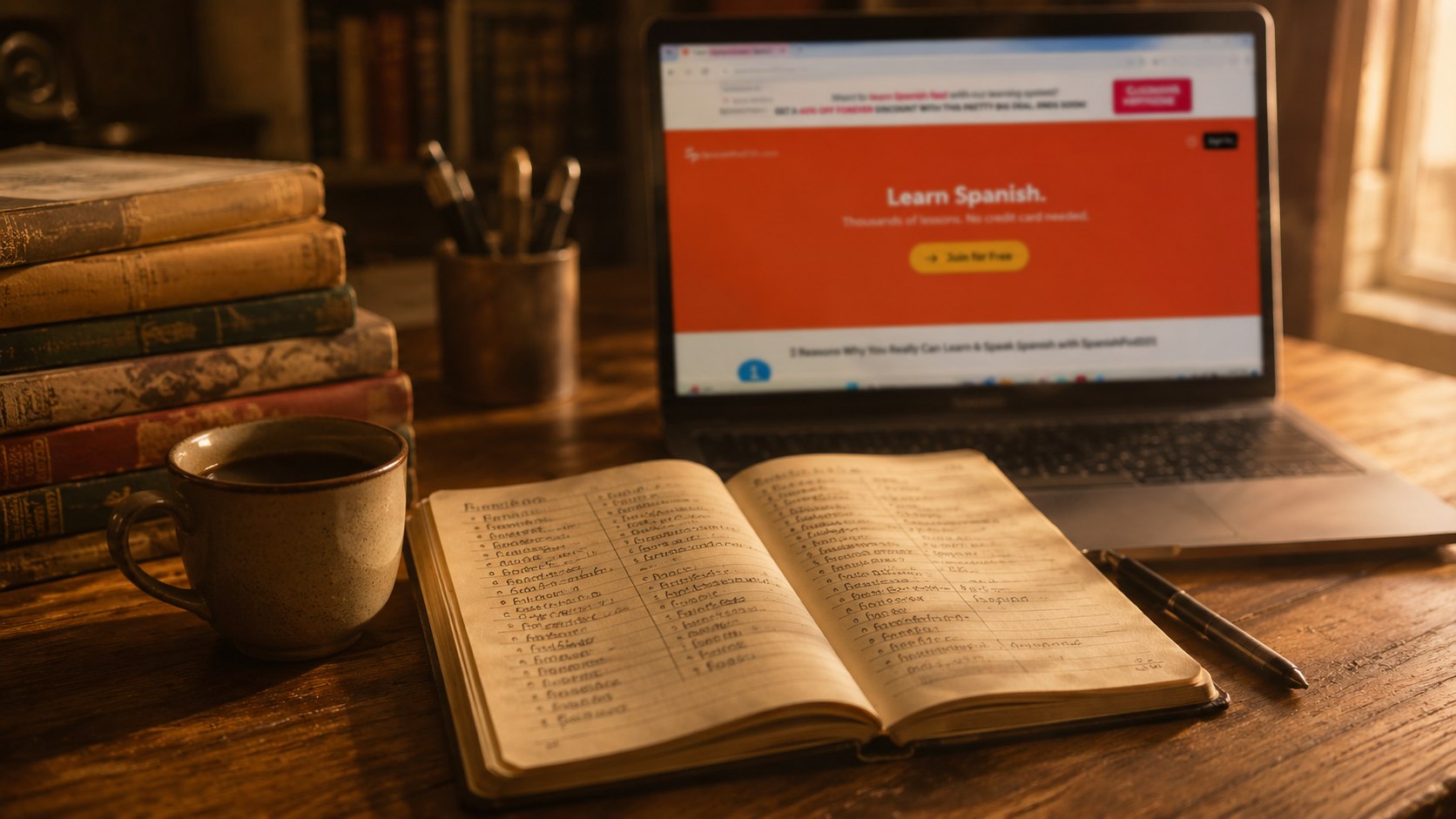
On the largest Spanish-learning library on the internet — and the curriculum it does not quite manage to be.
There is a distinction worth making at the start, because most reviews of SpanishPod101 fail to make it and most prospective subscribers do not yet know to ask. SpanishPod101 is not a Spanish course. It is a library of Spanish lessons. The two are different objects, and the difference shapes whether a learner walks away from the platform having learned Spanish or having merely consumed a great deal of content about Spanish.
A course is a curriculum. It has a beginning, a middle, and an end. It assumes the learner does not yet know what they need to know next, and it makes that decision for them. A library is a collection. It assumes the learner knows what they are looking for. The cataloguing may be excellent, the holdings may be vast, but the user who walks in without a question walks out without an answer. (See the platform →)
SpanishPod101 is closer to the second. The platform, owned by Innovative Language Learning and operating since the mid-2000s under the same business model as KoreanClass101, FrenchPod101, and a dozen others, hosts what is plausibly the largest collection of structured Spanish audio lessons on the open internet. Several thousand lessons across five proficiency levels (Absolute Beginner through Advanced), in multiple Spanish dialects — Mexican, Peruvian, Costa Rican, Iberian — with the usual apparatus around each lesson: transcripts, vocabulary lists, downloadable notes, and a clickable line-by-line dialogue tool that lets the learner play any single utterance at full speed or slowed down. As a library, it is unmatched in scale.
What it is not, despite its marketing and despite the friendly hosts at the top of every lesson telling you it is, is a path. The platform's attempt at a path — the "Learning Paths" feature added in recent years — is a real improvement and the right place for any new subscriber to begin, but the paths themselves are curated playlists drawn from the same library, not pedagogically sequenced curricula. A learner who completes Path A and Path B has not completed the equivalent of a textbook chapter and a textbook chapter; they have completed two playlists. The relationship between them is undefined. What to do next is left to the learner. This is the structural truth of the product, and the entire experience of using it shifts once it is grasped.
The lesson format is the thing the platform does well, and is worth describing carefully because it is the unit on which everything else is built. A typical SpanishPod101 lesson runs fifteen to twenty minutes. Two hosts — one American, one native Spanish speaker — open with three or four minutes of English banter establishing a real-life scenario. A dialogue in Spanish follows, perhaps thirty seconds long, between two native speakers. The hosts then walk through the dialogue line by line: translation, grammatical notes, vocabulary, cultural context, pronunciation tips. The lesson closes with the dialogue played a second time, now at conversational speed, the learner notionally able to follow it where ten minutes earlier they could not.
The format works when it works because the dialogue at its center is well-produced and the cultural notes are often substantive. The Spanish in the dialogues is recognizable as actual Spanish — the speakers are paid voice actors but they are reading material written by Spanish speakers, not Anglicized textbook prose, and the dialect tracks deliver genuinely different recordings. The Mexican track has Mexican speakers. The Peruvian track has Peruvian speakers. Where most Spanish courses sell a generic pan-American voice and call it "Latin American Spanish," SpanishPod101 sells dialect specificity, and that is one of the better things about it.
The format works less well in the parts surrounding the dialogue. The English banter — the affable, jokey, podcast-coded opening exchange — runs longer than it should and consumes lesson time that a learner is, on the premium plans, paying for. A beginner lesson can spend four of its fifteen minutes establishing through chitchat that today's dialogue is set in a restaurant. The information that the dialogue is set in a restaurant could have been conveyed in three seconds. The pattern, repeated across hundreds of lessons, accumulates into a real volume of English where there should have been Spanish. The platform's defense — that the banter creates "engagement" and makes lessons "fun" — is the defense of an audio product that has not entirely escaped the conventions of the comedic podcast its founders evidently grew up listening to. A Spanish learner who has reached the intermediate level often finds themselves wishing the hosts would simply read the dialogue and stop talking.
The cultural content is where SpanishPod101 surprises. The "Advanced Audio Blog" paths in particular contain real journalism — twenty-minute essays on Day of the Dead in Mexico, on the Mexico City subway, on Peruvian Andean festivals, on Cuban migration — narrated entirely in Spanish at natural pace. These are not language exercises with cultural decoration. They are cultural pieces that happen to be in Spanish, and they are the parts of the platform a serious learner returns to long after the beginner content has been exhausted. The audio for these blogs alone, if extracted and packaged separately, would constitute one of the better intermediate-to-advanced listening resources on the internet.
The intermediate and upper-intermediate audio in general, where the platform commits more fully to the target language and the hosts step further back, is also where the product is at its strongest. The early beginner content is the weakest — too much English, too much padding, too thin a Spanish payload for the lesson time. A learner who pushes through the absolute-beginner tier discovers a more substantial product than the front door of the site suggests.
The limitations are real and worth naming.
The pricing presentation is borderline dishonest. SpanishPod101 displays its plan prices throughout the site as monthly rates, but the rates shown are the rates one pays only by committing to a two-year subscription. The genuine monthly price, on a month-to-month plan, is several times higher. The pattern is industry-standard among subscription language products, but that does not make it good. A learner who signs up expecting to pay four dollars a month and discovers at checkout that the four dollars assumes a two-year commitment is being shown one number while being charged another, and the practice is the kind of friction that erodes trust before the first lesson has been completed.
The platform's depth thins out as proficiency rises. A learner moving from upper-intermediate to advanced finds the catalog narrowing — the Advanced Audio Blog material is excellent but finite, and beyond it the platform has progressively less to offer. Spanish at this level is better served by native-speaker podcasts, films, novels, and conversation than by structured lessons of any kind, and the platform does not pretend otherwise, but the marketing implies a path to fluency that the actual material does not quite continue down.
The grammar coverage is uneven. SpanishPod101 is not a grammar resource. The platform mentions grammar inside lessons but does not systematically teach it, and a learner who relies on the platform alone for grammatical instruction will end up with significant gaps. The right pairing is SpanishPod101 for listening and vocabulary, a proper grammar reference (Butt and Benjamin, or any solid coursebook) for the structural backbone.
The "extras" sold inside the premium tiers — the word banks, the conjugation tables, the flashcards, the dictionary, the teacher messaging on Premium PLUS — are mostly feature padding rather than real value. The honest version of SpanishPod101 is the lessons. Everything else is the platform looking like it has more value than its competitors when listed in a feature comparison.
The pricing question, taken seriously, comes out roughly as follows. The Basic plan, for which paying month-to-month is acceptable and committing to a year is the value choice, is the version of the product most learners should buy. Premium adds the interactive features around the dialogues and is worth the upgrade for learners who will actually use the line-by-line tool. Premium PLUS, which adds asynchronous teacher messaging, is the version of italki you would buy if you wanted to spend more money for less value; an italki tutor at the actual italki costs less per hour and provides synchronous instruction, and the recommendation to anyone who has reached the level of wanting a teacher is to buy a teacher, not a Premium PLUS subscription.
The 60-day money-back guarantee and the seven-day free trial are both honored and both genuine. A learner can sample the platform for a week without payment and can return it for two months after purchase, which is more generous than the industry norm and the right way to test fit.
The final position. SpanishPod101 is one of the more useful objects a Latin American Spanish learner can subscribe to, provided the learner understands what they are subscribing to. It is a vast, dialect-aware, well-narrated archive of structured listening material, weakest at the lowest levels, strongest in the intermediate-advanced cultural content, sold under marketing that overpromises curriculum and underdelivers it. Used as a library, with the learner bringing their own questions and reaching for specific lessons or paths as needed, it earns its monthly fee many times over. Used as the primary source of structured Spanish instruction, it leaves real gaps that the marketing does not warn the buyer about.
The seven-day trial is the right way to find out which kind of learner you are. The right learner will know within three lessons that the platform is for them. The wrong learner — the one who needs to be told what to do next, not given another playlist to choose from — should keep looking, and probably toward a structured coursebook, an italki tutor, or both. SpanishPod101 is not a course. The learner who buys it understanding this, and uses it accordingly, will be the better for it.
— A.C. Maas