Review: Rocket Spanish

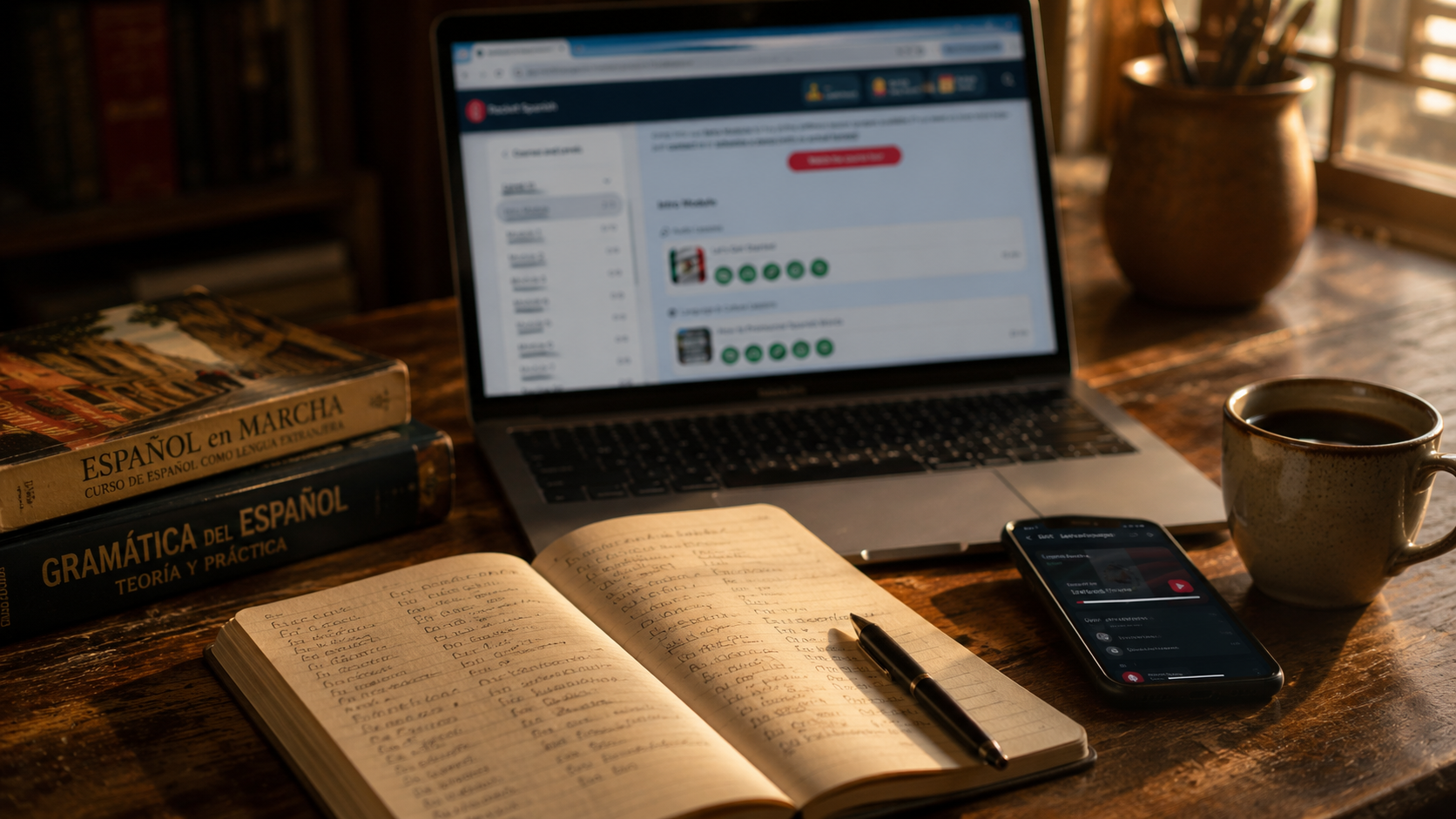
One of three products on my Recommendations page for serious learners of Latin American Spanish. A structured audio course built around twenty-to-thirty-minute lessons, with voice recognition for pronunciation and role-play exercises for simulated conversation practice.
I have included Rocket Spanish among the three products I actively recommend to serious learners of Latin American Spanish, alongside Spanish Uncovered and italki. This review explains why.
The course offers something neither of the other two recommendations provides — a structured, explicitly Latin-American-focused audio program with pronunciation training and conversation-simulation exercises. For the learner who needs structure more than they need narrative immersion, Rocket Spanish is the strongest course I have found.
What Rocket Spanish is
Rocket Spanish is a structured audio course built around discrete lessons, each typically twenty to thirty minutes long. Each lesson is a recording of native Latin American Spanish speakers conducting a structured conversation, with an instructor explaining the language and culture as the conversation unfolds. The learner listens, repeats, and works through the lesson's interactive components — pronunciation exercises using voice recognition technology, vocabulary reinforcement, role-play simulations in which the learner takes one side of a conversation while the program plays the other.
This is a different mode of learning from Spanish Uncovered. Where Spanish Uncovered asks the learner to engage with a single extended story over weeks, Rocket Spanish progresses through discrete lessons, each focused on a specific situation or grammatical structure. The learner who finishes a Rocket Spanish lesson has covered defined ground; the learner who finishes a chapter of Spanish Uncovered has moved forward in a narrative whose end is still ahead.
Both methods work. They work for different learners.
What Rocket Spanish offers that other courses do not
Three features distinguish Rocket Spanish.
Latin American Spanish from the start. Where Spanish Uncovered offers Latin American audio inside a course whose instructional framework leans Castilian, Rocket Spanish is built around Latin American Spanish throughout. The voice actors are Latin American. The vocabulary defaults to Latin American usage. The cultural references are Latin American. For a learner on this site specifically, this consistency is a real advantage — there is no Castilian framework to set aside, no vosotros conjugations to mentally translate. Latin American Spanish is the language being taught, without caveats.
Voice recognition for pronunciation. Rocket Spanish includes a voice recognition system that listens to the learner's pronunciation and indicates how close it is to native speech. This is technologically imperfect — voice recognition for language learning has not yet reached the level where it can replace a human teacher's feedback — but it is genuinely useful for the early stages, when the learner needs to build basic accuracy and is not yet ready for the cost of regular tutoring. Pronunciation that is built early is much harder to fix later. The voice recognition tool, used consistently, helps prevent the kinds of pronunciation habits that become difficult to change once they have set in.
Role-play conversation simulation. Rocket Spanish includes an exercise called Play the Part, in which the learner takes one side of a recorded conversation while the program plays the other. This is the closest a self-study course can come to actual conversation practice — the learner is producing Spanish in real time, responding to native-speaker prompts, with the pressure of an unfolding exchange. It is not the same as speaking with a human, but it is a useful intermediate step. The learner who has done dozens of Play the Part exercises arrives at their first italki lesson less rattled than the learner whose only output practice has been silent reading.
The three levels
The course is divided into three levels — Rocket Spanish Level 1, Level 2, and Level 3 — designed to take a learner from beginner through intermediate stages. The progression is structured, with each level building on the previous one.
Level 1 begins with the basics — greetings, introductions, basic verb conjugations, foundational vocabulary — and builds toward the ability to handle simple conversations in everyday situations. Level 2 expands into more complex grammar, longer conversations, and broader vocabulary, taking the learner into solid intermediate territory. Level 3 develops the comprehension and production needed for sophisticated conversations, more nuanced grammar, and a broader cultural understanding.
Each level is purchased separately, with lifetime access — a meaningful structural difference from subscription-based platforms. You pay once for each level, and you can return to your lessons months or years later. For a learner who works in bursts rather than steady weekly progression, the lifetime-access model removes a kind of pressure that monthly subscriptions impose.
How to use Rocket Spanish well
A few specific suggestions.
Treat the audio lessons as the core. Rocket Spanish offers many features beyond the audio — vocabulary reviews, grammar references, cultural notes, writing exercises — but the audio lessons are where the learning actually happens. Listen to each lesson multiple times. The first time, you will catch the structure. The second time, you will catch the details. The fifth time, you will hear how the speakers connect the words, where they pause, what they emphasize. The lessons reward repetition.
Do the Play the Part exercises actively, not passively. It is tempting to listen to Play the Part recordings without speaking aloud — to absorb the conversation rather than perform your half of it. Resist this. Speak your part aloud, in real time, even if you stumble. The exercise loses most of its value when the learner is not actually producing Spanish.
Use the voice recognition tool, but do not depend on it. The voice recognition is useful for pointing out gross pronunciation problems, but it is not a substitute for human feedback. When you eventually move to italki — also among my Recommendations — ask your tutor specifically about pronunciation. The voice recognition will have given you a baseline; the tutor will refine it.
Work consistently, even if briefly. Each lesson is short enough to fit into a daily routine — twenty minutes during a commute, thirty minutes before bed. The strongest results come from doing one or two lessons daily, sustained over months, rather than from intensive weekend marathons.
Pair with reading and listening practice outside the course. Rocket Spanish is structured and conversational, which is its strength. It is less effective at building the kind of extensive reading and listening that comes from engaging with full Spanish-language content — books, articles, films, podcasts. Most learners will benefit from pairing Rocket Spanish with such material as they progress.
Who I recommend Rocket Spanish for
Rocket Spanish is for the learner who wants structured progression and active practice tools, more than they want narrative immersion. If the idea of working through a single long story over months feels tedious — if you prefer the satisfaction of finishing a discrete lesson and seeing your progress measured in completed units — Rocket Spanish fits the way you learn better than Spanish Uncovered will.
It is also for the learner who specifically wants Latin American Spanish without Castilian undertones in the instructional framework. Rocket Spanish's Latin American focus is more consistent than what Spanish Uncovered offers, and for some learners this consistency is reason enough to choose it.
It is not, in my opinion, the best fit for the learner who responds strongly to stories — the reader who is drawn to language through literature and narrative. For that learner, Spanish Uncovered is the more natural starting point.
I have recommended both Spanish Uncovered and Rocket Spanish to friends and family at different times, depending on the learner. The right course is the one whose methodology fits the learner's temperament. Both, used seriously, will take a learner to genuine reading and listening comprehension.
— A.C. Maas